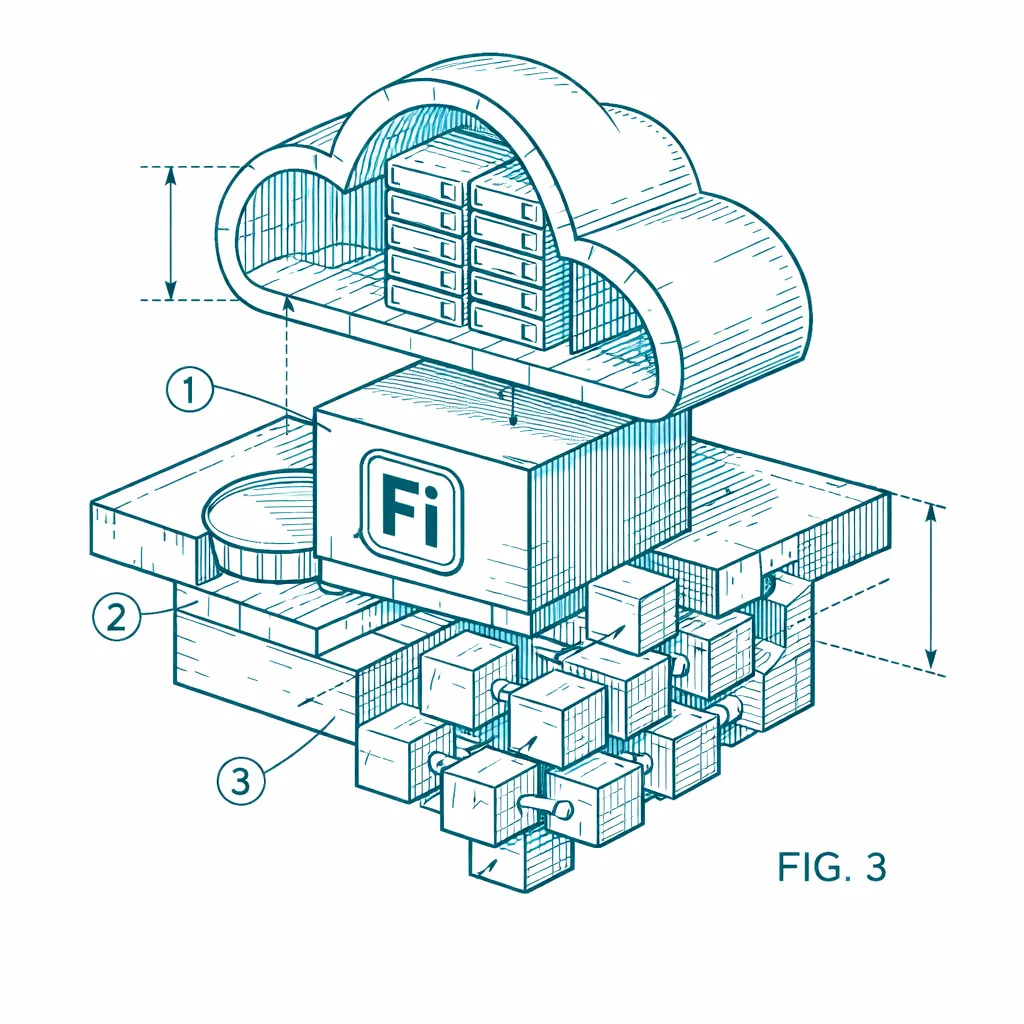
Decentralized cloud computing is not a single business model. It is a family of markets where blockchains coordinate pricing, escrow, collateral, and settlement for very different services: verifiable storage, containerized compute, GPU rendering, and replicated application execution.
The category is fragmented, and that changes the economics
Storage, GPU rendering, general-purpose rented compute, and fully replicated application hosting should not be analyzed as one “DePIN” bucket. Filecoin requires Proof-of-Replication and Proof-of-Spacetime for storage, Arweave charges an upfront AR-denominated contribution to a storage endowment, Render converts token burns into fiat-valued Render Credits for GPU work, and Internet Computer charges cycles for canister execution.
The economic question is therefore workload-specific. Storage networks sell durability and retrievability. Compute marketplaces sell access to heterogeneous third-party hardware. Replicated application platforms sell predictable execution and data persistence, but only by paying the cost of redundancy across validator or subnet infrastructure.
Scale discipline matters because decentralized networks compete against incumbents with enormous operating leverage. Amazon reported $128.7 billion of AWS segment sales in full-year 2025, and Microsoft said Azure surpassed $75 billion in revenue in fiscal 2025. That scale gap does not make decentralized cloud irrelevant. It does mean the winning wedge is selective displacement, not broad replacement of hyperscalers.
Blockchain usually coordinates the market. It rarely performs the work.
Akash is a clean example of the pattern. Tenants specify deployments, providers bid in a reverse auction, and a lease is created for the winning provider. The chain records marketplace state and payment flows, while the actual application runs on provider infrastructure.
Golem follows the same architecture. Requestors publish demand, providers publish offers, the market matches them, and providers bill requestors in GLM, most commonly over Polygon. Golem also requires a reserved wallet allocation from the requestor wallet up front, which both proves budget availability and caps overspending by the client script.
Decentralized cloud therefore works best when the blockchain is treated as a contract and settlement layer. Even systems marketed as decentralized keep explicit control-plane components where performance requires them. Storj’s own architecture depends on satellite-managed orchestration for metadata, node reputation, repair, billing, and payments on behalf of users.
Verification strength differs sharply by workload. Filecoin can verify storage cryptographically through PoRep and PoSt, but general-purpose compute networks still rely heavily on reputation, filtering, and workload-level validation. Golem’s reputation tooling exposes filters for ping, region, and open ports, which is strong evidence that heterogeneous service quality is part of the product rather than a minor operational nuisance.
Workload fit is real, but it is narrower than the marketing suggests
Archival and durability-heavy storage fit decentralized models best because storage can be audited and underutilized disk supply is abundant. Filecoin ties storage deals to proofs, storage power, and slashing, while Arweave requires uploaders to make an upfront contribution to a storage endowment intended to support permanent persistence over time.
Object storage can also work in hybrid forms that trade purity for performance. Storj encrypts data before upload, erasure-codes it, and distributes pieces across independent nodes, while only a subset of pieces is required for reconstruction. That improves resilience and privacy, but it also depends on satellite-managed orchestration instead of pure peer symmetry.
Parallel batch compute and specialized GPU work are the second credible wedge. Akash exposes containerized CPU, memory, storage, and GPU deployments through a marketplace, and Render’s Burn-and-Mint Equilibrium lets creators or compute clients burn RENDER in exchange for fiat-valued Render Credits used to submit work. These are workloads that can tolerate retries, price discovery, and provider heterogeneity.
Latency-sensitive, stateful workloads are harder. Akash explicitly frames provider choice around price, location, and reputation, while Golem gives requestors tools to filter for latency and open ports. The practical implication is clear: the best opportunities are burst capacity, rendering, model experimentation, crypto-native applications, and other jobs where failure domains can be bounded and retries are acceptable.
Fully on-chain application execution is a different trade-off again. Internet Computer runs canister smart contracts and publishes cost formulas and freezing thresholds for ongoing execution. That looks less like renting idle hardware and more like prepaid replicated application hosting.
Token design works only when it mirrors infrastructure cash flows
| Network model | Economic unit | Mechanism | Treasury implication |
|---|---|---|---|
| Akash | Lease priced through a marketplace | Reverse auction, escrow deposit, provider fees paid per block | Short lease horizons and refundable deposits limit duration risk, but user budgets still face token-denominated exposure. |
| Golem | Pay-as-you-go resource usage | Offer-demand matching, GLM settlement, reserved wallet allocation, batching to reduce transaction costs | Budget caps are explicit, but token mediation must still justify itself relative to simpler payment rails. |
| Filecoin | Storage deals secured by collateral | PoRep, PoSt, initial pledge, slashing, and vested rewards as collateral | Capital intensity is part of the design, which strengthens service guarantees but ties growth to financing conditions. |
| Render | Fiat-valued Render Credits for GPU jobs | Users burn RENDER for work credits, while node incentives come from scheduled emissions | Governance over emissions is treasury policy. If demand-side burns lag supply-side emissions, dilution fills the gap. |
| Internet Computer | Cycles consumed by canisters | Published cost formulas and freezing thresholds for ongoing execution | Price stability improves for applications, but developers or treasuries still need continuous top-up discipline. |
Render and Internet Computer are the clearest attempts to shield users from raw token volatility. Render converts spend into fiat-valued credits inside BME, while Internet Computer publishes resource pricing formulas in cycles. That improves budgeting for users, but it pushes volatility management and reserve planning into protocol governance or the application treasury.
Filecoin takes the opposite route. It internalizes security and service guarantees through pledge collateral, vesting, and slashing. That can produce stronger incentive alignment, but it also means that network expansion is balance-sheet intensive from day one. When supply providers need locked capital before revenue is fully realized, tokenomics and capital structure become inseparable.
Treasury discipline is the difference between a market and a subsidy program
A decentralized cloud protocol survives when user payments, provider rewards, and treasury commitments converge on the same unit economics. It struggles when emissions must bridge the gap indefinitely. Render’s approved Year 1 schedule minted 9,126,804 RENDER, and the network’s knowledge base states that Year 2 emissions were allocated at 5,905,580 RENDER. Those are not cosmetic token events. They are capital-allocation decisions for the supply side of the network.
Governance constraints matter because infrastructure subsidies are sticky. Once node operators, liquidity providers, or ecosystem grantees price in support, reducing emissions becomes politically harder than approving them. The safer structure is rule-based spending: explicit schedules, objective eligibility tests, and clear separation between security reserves and discretionary growth budgets. Render’s proposal repository, Golem’s budget reservations, and Internet Computer’s freezing thresholds all point in that direction.
Large discretionary treasuries are not automatically a strength. In decentralized cloud, a treasury is a liability buffer against idle capacity, volatile demand, and hardware refresh cycles. If reserves are large but weakly constrained, the protocol can drift into subsidizing uncompetitive workloads or overpaying for supply that real demand does not justify. The trade-off is direct: ecosystem investment can accelerate adoption, but every token emitted ahead of durable usage either dilutes holders or reduces optionality for future stress periods.
The strongest mechanisms already show what good discipline looks like. Akash keeps deployments collateralized through refundable deposits and pays providers from escrow. Golem reserves wallet budget before execution. Filecoin forces providers to post pledge collateral and exposes them to slashing for failure. Different architectures, same lesson: infrastructure markets break quickly when counterparties can consume resources without pre-committed capital.
What builders should optimize before launching a decentralized cloud token
The first design task is choosing the real economic primitive. If the network sells storage durability, it should design around proofs, retrieval quality, and long-dated liabilities. If it sells burst compute, it should design around matching, retry tolerance, and hard budget controls. If it sells replicated application execution, it should publish cost formulas and reserve rules early. The wrong token model usually starts with ideology and ends with a treasury shortfall.
The second design task is reducing volatility exposure for the party making recurring payments. Render’s fiat-valued credits, Golem’s pay-as-you-go accounting, and Internet Computer’s published fee formulas all move in that direction. Cloud customers care more about predictable spend than about participation in token price discovery. Provider incentives can be tokenized. End-user budgeting usually should not be.
The third design task is treasury segmentation. Security reserves, provider bootstrapping, grants, and liquidity incentives should not sit in one discretionary pool governed by one vague mandate. Networks with long-duration obligations, especially storage networks, should treat prepaid revenue and treasury assets as different buckets because they back different liabilities. That is also part of best tokenomics practices. Arweave’s storage endowment is the clearest expression of that principle in public crypto infrastructure.
From a FinDaS Tokenomics standpoint, token economy design for decentralized cloud should start with reserve policy, emissions control, and measurable service demand. That is the practical core of serious tokenomics consulting in infrastructure markets. If a protocol cannot show how provider payouts converge with user-paid revenue under conservative assumptions, the token is financing a gap rather than expressing a durable business.