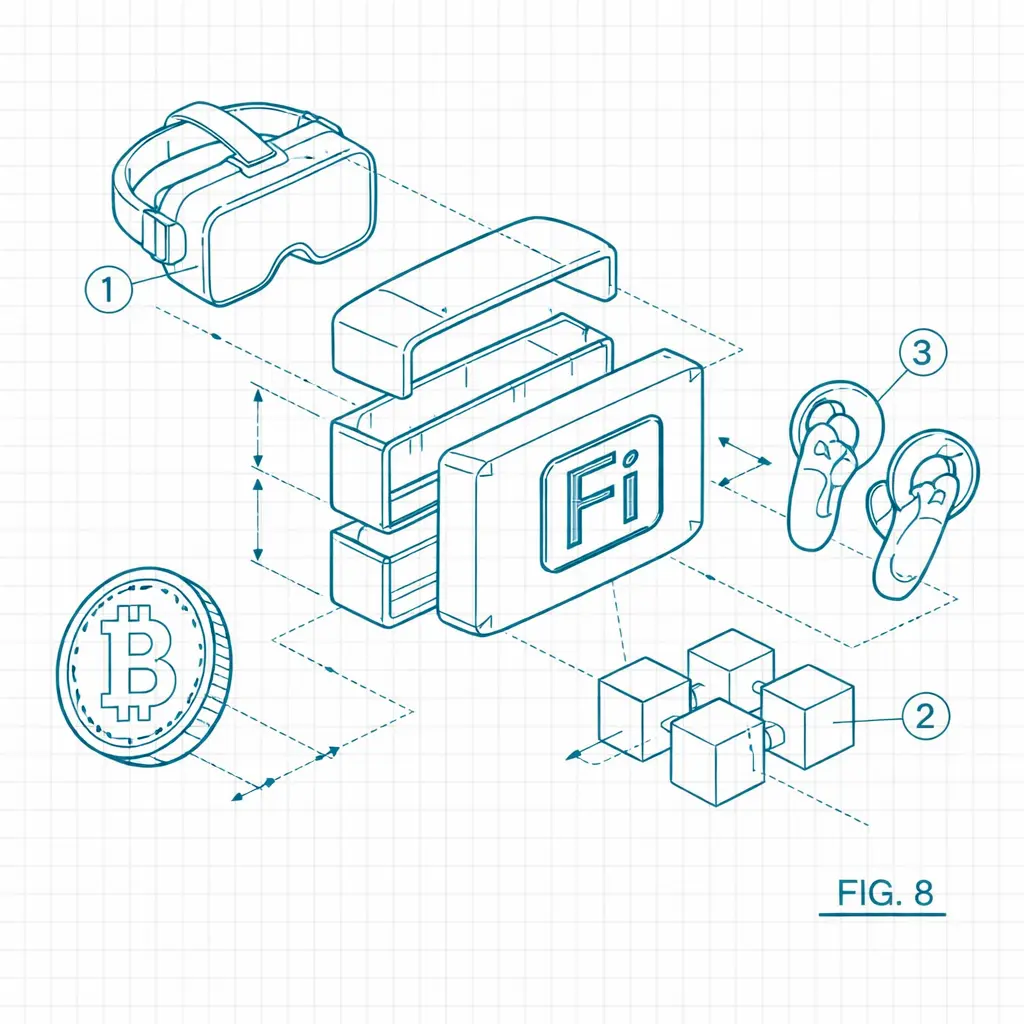
Web3 improves AR and VR only when it turns user effort into enforceable rights and durable revenue flows. The open stack is finally real enough to matter. Khronos publishes OpenXR 1.1 for runtime interoperability. The browser layer exists through the W3C WebXR Device API, which is still on the Recommendation track. Khronos positions glTF as the runtime delivery format for 3D assets, while the Alliance for OpenUSD is explicitly focused on 3D content interoperability. Portable identity is also no longer hypothetical because W3C has Recommendations for Decentralized Identifiers and Verifiable Credentials 2.0. The token is now the easy part.
The stack is real, but ownership is only one layer
On-chain ownership does not create XR interoperability by itself. ERC-721 gives each NFT a globally unique identifier through the pair of contract address and token ID. That is useful for land parcels, unique avatars, and one-off wearables. It does not make the underlying object portable across engines, browsers, or headsets. For that, teams still need compatible runtime and asset standards such as OpenXR, WebXR, glTF 2.0, and increasingly OpenUSD.
The practical implication is simple. A token can prove entitlement. A token cannot, by itself, make a sword render correctly, animate correctly, preserve material behavior, or satisfy an identity check. glTF 2.0 was designed as an extensible, runtime-neutral format for real-time 3D asset delivery with compact transmission and fast load time, while OpenUSD is being standardized to promote interoperability of 3D content. Those are the layers that make a wearable or prop usable outside the marketplace screen. Without them, many “interoperable” NFTs are receipts with branding, not portable game objects.
Identity has the same problem. Wallets are good at signing and settlement. XR systems also need portable identifiers and attestations, which is why identity management matters in immersive environments. W3C’s DID standard targets identifiers that are decentralized, persistent, cryptographically verifiable, and resolvable. W3C’s VC Data Model 2.0 standardizes digital credentials for the web. That is a much better fit for age gates, access rights, memberships, or reputation than pretending that every social or compliance problem can be collapsed into a public address.
The status asymmetry across the stack also matters. Native XR runtime interoperability is further along than browser-native decentralization. OpenXR 1.1 is published, while WebXR is still a Candidate Recommendation Draft. That does not invalidate web-based immersive apps. It does mean that teams pitching an open metaverse on the browser should be more careful about what is mature, what is emerging, and where compatibility risk still sits.
XR ownership works when rights are granular, not monolithic
XR economies need more than simple one-owner collectibles. The ERC-1155 standard was designed for contracts that manage multiple token types at once, including fungible, non-fungible, and semi-fungible assets. It also supports batch transfers, which reduce gas costs when multiple token IDs move together. That makes ERC-1155 structurally better than a pure ERC-721 default for inventories that contain stackable consumables, tickets, crafting materials, or editioned wearables.
Renting is native to XR, and most token models still treat it as an afterthought. ERC-4907 extends ERC-721 with a separate user role and an expiry time. The user can use the NFT without gaining the right to transfer it. Economically, that is a much cleaner primitive for access rights, time-limited vehicle use, event passes, premium avatars, or enterprise training licenses. It rewards utility, not only possession.
ERC-6551 pushes the model further by giving NFTs deterministic token-bound accounts. The EIP explicitly allows the same NFT-linked account structure across chains and discusses cross-chain account execution. In XR terms, that means an avatar can be modeled as a container that holds inventory, credentials, badges, or session assets, rather than as a static JPEG-plus-metadata wrapper. This is closer to how users actually experience identity in virtual environments.
Creator revenue is where many Web3 XR proposals still fail incentive alignment. EIP-2981 standardizes royalty information retrieval, but the EIP is explicit that royalty payments are voluntary and that the actual funds transfer is executed by the marketplace. It even notes that if a marketplace chooses not to implement the EIP, no secondary royalty is paid. For XR teams, that means secondary royalties are a weak foundation for creator livelihoods. Primary sales, access fees, rentals, subscriptions, sponsorship, and service revenue are far more defensible because the payment path is defined by the product, not left to third-party venue discretion.
Existing virtual worlds already reveal the incentive trade-offs
The strongest evidence in Web3 x VR is not in the pitch decks. It is in the behavior that live systems already reward.
| Platform | Verified mechanism | Incentive effect |
|---|---|---|
| Decentraland | MANA is used to purchase LAND, NAMEs, and other digital assets. A NAME gives its holder a personal World and 100 VP. DAO voting power is weighted by holdings, with 1 MANA = 1 VP, 1 NAME = 100 VP, and 1 LAND = 2000 VP. Marketplace transactions are subject to a 2.5% MANA cost that goes to the DAO treasury. The Foundation says it holds IP rights over the client, SDK, marketplace, and related tools, while governance and ownership are community-driven through the DAO. | Decentraland rewards asset ownership directly through both influence and treasury funding. That is sybil-resistant and legible. It also makes governance power heavily property-weighted, which can favor passive balance-sheet exposure over creator labor. |
| The Sandbox | The Sandbox lets users access free no-code creation and free experiences without a crypto wallet. Wallet connection is required to own, earn, monetize, stake, and govern. Users do not need a LAND NFT to share an experience page, but LAND ownership enables direct in-world play access. SAND is the main utility token and medium of exchange. The docs state a 2.5% marketplace fee supplies the Foundation, and there is a separate staking program for LAND owners. The platform also offers 10 free Polygon transactions every 28 days. | The Sandbox subsidizes onboarding first and monetization second. That is cleaner growth design than forcing users to buy scarce assets before they discover utility. The trade-off is that capital still receives privileged reward paths through staking and LAND-linked programs. |
Decentraland shows the purest form of property-weighted governance in the sector. If a world’s rules are set by token and land balance, then the world is optimizing for capital commitment first. That can be a rational choice. It is not neutral. It means the system assumes holders are the stakeholders that matter most.
The Sandbox shows a different funnel. Free creation, free discovery, gasless subsidization, and later wallet conversion are all incentive tools. They reduce the cost of trying the product before asking users to join the token economy. That tends to align growth better than hard paywalls. But once the economy turns on, the system still steers value toward token holders, LAND owners, and marketplace volume.
AR breaks weak token models because location is permissioned and gameable
AR is economically harsher than VR because the scarce input is not just attention. It is verified location, sensor access, and map context. The Geolocation API requires express user permission before location data is shared and recommends short permission lifetimes. The WebXR specification also integrates with the browser Permissions API and explicitly flags unique privacy and security risks for immersive features.
Location portability is now getting its own standards layer. The OGC GeoPose standard defines interoperable exchange of the location and orientation of real or virtual geometric objects within earth-anchored reference frames. That is useful. It is still only a data exchange standard. It does not prove that a user is physically present, that the reported coordinates are honest, or that anyone has exclusive rights to augment a given real-world location.
This is where many AR token models quietly collapse. If rewards are tied to “being there,” the system is buying a claim that is expensive to verify and easy to attack. GPS spoofing, relay abuse, multi-account farming, and venue-level disputes are not edge cases. They are what vague incentives invite. Any AR protocol that pays users for raw presence data should be assumed exploitable until it specifies verification, dispute handling, and privacy disclosure.
That also means “AR land” is usually a branding layer unless it is tied to enforceable off-chain rights. Venue agreements, event contracts, access-control systems, or verified creator licenses can create defensible scarcity. Coordinates alone do not. The token can record a claim. It cannot make a city recognize it.
Distribution and permanence are separate economic problems
Decentralized content distribution for XR is not one problem. It is at least three. You need content integrity, storage financing, and retrieval performance.
The IPFS model solves integrity through content addressing and a Merkle DAG structure. Filecoin adds an open market for storage and retrieval, with storage pricing and availability determined by providers rather than a single platform. Its retrieval market facilitates retrieval deals paid in FIL, and the docs note that clients can also retrieve matching content from IPFS when an IPFS node is serving the CID.
Arweave takes a different route. The official material describes a one-time payment model for permanent storage and a storage endowment that releases funds to miners when ordinary rewards are not enough to cover long-term storage costs. That is a very different incentive promise from IPFS and Filecoin. IPFS gives you an addressable object. Filecoin gives you a market for storage and retrieval. Arweave gives you an economic story for permanence.
For XR, the distinction matters because headsets and browsers do not consume narratives. They consume large assets under latency constraints. A CID can identify the file. A storage contract can pay to keep it available. A permanence model can fund long-lived metadata. None of those guarantees fast scene delivery by itself. Teams promising persistent worlds, permanent avatar inventories, or immutable wearable metadata should specify exactly which layer handles which obligation and who is paid to maintain it.
Open 3D asset formats also belong inside this discussion. Khronos describes glTF 2.0 as a real-time delivery format with compact transmission and fast load time. That makes glTF more important to interoperable XR than many token launches admit. If the asset cannot move efficiently, the ownership proof is commercially weaker than the marketing suggests.
What a defensible Web3 x AR/VR token economy should reward
Good XR token economies reward behavior that improves the world for the next user. These token economy design components usually mean creation, curation, moderation, session hosting, verified mapping, successful referrals that retain, or access rights that expire and renew. It rarely means open-ended subsidy for idle land holding.
- Use ERC-1155 for dense inventories and multi-asset flows. Use ERC-4907 when the real product is time-limited usage, not permanent ownership.
- Treat ERC-2981 royalties as additive revenue, not the economic base case. The standard itself makes clear that royalties are voluntary and marketplace-executed.
- Keep onboarding off-token where possible. The Sandbox’s free creation flow and gasless Polygon subsidy are strong examples of rewarding participation before demanding financial commitment.
- If governance controls world rules, be explicit about whether you are rewarding capital, labor, or both. Decentraland’s formula shows how quickly governance becomes property-weighted once balance-based voting is the only gate.
- For AR, never pay for raw location claims without independent verification and strong privacy disclosures. The standards stack around geolocation and GeoPose helps with permission and interoperability, not with truth.
- If portability is promised, specify the runtime standard, asset format, identity model, and storage layer in the product docs. “NFT interoperable” is not a technical specification.
For teams seeking tokenomics consulting around XR, the sequencing matters more than the ticker. At FinDaS Tokenomics, the hard problem is usually not inventing a token. It is defining which right is actually scarce, who earns from making the environment better, who pays for persistence, and which behaviors the system refuses to subsidize. In Web3 x AR and VR, that is token economy design in its most concrete form.