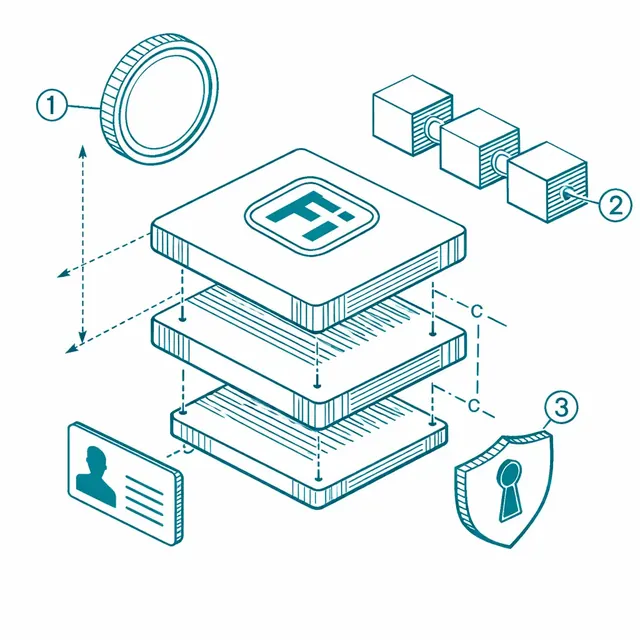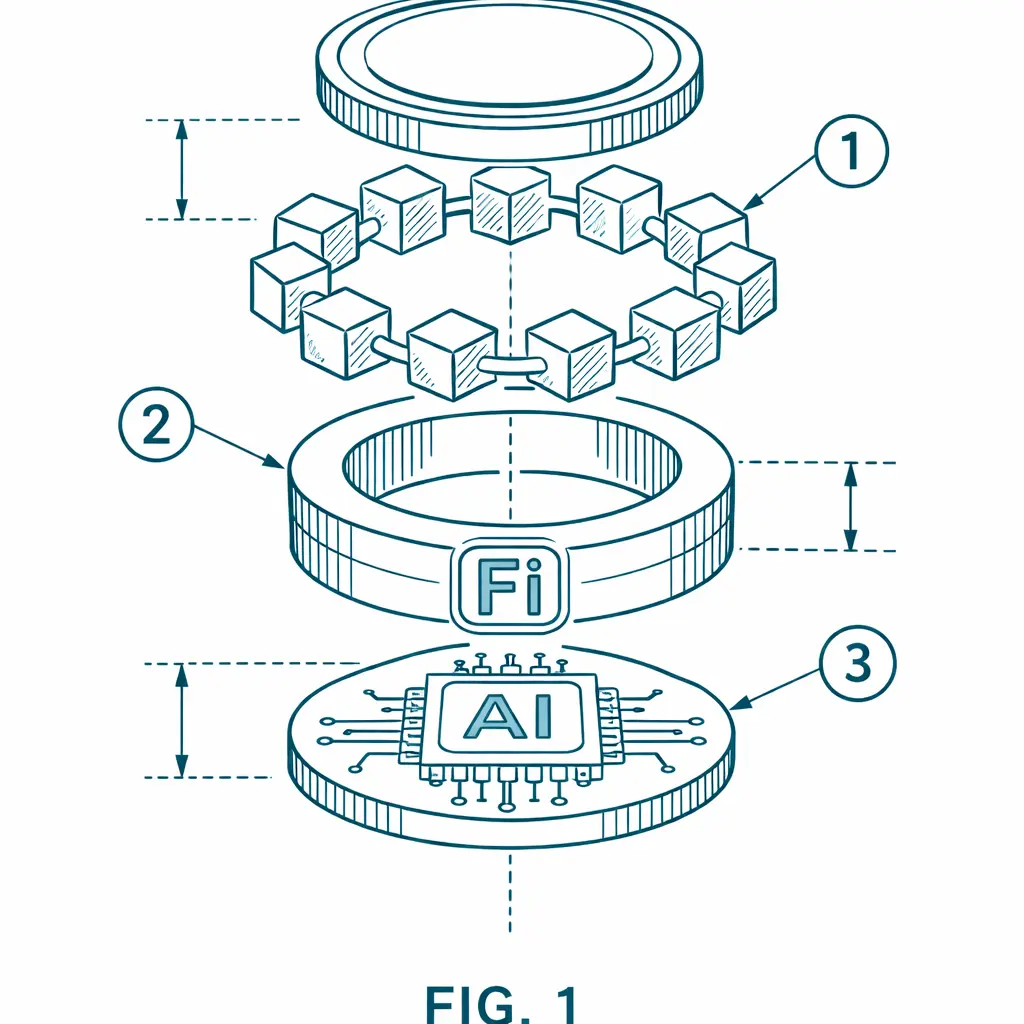
Web3 x AI matters because AI is getting cheaper at the model layer while remaining structurally concentrated at the infrastructure layer. Stanford HAI’s 2025 AI Index says nearly 90% of notable AI models in 2024 came from industry, and that open-weight models narrowed the gap with closed models from 8% to 1.7% on some benchmarks in a single year. At the same time, the OECD describes AI infrastructure as a stack with high concentration, high barriers to entry, and growing vertical integration across chips, cloud, and data centers. That mismatch is the opening for crypto. The credible opportunity is not “put AI on-chain.” It is redistributing who can supply compute, contribute data, verify outputs, and change rules.
The strongest Web3 x AI designs decentralize coordination, not intelligence itself. Blockchains are good at identity, provenance, payments, access control, and governance. GPUs still do the matrix multiplication. Data centers still host the heavy workloads. If a project claims to decentralize AI, the first question is simple: which control surface is actually being dispersed, and what measurable threshold prevents it from recentralizing around a foundation, council, top validators, or a hosted interface.
What blockchains can actually decentralize in AI
In practice, Web3 x AI systems decentralize four different things: attribution, market access, governance, and verification. Gensyn frames its protocol as a way to execute, verify, and coordinate machine learning work across distributed devices. Ocean frames its stack around data rights, datatokens, and compute-to-data. Fetch frames its ledger around agent registration, payments, and smart contracts. These are not the same business. They are different slices of the AI supply chain, and they should not be valued or governed as if they were interchangeable.
Most “decentralized AI” products are therefore hybrid systems by design. Akash exposes decentralized bidding for compute, but the actual providers are still infrastructure operators. Ocean lets buyers run algorithms where private data sits, but the data owner still controls what can be run. Fetch can settle agent interactions and payments on-chain, but the reasoning stack often sits in agents or model endpoints outside consensus. That is not a flaw. It is the current engineering reality. The mistake is pretending hybrid architecture is equivalent to full authority dispersion.
| Layer | Representative stack | What is actually decentralized | Main bottleneck that remains |
|---|---|---|---|
| Data access | Ocean | Access control, provenance, and pricing for data services via data NFTs, datatokens, and compute-to-data | Dataset owners still define terms, approve compute environments, and often keep custody of the valuable raw data |
| Storage and retrieval | Filecoin / IPFS | Replication, retrieval, and content addressing | Confidentiality is not native. IPFS DHT lookups and PeerIDs are public unless extra privacy layers are added |
| Compute market | Akash | Provider competition for CPU and GPU leases | Supply still clusters in professional operators and data centers, not evenly across end users |
| Model evaluation market | Bittensor | Miner competition, validator scoring, and tokenized emissions at subnet level | Stake-weighted validator permits and governance gatekeeping still shape control |
| Training coordination | Gensyn | Distributed workload execution, attribution, verification, and payments | As of March 2025, it is still operating as a public testnet rather than a mature production network |
| Agent coordination | Fetch / ASI | Agent registration, discovery, and settlement rails for autonomous interactions | The model layer and user interface can still recentralize power outside the chain |
Data markets are the cleanest Web3 x AI fit
Data is where the Web3 x AI story is most coherent. Ocean describes itself as a decentralized data and compute protocol. It publishes data services as ERC721 data NFTs plus ERC20 datatokens, and its compute-to-data flow lets algorithms run against private data on the data holder’s premises while only results leave the environment. That is a real tokenizable right. It ties value capture to access control, provenance, and usage rather than vague future demand for “AI.”
This design also maps well to sensitive datasets. Compute-to-data is structurally better than naive marketplace upload flows because it avoids forcing the seller to surrender raw records. For healthcare, enterprise telemetry, or regulated data, that architecture is materially different from simply hosting a file and charging for downloads. It gives a protocol a reason to exist beyond speculation.
But decentralized storage is not the same thing as private AI data sharing. IPFS explicitly warns that DHT queries are public and that PeerIDs are public, which means third parties can monitor what content identifiers are being requested and potentially link nodes to IP addresses. Filecoin gives decentralized storage and retrieval markets. It does not, by itself, solve confidentiality, consent, or regulated access. The data layer still needs encryption, permissioning, secure execution, or compute-to-data style isolation.
Compute and model networks are where decentralization gets harder
Compute marketplaces decentralize supplier access more easily than they decentralize supplier ownership. Akash says providers compete to offer CPU and GPU resources and markets itself as a decentralized cloud marketplace with providers bidding on workloads. That is useful. It can reduce dependence on a single hyperscaler and create price competition for inference and training jobs. But the provider role is still played by identifiable infrastructure operators. The result is a more open market for compute, not a flat distribution of compute power across the public.
Gensyn is more ambitious because it tries to decentralize machine learning execution and verification itself. Its docs describe a protocol that standardizes how ML workloads are executed, verified, and coordinated across devices, and its public testnet launched in March 2025 with on-chain identity, attribution, remote execution, and payments for decentralized training activity. That is closer to the core AI production loop than most crypto AI products. It is also why the execution risk is higher. Verifiable distributed training is a harder problem than listing idle GPUs.
Bittensor is the most mature live example of a crypto-native market for machine intelligence, but it also shows where decentralization gets messy. In Bittensor, validators score miners and Yuma Consensus uses those scores to distribute emissions. More stake means more influence, and each subnet has up to 64 validator permits by default. Dynamic TAO is a meaningful decentralization step because it extends subnet valuation beyond the validator set into market-based price discovery through subnet pools. That reduces dependence on a small validator clique deciding which subnets deserve emissions. It also introduces a different politics: market liquidity now shapes influence.
Bittensor also documents a problem many token designers ignore: validators can free-ride. The protocol added commit-reveal because transparent weight submission made it possible for validators to copy consensus instead of performing independent evaluation work. That is a crucial lesson for Web3 x AI token design. A network can have many participants on paper and still centralize epistemically around a few actors who actually do the costly evaluation.
Agents and AI-driven smart contracts mostly decentralize workflow, not judgment
Agent networks are the most commercially intuitive part of Web3 x AI. Fetch describes its ledger as the settlement layer for agent transactions and smart contracts, and its documentation says the Almanac contract registers agents so they can be discovered by others in the network. This is the right place for blockchains in autonomous systems: identity, settlement, routing, escrow, and policy enforcement. An agent can negotiate, pay, or trigger execution without every reasoning step being forced through consensus.
The decentralization caveat is obvious and often ignored. If discovery, hosting, or the user-facing assistant layer concentrates around one managed interface, then the workflow may be on-chain while decision authority recentralizes around whoever operates the gateway. That is why AI-driven smart contracts should have narrow mandates. Good designs use models to recommend actions, match counterparties, or optimize parameters. They do not give opaque off-chain systems unlimited control over treasury, governance, or upgrade rights.
Governance is the real fault line
Governance is where most Web3 x AI projects stop being decentralized in the strong sense. Bittensor’s own governance docs say the network is transitioning from foundation management toward community ownership, but the first stage is explicitly bicameral, with a Triumvirate and Senate. Opentensor Foundation employees in the Triumvirate create proposals, while the Senate approves them. A proposal executes only after 50% + 1 Senate approvals and closure by a Triumvirate member. Senate participation requires a hotkey with more than 2% of total network stake, and there are only 12 Senate seats. That is not meaningless decentralization. It is measurable decentralization with visible choke points.
Fetch.ai’s governance is procedurally cleaner. Its docs say any FET holder can submit a proposal if the deposit threshold is met, bonded FET holders can vote, the voting period lasts 5 days, and proposals pass with more than 50% Yes votes excluding abstentions and less than 33.33% NoWithVeto. That is a more legible threshold system than many AI-token projects publish. But authority still follows delegated stake because the active validator set is determined by the candidates with the most stake. A delegated PoS network can have open voting and still end up politically concentrated if stake clusters around a few validators.
The Artificial Superintelligence Alliance adds another governance layer without fully unifying control. The alliance announcement said Fetch.ai, Ocean Protocol, and SingularityNET would remain independent legal entities, with existing leadership, teams, communities, and treasuries unchanged, while a governing council would handle alliance governance. Structurally, that is a federation, not a merged sovereign protocol. Federation can be rational. It also means token holders should not confuse brand unification with authority unification.
SingularityNET’s own decentralization blueprint is unusually candid about the remaining centralization. It states that funding allocation was proposed by the Foundation and ratified by a nonbinding community vote, that in practice the Foundation determines allocation across areas of SingularityNET, and that the Foundation signs multisig wallets and approves expenses for several ecosystem wallets. The document then proposes concrete fixes such as rotating multisig signers and creating a participatory funding process that cannot be vetoed or changed by one body. That is the right kind of self-diagnosis. Progressive decentralization only deserves the name when it comes with hard signer, proposal, and veto reforms.
What credible token economy design looks like in Web3 x AI
For Web3 x AI, token value is credible only when the token governs a scarce coordination right. The right might be validator admission, dataset access, compute leasing, agent settlement, emissions weighting, or treasury control. It cannot just be “exposure to AI growth.” Ocean ties value to access and usage. Bittensor ties emissions to evaluation markets and subnet valuation. Fetch ties token utility to staking, governance, and network settlement. Those are much stronger starting points than generic utility claims because they connect the token to a control surface the system genuinely needs across core token economy design components.
- Governance milestones should be numeric. Publish signer counts, validator caps, quorum rules, veto rules, and proposal rights instead of “community-led over time.”
- Reward functions must pay for hard-to-fake work. Bittensor’s weight-copying problem shows why nominal participation counts are weak if evaluators can free-ride.
- Privacy claims need architectural backing. IPFS and Filecoin solve availability better than confidentiality, so “secure AI data sharing” needs extra layers such as encryption or compute-to-data.
- Market decentralization and governance decentralization are different. Akash can open the compute market while supply still clusters. Fetch can open proposal submission while stake-weighted validators still dominate voting power. Both distinctions matter for tokenomics.
For teams seeking tokenomics consulting around Web3 x AI, the decisive question is not whether a token can be attached to an AI product. The decisive question is whether the token allocates real authority over data, compute, verification, or rule changes in a way that remains legible under stress. If the protocol can state who may propose, who may veto, how validator influence is distributed, how private data stays private, and what remains off-chain, then the token economy design is at least structurally honest. If it cannot, the project usually has an AI wrapper and a governance theater problem.