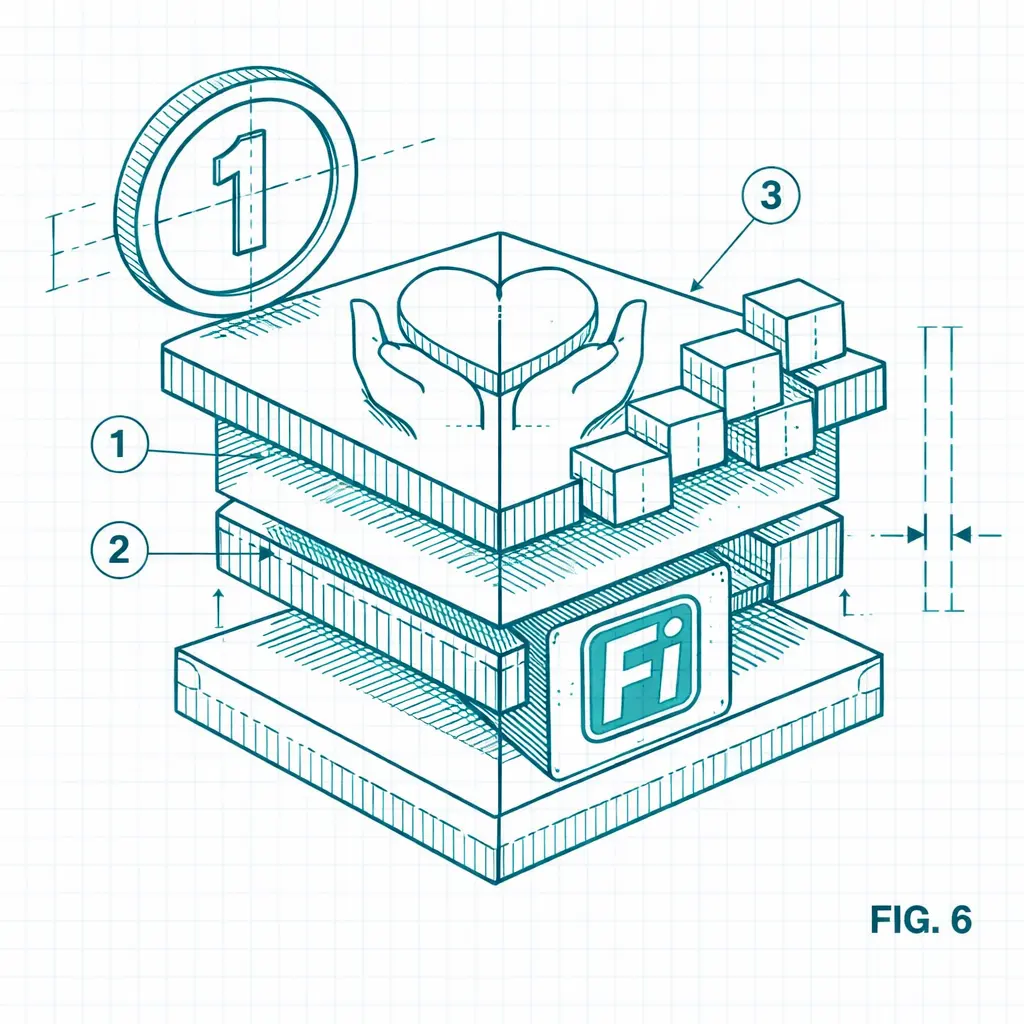
The real opportunity is financial plumbing, not token theater
Web3 philanthropy is strongest when it behaves like infrastructure. The credible use cases are narrow and practical: accepting appreciated digital assets, moving value with auditable transaction records, coordinating disbursement across organizations, and reducing friction in cross-border or multi-party aid flows. The weak use cases are the familiar ones from speculative crypto: governance tokens with no cash-flow role, donor rewards funded by emissions, and impact claims that stop at the wallet address.
Crypto giving is real, but it is still small relative to mainstream philanthropy. The Giving Block reports that it has facilitated more than $300 million in crypto donations since 2018, including more than $100 million in 2025 alone, with an average crypto gift of $11,019 in 2025. That is meaningful growth. It is also tiny next to traditional donor-advised fund infrastructure: Fidelity Charitable says it distributed $18.3 billion to charities in 2025 by itself. The scale gap matters because it shows where crypto currently sits in sector economics. It is a growing rail, not yet a dominant funding base.
The main economic driver of crypto donations is not ideology. It is tax-efficient transfer of appreciated property. The IRS states that digital assets are treated as property for U.S. tax purposes, not currency. Publication 526 also states that if the value of donated digital assets exceeds $5,000, appraisal requirements apply, because digital assets are not treated as publicly traded securities for Form 8283 purposes. Fidelity Charitable describes the donor benefit directly: donating appreciated cryptocurrency can potentially eliminate capital gains tax on the contributed asset, while also supporting a fair-market-value deduction subject to the normal rules. That means crypto philanthropy tends to rise with bull markets, appreciated balances, and donor liquidity events.
The evidence is best in donation rails and controlled disbursement systems
Web3 improves charitable giving most clearly at the transaction layer. Every.org uses its own 501(c)(3) and DAF structure to receive crypto, liquidate it, issue tax receipts, handle Form 8282, and grant cash onward to nonprofits. The exchange fee is a flat 1%, and Every.org says it has accepted more than $50 million in crypto for nonprofits. Endaoment takes a similar route with more explicit onchain architecture: when a donor funds an Endaoment DAF with tokens, Endaoment says it immediately exchanges them for USDC via Uniswap, with a 0.50% inbound fee and a 1.0% outbound fee. These are not ideology-first models. They are service businesses selling compliance, liquidation, donor experience, and administrative relief.
Blockchain also has a credible record in aid coordination when the system is tightly scoped. WFP says the system serves more than 1 million refugees in Jordan and Bangladesh, has processed $555 million in cash-based food interventions across 25 million transactions, and has saved $3.5 million in bank fees. That is one of the clearest examples of blockchain creating operating leverage in humanitarian delivery. It is also telling that the model is not permissionless retail tokenomics. It is a controlled, mission-specific network.
UNICEF’s crypto work points in the same direction. UNICEF says its CryptoFund has, since 2019, accepted, held, and deployed crypto for children-focused programs and has invested the equivalent of more than $4 million. In 2026, UNICEF added USDC, explicitly arguing that stablecoins are better suited to humanitarian action because they are pegged to the U.S. dollar and avoid the dramatic price swings of volatile crypto assets. That is the pragmatic center of gravity for serious philanthropy: stable units of account, clear reporting, and fast transfer rails.
The business models that actually capture value are easy to identify
The money in Web3 philanthropy usually accrues to service layers, not to philanthropy tokens. That is not a criticism. It is just the financial map of the stack.
| Model | What it solves | Where value capture sits | Main limitation |
|---|---|---|---|
| Intermediated crypto-to-cash giving | Lets nonprofits accept crypto without custody, liquidation, or tax administration overhead. | Processing and administrative fees. Every.org uses a 1% exchange fee. | Onchain transparency usually ends once funds are liquidated and granted in fiat. |
| Onchain DAF infrastructure | Wraps tax optimization, portfolio management, and grant recommendation into a crypto-native interface. | One-time inbound and outbound fees. Endaoment charges 0.50% inbound and 1.0% outbound. | Still relies on a charitable intermediary and legal approval of grants. |
| Permissioned aid coordination | Coordinates entitlements and reduces settlement costs across aid providers. | Operational savings, lower reconciliation burden, and reduced bank fees. | Not a public or trustless model. It is specialized infrastructure. |
| Token-rewarded donation platforms | Use token rebates or rewards to drive donor activity. | Usually no durable revenue at the donation layer. The reward is a subsidy unless backed by real cash flow. | Can blur philanthropy, marketing spend, and speculative behavior. |
| Matching and public-goods allocation | Improves capital allocation by amplifying broad donor support. | No intrinsic revenue engine. Matching pools come from sponsors, ecosystems, and donors. | Allocates subsidies well, but does not create the subsidy. |
This is the central TradFi-style conclusion. Web3 x charity has working products, but the revenue capture is overwhelmingly in compliance, conversion, custody, and administration. That is where the measurable cash flow sits. If a philanthropy project claims token value accrual without showing who pays recurring fees, what those fees fund, and why the token is necessary for that activity, the burden of proof is not being met.
Token incentives usually subsidize giving rather than making it sustainable
Giveth is one of the clearest examples of the trade-off. The platform says donations are peer-to-peer, that 100% of donated funds go directly to the project, and that there are no platform fees on donations. At the same time, Giveth’s GIVbacks program gives donors token rewards worth 50% to 80% of the USD value of their donation depending on project ranking. Economically, that functions like a token-financed rebate on charitable activity. It may increase participation. It does not, by itself, create a durable business model for the platform or a stronger financial base for philanthropy. Giveth also says it is predominantly funded by donations and grants while it develops future revenue streams. That is not a failure. It is simply a subsidy model, not a self-funding one.
Gitcoin shows a more financially honest framing. Gitcoin says it has distributed more than $67 million to 6,700+ projects since 2019, and its grants interface states that donations go directly to projects in real time. Quadratic funding is a strong allocation mechanism for public goods and philanthropy-adjacent funding because it can surface broad community preference better than pure whale funding. But it still depends on external matching pools. That means Gitcoin should be analyzed as crowdfunding infrastructure for capital allocation, not as a token economy that self-generates philanthropic demand.
The practical lesson is simple. Incentives can be useful when they direct already-available capital toward better outcomes. Incentives become economically suspect when they try to manufacture altruism with token emissions. In philanthropy, the difference is not philosophical. It is balance-sheet level. One model allocates capital. The other spends treasury to simulate traction.
Transparency is real, but it is narrower than the marketing suggests
Blockchain improves transaction transparency more reliably than impact transparency. UNICEF has emphasized that native crypto transfers create public records of where funds move. Giveth lets donors inspect donations onchain and says each project page shows donation history and links to transaction records. Those are real improvements over opaque donation flows. But neither a block explorer nor a wallet history tells a donor whether a vaccination happened, whether a school remained connected, or whether an aid recipient was better off six months later. Outcome reporting still depends on offchain evidence, recipient reporting, and operational controls.
The same problem applies to “disintermediation.” Most successful charitable crypto systems do not remove intermediaries. They replace expensive or slow intermediaries with cheaper, more specialized ones. Every.org is the legal recipient of the crypto donation before passing cash onward. Endaoment’s board still approves grant recommendations. WFP’s Building Blocks is a privately managed network shared among aid organizations, not a public settlement layer open to anyone. The economically relevant question is not whether intermediaries disappear. It is whether the remaining ones are cheaper, faster, easier to audit, and better aligned with donor intent.
Stablecoins matter more than governance tokens for this reason. UNICEF’s move to USDC is economically intuitive because aid budgets need a stable unit of account. Volatile assets inject treasury risk into a workflow whose job is delivery, not speculation. If the charitable use case is rent, food, medicine, school connectivity, or small-grant disbursement, price stability is usually more valuable than upside optionality.
Compliance and sanctions risk are not side issues
Any nonprofit that accepts digital assets directly is dealing with noncash contribution rules, acknowledgment rules, and disposal reporting. The IRS says a charity can assist donors by providing the contemporaneous written acknowledgment needed for gifts of $250 or more. The IRS also says charities receiving digital asset donations should treat them as noncash contributions, report them on Form 990-series returns and Schedule M where applicable, and file Form 8282 if donated property is later sold, exchanged, or otherwise disposed of in covered cases. Publication 526 adds that donors claiming more than $5,000 for donated digital assets face appraisal requirements and Form 8283 procedures. This is manageable. It is not frictionless.
Sanctions and counter-terror financing controls are material. Treasury’s anti-terrorist financing guidelines for charities recommend screening key employees and grantees against OFAC sanctions lists and obtaining grantee certifications regarding compliance with sanctions laws. Treasury has also designated a sham charity tied to Hamas fundraising networks. Those facts do not mean crypto donations are inherently illicit. They do mean that wallet-level giving without screening and source-of-funds controls is not a serious operating posture for a charity.
The do-it-yourself wallet model is therefore the highest-risk option for most nonprofits. The National Council of Nonprofits notes that organizations using their own wallets should establish gift acceptance policies, decide when to liquidate, collect donor information because blockchain transactions are typically anonymous, and secure wallet credentials such as seed phrases. For most charities, that operational burden is exactly why intermediary models keep winning.
What good token economy design looks like in philanthropy
Good design starts with treasury policy, not branding. A charity or philanthropy-adjacent protocol should first decide whether it wants exposure to crypto price risk at all. If the answer is no, immediate conversion to fiat or stablecoins is usually the right default. If the answer is yes, the organization should explicitly state why it is taking volatility risk and what percentage of donations may be held on balance sheet.
Good design also separates capital allocation from donor incentives. Matching pools, milestone-based disbursement, and transparent grant routing can all improve philanthropic efficiency. Token rebates for donors are much harder to justify unless there is a clear external revenue source paying for them. Otherwise the token economy is just financing donor acquisition with dilution. Those are core token economy design components.
Most importantly, any token attached to philanthropy should answer four financial questions in plain English. Who pays? What service are they paying for? Why is a token required instead of ordinary software and stablecoins? What measurable value flow reaches beneficiaries at lower cost or higher accountability because the token exists? If those questions do not have crisp answers, the token is usually ornamental. Those are practical token economy design principles.
From FinDaS Tokenomics’ standpoint, this is where tokenomics consulting becomes less about community narrative and more about cash-flow mapping. In Web3 charity, sound token economy design should improve at least one of three measurable variables: fundraising conversion, disbursement cost, or accountability quality. If it cannot improve one of those with evidence, it is not serious financial infrastructure. It is donation UX wrapped in token language.