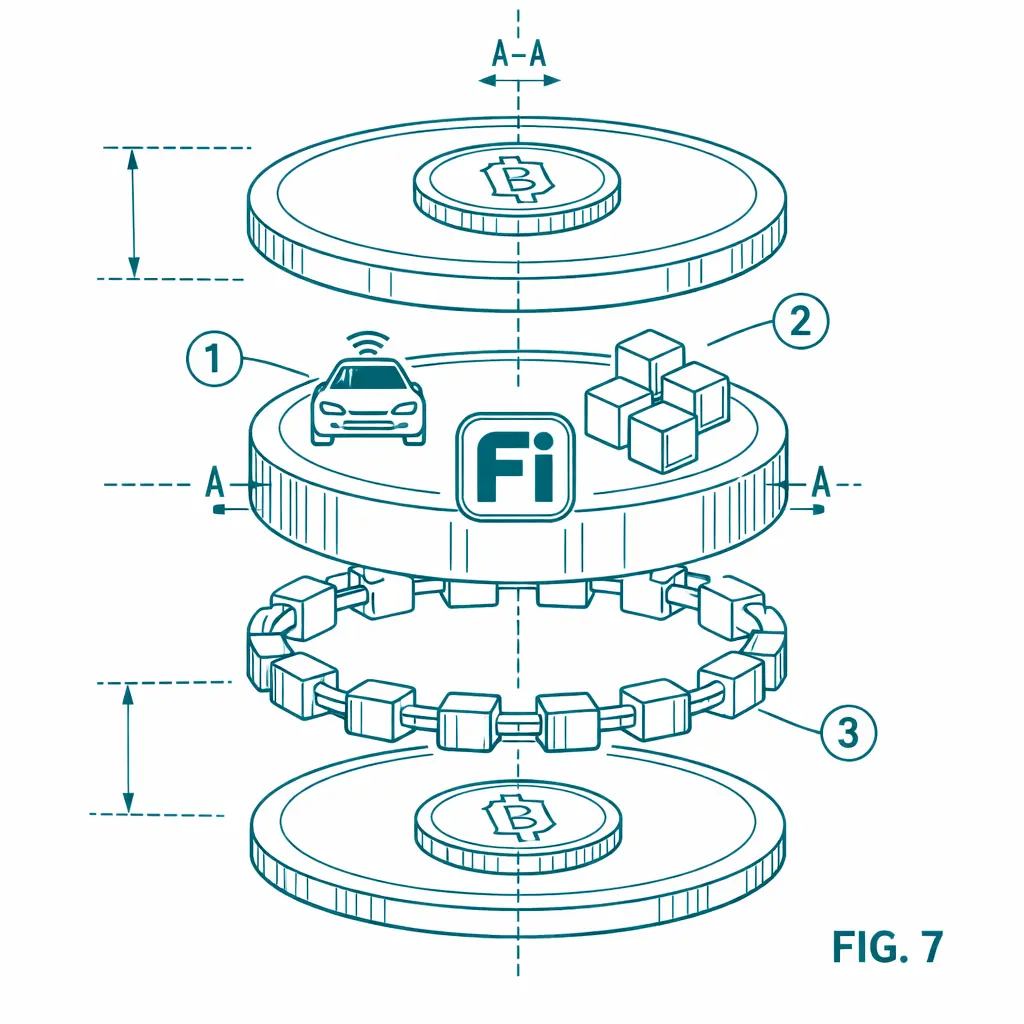
Autonomous vehicles do not need a token to steer, brake, or classify pedestrians. Autonomous vehicles do need a credible way to identify machines, authorize data access, verify software history, and settle payments across firms that do not fully trust one another. That is where blockchain can matter. The backdrop is no longer theoretical. On April 24, 2025, Alphabet said Waymo was serving over 250,000 paid trips weekly. On May 1, 2025, Aurora said it had begun regular driverless customer deliveries between Dallas and Houston and had completed over 1,200 miles without a driver. On February 20, 2026, the California DMV said autonomous vehicle permit holders logged more than 9 million test miles on public roads between December 1, 2024 and November 30, 2025.
The key implication is simple. The commercialization of AVs is real, but the ownership model is still heavily centralized. Today’s meaningful deployments are operated by large corporate balance sheets, proprietary software stacks, and closed data pipelines. Blockchain only creates a genuine synergy if it changes that power structure at the edges of the system. If it merely adds a token on top of an already concentrated market, it does not decentralize mobility. It financializes it.
The real overlap is at the coordination layer, not the driving stack
Safety-critical AV functions already have stricter trust requirements than most Web3 systems. NHTSA has long framed vehicle cybersecurity as essential to public acceptance and safety, and its connected-vehicle architecture relies on a Public Key Infrastructure called the Security Credential Management System for trusted V2V and V2I communications. UNECE’s vehicle rules similarly require manufacturers to run auditable cybersecurity and software update management processes, including recording relevant hardware and software versions, verifying software authenticity, checking update compatibility, and documenting impacts on safety.
That matters because it narrows the credible blockchain thesis. AV control loops cannot wait for chain finality, public mempool exposure, or token price discovery. The place for blockchain is the coordination layer around the vehicle. That includes machine identity, entitlement management, software provenance, usage-based billing, cross-fleet settlement, and tamper-evident audit trails. It is the legal-economic shell around autonomy, not the autonomy kernel itself.
The literature also supports a more restrained view than the average pitch deck. A systematic review of blockchain in smart mobility concluded that the field remains fragmented and that much of the work is still conceptual rather than validated in real-world deployments. That is an important corrective. The strongest evidence today is not that blockchains run autonomous driving. The strongest evidence is that blockchains can help govern the assets, rights, and incentives around connected mobility networks.
Vehicle identity is the clearest blockchain use case
Shared vehicle identity is the cleanest reason to put mobility data on a ledger. MOBI’s Vehicle Identity work defines a vehicle’s “self-sovereign digital twin” as a bridge to the physical asset that can manage access control, confirm ownership history, log key life events, and support interaction in connected mobility ecosystems. MOBI’s earlier VID announcement made the same logic explicit: the goal was a trusted vehicle master record that could support data transparency, coordination, and automation across the vehicle lifecycle.
This is exactly where AV systems become economically interesting. A self-driving taxi, delivery pod, or long-haul truck is not just a robot. It is an asset that needs to prove what it is, what software it is running, who may command it, who may read its data, and who gets paid when it performs work. A tamper-evident identity and event layer can lower reconciliation costs between OEMs, fleet operators, insurers, infrastructure providers, municipalities, and service apps.
What blockchain cannot do by itself is solve the hardest governance question: who owns the data and therefore the downstream bargaining power? An immutable record is only empowering if the rights attached to that record are distributed fairly. A vehicle NFT or digital twin that ultimately routes value to the OEM, the fleet lessor, or the protocol treasury without meaningful participation for users and operators is still a centralized mobility regime. It is just better documented.
Data rights are becoming a policy issue, which makes ownership structure more important
Connected-vehicle data is no longer a side topic. It is turning into a regulatory battleground. The EU Data Act entered into force on January 11, 2024 and became applicable on September 12, 2025. The European Commission says it is designed to give users more control over data generated by connected devices such as cars, ensure devices are designed to allow data sharing, and let users choose services without depending only on the manufacturer.
The U.S. record is also moving in the same direction, though through enforcement rather than horizontal data-rights law. On January 16, 2025, the FTC announced action against General Motors and OnStar, alleging the company collected precise geolocation and driving behavior data and sold it without properly informed consent. The FTC said some geolocation data was collected as often as every three seconds.
This is the strongest argument for blockchain in mobility, and it is not a throughput argument. It is a rights and bargaining-power argument. If vehicles continuously generate commercially useful data, then the key design choice is who can grant access, revoke access, and monetize access. DIMO’s current positioning reflects this architecture: it describes a user-owned data architecture with granular permissions built on verifiable credentials, plus open APIs and optional hardware for connected vehicles.
But blockchain is not the only way to improve the data market. Germany’s Mobility Data Space is explicitly organized as a data marketplace built on “equality and self-determination,” with transparency, decentrality, peer-to-peer transfer, and no central storage as core features. That is a useful reminder for tokenomics analysts. Many coordination problems in mobility can be improved by standards, connectors, contracts, and governance without introducing a transferable token at all.
Machine payments are plausible, but payment rails and value capture are separate questions
Autonomous vehicles are natural candidates for machine-to-machine payments. A robotaxi can pay for charging. A truck can settle tolls and docking fees. A delivery bot can pay for right-of-way, parking, or data access. Jaguar Land Rover’s 2019 smart wallet work with IOTA framed this clearly: a connected vehicle wallet could earn money from shared data and spend it on parking, tolls, EV charging, or other services. MOBI’s vehicle identity work similarly linked digital identity to usage-based payment for congestion, pollution, and infrastructure.
The economic case is credible because autonomous fleets produce a high volume of low-value transactions across multiple counterparties. That is exactly the environment where automated settlement and programmable permissions can reduce overhead. The weaker claim is that these transactions require a volatile native token. In most real mobility contexts, the service being purchased is priced in fiat terms. That means the hard problem is not transaction automation. The hard problem is predictable settlement, compliance, dispute handling, and fair distribution of the surplus created by the network.
For that reason, many mobility systems may benefit more from blockchain-based identity and auditable settlement than from speculative tokenization. A stable settlement asset, enterprise ledger, or regulated on-chain payment rail can capture most of the coordination benefit without turning every toll, parking space, and battery top-up into a governance referendum on token emissions.
Tokenized mobility networks live or die on allocation fairness
The most instructive live example is not a pure AV network. It is the connected-vehicle layer around it. DIMO is useful precisely because it shows the real tokenomics trade-off. Its documentation says the original 1 billion token supply was allocated as 450 million for airdrop and driver rewards, 250 million to a community-controlled DAO treasury, and 300 million to the core team and capital partners. DIMO also says that as of April 11, 2025, the distribution stood at 423,831,184 for driver rewards, 241,159,934 for treasury and other, and 335,008,882 for core team and capital partners.
That is better than the standard Web3 mobility pattern where users provide data and capital while insiders keep most of the upside. Drivers are the largest single allocation bucket in DIMO’s design. But the concentration question does not disappear. Treasury plus team and capital partners represented 576,168,816 tokens on April 11, 2025, or 57.62% of the stated distribution. Treasury governance can mitigate that concentration, but only if governance participation is broad and hard to capture.
DIMO’s governance parameters show the other side of the trade-off. Its documentation lists a quorum of 4% of supply, a proposal threshold of 0 DIMO, and an execution delay of 21,600 seconds. A zero proposal threshold lowers the barrier to entry, which is good. A 4% quorum can also make governance operable. But low quorums in networks with uneven ownership often amplify the influence of the most organized holders. In mobility, that usually means early capital, foundations, and coordinated treasuries are structurally advantaged over dispersed drivers or fleet users.
DIMO’s identity architecture also shows what the token is actually supporting. The protocol uses signed claims, wallet ownership, and on-chain linking between devices and vehicles, while developers use permission management and APIs around that base layer. This is closer to a rights-and-access network than to an “autonomous car token” story. That is exactly why the ownership split matters so much. If drivers, fleet operators, and data contributors are the ones creating long-run network defensibility, then they need more than symbolic rewards. They need durable governance weight and economic participation.
What fair token economy design for autonomous mobility should actually optimize
The right question is not whether blockchain and AVs are synergistic. The right question is which stakeholders gain bargaining power when that synergy is implemented. From a token economy design perspective, credible design for machine mobility should start with ownership maps, governance thresholds, and payout logic before it starts talking about DePIN growth loops.
| Stakeholder | Why they should capture value | Main concentration risk | Useful guardrail |
|---|---|---|---|
| Vehicle owners and operators | They supply the physical asset, operating risk, and often the data exhaust | Becoming unpaid raw-material providers for OEMs or protocols | Long-duration rewards tied to verified contribution, plus meaningful voting power |
| Fleet managers | They create utilization, maintenance discipline, and service reliability | Treasury or foundation captures economics while fleets face thin margins | Revenue-share mechanisms and role-based governance, not token-only symbolism |
| Infrastructure providers | Charging, tolling, mapping, curb access, and roadside compute are scarce assets | Protocol underpays physical bottlenecks and over-rewards financial insiders | Explicit settlement rights and contract-level pricing, not discretionary grants |
| Developers and protocol maintainers | They build the coordination layer and keep it secure | Over-allocation justified indefinitely in the name of “builder incentives” | Vesting, milestone-based emissions, and transparent treasury budgeting |
| Treasury and DAO | They fund public goods, integrations, and ecosystem defense | Treasury becomes a shadow insider bloc | High disclosure, delegation transparency, and anti-capture governance design |
If AV networks move toward tokenization, four principles should be non-negotiable. First, raw data contributors and physical asset operators must receive a larger long-run share than passive financial sponsors. Second, governance should not be passively capturable through low turnout and concentrated treasury voting. Third, most high-frequency operational data should stay off-chain, with the chain used for rights, attestations, and settlement proofs. Fourth, teams should prove why a transferable token is superior to a non-token data space, consortium ledger, or regulated payment rail for the exact job being done.
That leaves a fairly hard conclusion. Blockchain and autonomous vehicles are synergistic when the problem is cross-entity trust, machine identity, auditability, and automated settlement. Blockchain is not synergistic when it is used to repackage centralized fleet economics into a speculative token wrapper. The winner in mobility will not be the project that puts cars on-chain. It will be the one that allocates control, revenue, and data rights in a way that the actual operators of autonomous systems can live with for a decade.