A token relaunch can fix a broken contract, a mistaken chain choice, or a genuine rebrand with new utility. It cannot fix tokenomics that were designed badly the first time, because the same team and the same incentive structure usually produce the same outcome on version two. Terra 2.0, airdropped in May 2022 at over a $1B market cap, now trades at a market cap below $70M. Before deciding to relaunch, the honest question is whether the failure is mechanical or structural.
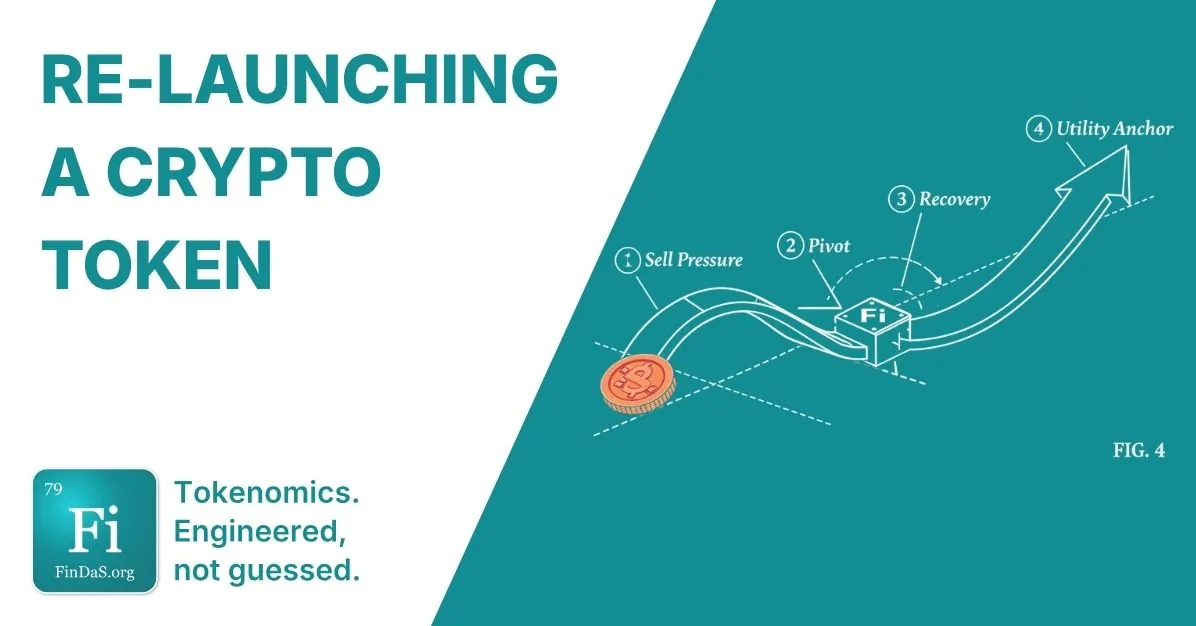
Why projects relaunch, and why most shouldn't
Most token relaunches I am asked to advise on are not really migrations. They are attempts to reset a price chart that will not recover on its own. The team's internal framing is almost always "we have fixed the problem and want a clean slate", but when you dig into what changed, the answer is usually that the thing that failed the first time, whether team, tokenomics, or narrative, is still present on version two. The relaunch becomes a surface-level change dressed up as a structural one.
Three reasons justify a relaunch. The first is a smart contract exploit serious enough that patching the existing token is either technically impossible or leaves holders exposed. The second is a genuine platform migration, where the project is moving from one chain to another because the original chain cannot carry the product the team is building. The third is a real utility change, where the token now does something it did not do before and the old contract cannot accommodate the new mechanics. All three have in common that the mechanical problem is clearly defined and the fix is clearly defined.
The other reasons I see are less disciplined. Price has drifted down and the team wants a reset. The community is demanding "something be done" and a relaunch is visible action. The old tokenomics had design flaws that the team now understands better and hopes a v2 will quietly resolve. In each of these cases, the failure is structural, not mechanical. Relaunching does not address the thing that actually broke.
I disagree with the position that a relaunch is a low-cost intervention. It burns credibility with everyone who held the original token, forces exchanges to coordinate on a new listing, exposes the project to a fresh round of regulatory scrutiny, and resets the chart to zero in a market that has lost interest. If the underlying economics were working, you would not need a relaunch.
What a relaunch can fix, and what it cannot
The cleanest way to think about a relaunch is by asking what it mechanically changes. A token swap migrates holders from one contract to another, at a specified ratio, over a specified window. That is the operation. Everything else is marketing around it.
Mechanically, a relaunch can replace an exploited contract with a clean one. It can move a token from a chain with the wrong fee profile or the wrong user base to one that fits the product better. It can accommodate a legitimate change in token utility, like adding staking mechanics or changing the supply schedule, when the original contract was not written to support that change. It can also execute a rebrand where the name, ticker, and supply all shift at the same time. In each of these, the problem statement is specific and the fix is verifiable.
What a relaunch does not fix is the harder category:
- Tokenomics that were badly designed the first time. A new contract with the same supply schedule, same emission mechanics, and same utility assumptions produces the same outcome.
- Team execution problems. If the team did not deliver on the original roadmap, a relaunch does not staff them differently.
- Broken trust with holders. Airdropping new tokens to old holders is a gesture, not a remedy, and most of them sell into the relaunch and do not come back.
- A narrative that lost the market. Relaunches cannot re-attract attention that has moved elsewhere, and the relaunch itself often signals to the market that the project does not trust its own v1.
In my experience, the projects that relaunch successfully are usually the ones where the failure was mechanical to begin with. The projects that cannot be saved by a relaunch are the ones where the failure was structural. Teams often invert this: mechanical problems get patched in place, and structural problems get the "fresh start" treatment. That is the wrong direction for both.
Three relaunches, three different outcomes
Three public relaunches cover most of the shape of what can and cannot be fixed. The private cases I have worked on follow the same patterns, just with less public coverage. Put these three next to each other and the lessons separate cleanly.
Terra 2.0. The collapse of UST in May 2022 wiped out nearly the entire original LUNA supply. Terra forked the same month, airdropped a new LUNA to snapshot holders, and at launch briefly reached a market cap above $1 billion. As of April 2026, LUNA trades near $0.06 with a market cap under $70M, placing it outside the top 500 tokens by size. LUNC, the so-called dead chain from before the relaunch, has a larger market cap than LUNA 2.0. The swap mechanics worked. The project did not, because the thing that broke was the algorithmic stablecoin design, not the contract that held it.
ICON. ICON swapped from ERC-20 to its own mainnet in 2018. The operation was clean, with exchange partners and an official wallet handling most holders. By that standard, the 2018 relaunch worked. By 2025, however, the ICON Foundation announced a second migration, this time to SODAX on the Sonic chain, with ICX holders swapping 1:1 to a new SODA token. The original ICON network is being decommissioned, with economic shutdown scheduled for the end of March 2026. The useful lesson from ICON is that clean swap mechanics do not equal a successful project. The mainnet migration in 2018 gave ICON custody of its own chain, and seven years later the team is moving off that chain because the product that was supposed to justify it never reached enough adoption.
VeChain. VeChain's 2018 swap from VEN to VET ran at a 1:100 ratio, which expanded the supply to a level that made the token more accessible for the supply chain use cases VeChain was pursuing. Unlike Terra and unlike ICON, VeChain has continued iterating on the same chain ever since. In December 2025, the Renaissance upgrade moved the network from Proof-of-Authority to a Delegated Proof-of-Stake model, restructured VTHO emission so that only staked VET produces rewards, and introduced 101 active validators. The chain is still evolving, but the original 2018 migration has not needed to be redone. That is the standard a relaunch should aim for, not one that survives the launch window and then quietly fails to deliver.
The pattern that falls out of these three is that relaunches are most useful when the project has a specific technical constraint that the new chain or new contract removes, and when the product underneath is already working or close to it. Relaunches as rescue operations are different, and the track record on those is poor.
A relaunch cannot be the fix. It can only be the operational consequence of a fix that has already happened.
The mechanics that actually matter
Assuming you have decided the relaunch is justified, a short list of operational choices determines whether the swap itself causes additional damage. These are the ones I pay attention to in design reviews.
- Swap ratio. 1:1 is the default and the cleanest. Anything else needs a clear justification beyond "we are expanding the supply". Holders do not trust ratio changes that benefit the team's allocation more than theirs.
- Swap window. Long enough for custodial exchanges and retail holders to act, short enough that the two-token period does not drag on. Six to twelve weeks is typical. Indefinite windows leak holders over time and create persistent confusion on exchanges.
- Exchange coordination. Major CEXs handle swaps for their custodied balances if the project engages them early. Without that coordination, the retail cost is high, because every exchange holder has to withdraw, swap manually, and redeposit. Many will not.
- Post-swap liquidity. Day-one liquidity on the new token is usually thin, because the old trading pairs are gone and the new ones take time to form. Projects that pre-arrange market-making for the first four to eight weeks avoid the worst of the volatility spiral.
- Bridge and vesting continuity. Locked tokens, vesting contracts, and cross-chain representations all need explicit migration paths. Treating these as an afterthought is how "we forgot the team lockups" incidents happen, and those incidents have killed the credibility of more than one relaunch on their own.
None of the items on this list is optional if you care about ending the swap in a better position than you started. All of them scale with the size of the holder base. If your project has 200 holders, a clumsy swap is recoverable. If it has 200,000, each unforced error compounds.
The regulatory dimension
Regulatory exposure is the part of a relaunch that founders most often under-think. Under MiCA, material changes to a token, including changes that re-issue it on a different contract or chain, are likely to trigger a fresh classification review and a new whitepaper obligation, depending on how the specific jurisdiction interprets continuity. A project that was operating under a legacy classification before the relaunch can find itself back in the disclosure queue with the current rules applied.
Securities classification questions get sharper, not softer, after a relaunch. Regulators tend to view material changes to token economics that holders could not reasonably have anticipated at purchase as evidence supporting a securities characterization, rather than weakening one. Jurisdictions where that distinction matters become more cautious once they see a team demonstrating that the rules of the game can be changed after purchase, which is exactly what a relaunch looks like from the outside.
If you are relaunching in 2026 and intend to offer the new token in the EU, I would treat MiCA compliance as a gating requirement rather than a post-launch workstream. Our team has worked through the regulatory path for multiple token relaunches through the MiCA-ready tokenomics whitepaper service, and the pattern is consistent. Projects that front-load the disclosure and classification work ship cleanly. Projects that treat it as a checkbox after the chain switch ship late, often with remediations attached.
Before you relaunch: decide these three things first
Three questions should be answered honestly, in writing, before the decision is made. If the answers are uncomfortable, the relaunch probably is not the right response.
- Is the failure mechanical or structural? A mechanical failure means there is a specific, bounded, verifiable problem: a contract exploit, a chain mismatch, a supply or utility change the current contract cannot accommodate. A structural failure means the tokenomics assumptions, the team, or the incentive design were wrong. Mechanical failures can be fixed with a relaunch. Structural ones usually cannot.
- What has actually changed in the team or the incentive structure? If the same people are running the same playbook with the same treasury structure and the same vesting schedule, the v2 outcome tends to mirror the v1 outcome. A good answer here names specific things that are different, and those things ideally predate the relaunch decision rather than being produced in response to it.
- What is the counterfactual? If you do not relaunch, what happens next quarter? Sometimes the honest answer is "we lose exchange listings, lose treasury runway, and wind down in six months", which is a real constraint that can justify a relaunch even when the odds are bad. Usually the answer is closer to "we continue the current trajectory", in which case a relaunch is a more expensive version of staying put.
None of this rules out relaunching. It does push back on treating the relaunch as the fix rather than as the last operational step of a fix that has already happened. The teams I have seen get through a relaunch cleanly did the hard work before the chain swap, not during it.
Frequently asked questions
01How long does a typical token swap window stay open?
+
02What happens to holders who miss the swap window?
+
03Does a relaunched token keep its price history on exchanges?
+
04Can a token relaunch reset its regulatory classification?
+