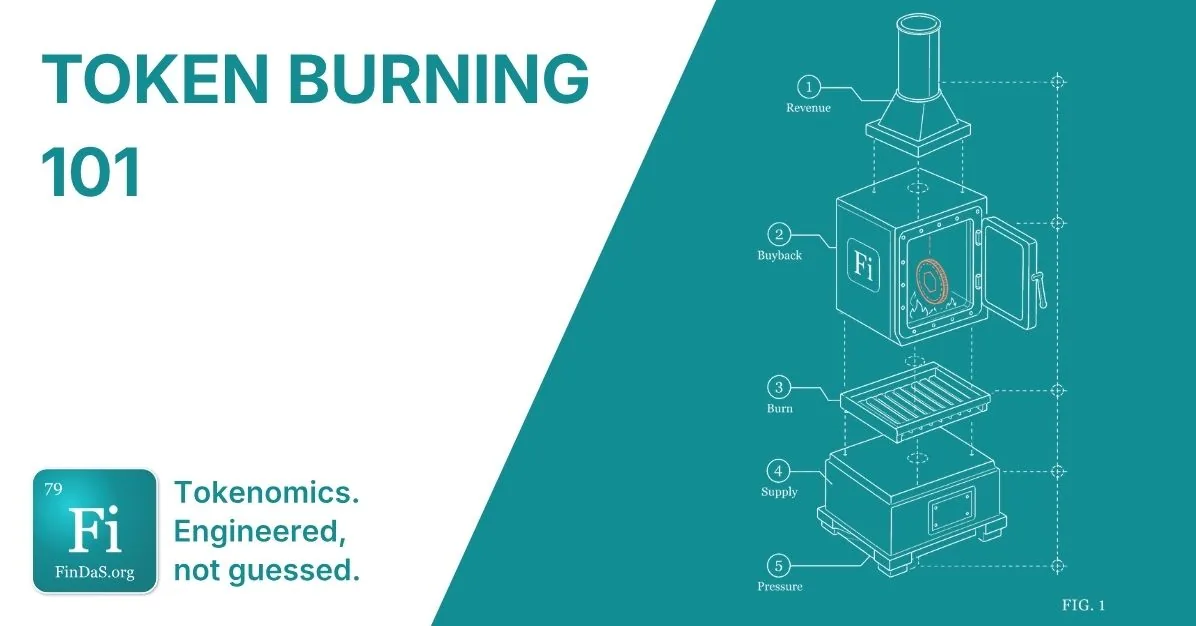
Token burning is the permanent removal of tokens from circulating supply, usually by sending them to an address with no known private key, or by destroying them through a smart contract. Four very different mechanisms get called burning, and they have different game theory, different regulatory exposure, and different odds of working. Burning without revenue is theater. Burning with revenue is, depending on the design, anywhere between a clean alignment tool and an admission that the protocol cannot deploy its capital productively.
What token burning actually is
A burn is the permanent removal of tokens from circulating supply. There are two ways to do it. The first is to send the tokens to an address that has no known private key, so nothing on-chain can ever spend them. The second is to call a smart-contract function that decrements the total supply variable directly, which works on any token standard that exposes a burn function (most modern ERC-20 implementations do).
The unspendable-address method is the older and more common pattern. Addresses like 0x0000000000000000000000000000000000000000, the all-dead variant 0x000000000000000000000000000000000000dEaD, and protocol-specific system addresses (Hyperliquid uses 0xfefefefefefefefefefefefefefefefefefefefe for its Assistance Fund) all carry the same property: there is no private key that produces them, so no one can sign a transaction spending what gets sent there. The keys are not "lost." They were never derived in the first place.
Founders sometimes ask whether someone could eventually find the keys to a burn address. Mechanically the answer is no, in any timeframe that matters. The address space is 2^160, the keyspace is 2^256, and producing a private key that hashes to a chosen address is the same problem as inverting Keccak. Quantum computers do not change this materially for ECDSA's address derivation step, only for spending from addresses with publicly revealed public keys (which a burn address by construction does not have, since no transaction was ever signed from it). For practical tokenomics purposes, treat burn addresses as final, and read our note on token storage and key custody if the broader cryptography questions are what you are actually asking.
Not all burning is the same
The word "burn" gets used for four mechanisms that have almost nothing in common except the supply outcome. Treating them as one category is the source of most bad burn-related decisions I see at the design stage.
- Transaction-level burn (EIP-1559 style). Every on-chain transaction destroys a small amount of the gas token as a base fee. Burns scale with usage, no ongoing governance is needed, and there is no buy-side market action. Ethereum's implementation is the canonical example. This is a fee design choice, not a tokenomics choice, and it lives at the chain level.
- Buyback-and-burn. The protocol uses revenue (or treasury) to purchase its own token on the open market, then destroys what it bought. This creates real buy pressure plus permanent supply reduction, but only works while revenue is real and meaningful relative to the token's market cap. Hyperliquid is the dominant 2025 example.
- Treasury burn. The protocol commits to destroy unallocated tokens sitting in its own treasury or emissions schedule. There is no buy-side action. The economic content is "we promise to inflate less in the future." It is a credible commitment, not a market event.
- TGE burn allocation. A percentage of the supply is sent to a burn address at launch. This is almost always cosmetic. If those tokens were never going to circulate anyway, removing them changes nothing about the actual circulating-supply trajectory. It is a marketing line dressed as a mechanism.
The taxonomy matters because the regulatory exposure, the cash-flow implications, and the way each mechanism interacts with early sell pressure are all different. A founder who picks "we'll do a burn" without specifying which one has not actually picked anything.
The 2025 buyback-and-burn renaissance
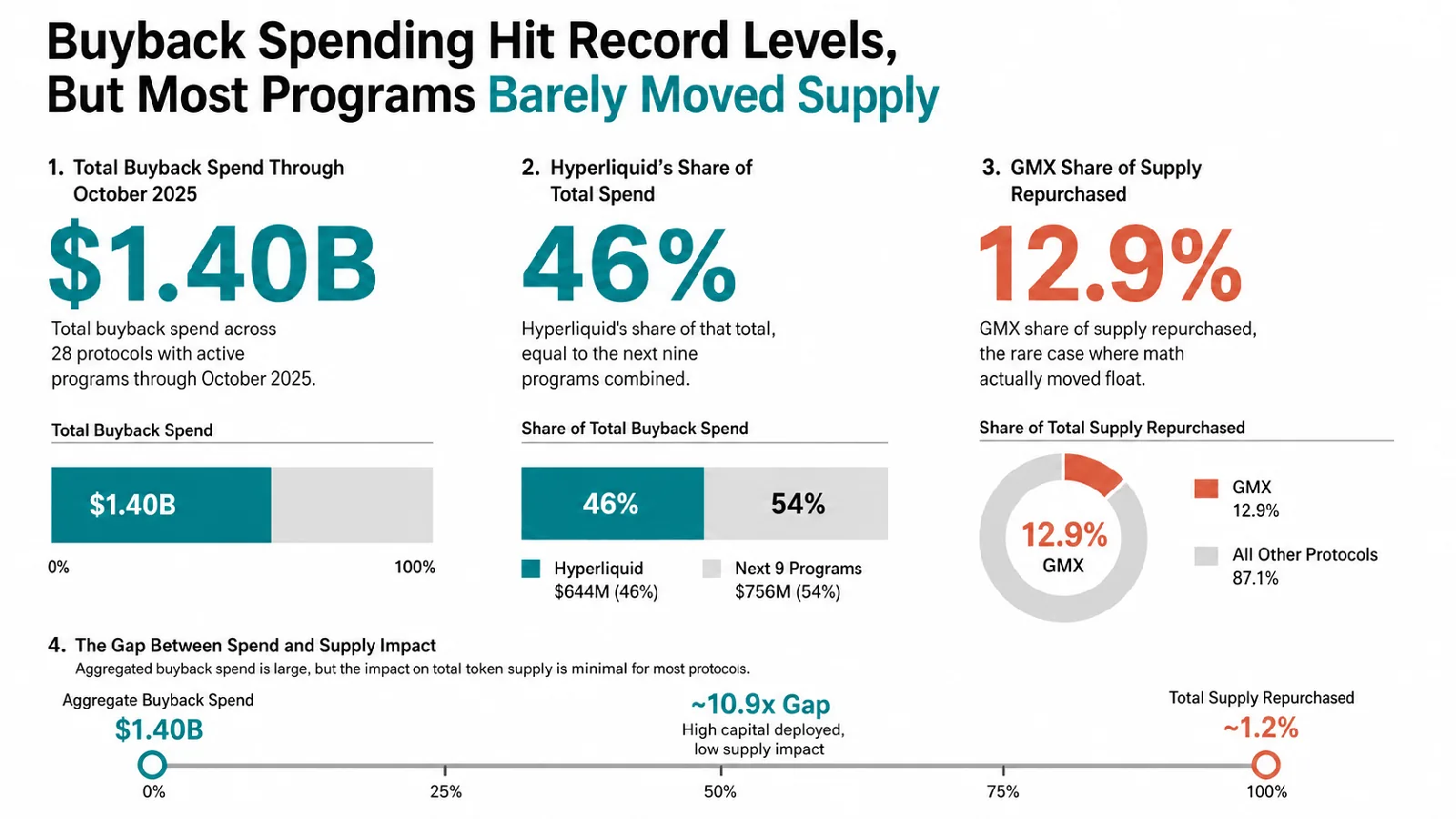
In any honest article about burning written in 2026, the first concrete data point is CoinGecko's October 2025 buyback report. Across 28 protocols with meaningful programs, total spend through October 2025 hit roughly $1.40 billion, averaging about $146 million per month. The pace accelerated through the second half of the year. After three relatively quiet years for buyback programs, 2025 turned this into the default value-accrual story for revenue-generating protocols.
One protocol drove most of it. Hyperliquid spent roughly $644 million on HYPE buybacks through October 2025, which is 46% of the full-year total across all programs combined, and equal to the next nine programs put together. The mechanism is automated: the chain's Assistance Fund directs about 97% of trading fees into open-market HYPE purchases. As of mid-October the fund held more than 21 million HYPE, equivalent to about 2.1% of total supply.
The 2025 story did not stop at buybacks. On December 16, 2025, the Hyper Foundation proposed a validator vote to formally recognize the roughly $920 million of HYPE then sitting in the Assistance Fund as burned, removing those tokens permanently from circulating and total supply. There is no on-chain destruction transaction in the proposal. The burn is the governance commitment itself ("binding social consensus to never authorize a protocol upgrade to access this address," in the Foundation's words). This pattern, which the market started calling a social burn, is a new design space. The supply effect is the same as a cryptographic burn. The mechanism is coordination, not code.
Every time we get the burn question on a client call, the same worry comes up: aren't we going to run out of tokens at some point? Should we cap the burn? The math says no. If a burn actually works and price rises, the same fee base destroys fewer tokens. The system self-regulates. You cannot burn down to zero, because at the limit each remaining token is worth so much that almost no economic activity clears a single one. That is the theoretical answer. The practical answer, which matters more, is that very few protocols ever burn enough supply for the question to come close to mattering.
The fork everyone misses: burn vs distribute vs accumulate vs lock
Once a protocol decides to redirect revenue toward its token holders, it has four options that all get presented as if they were the same trade. They are not. Each one has different tax treatment, different regulatory exposure, and a different game-theoretic relationship with holders.
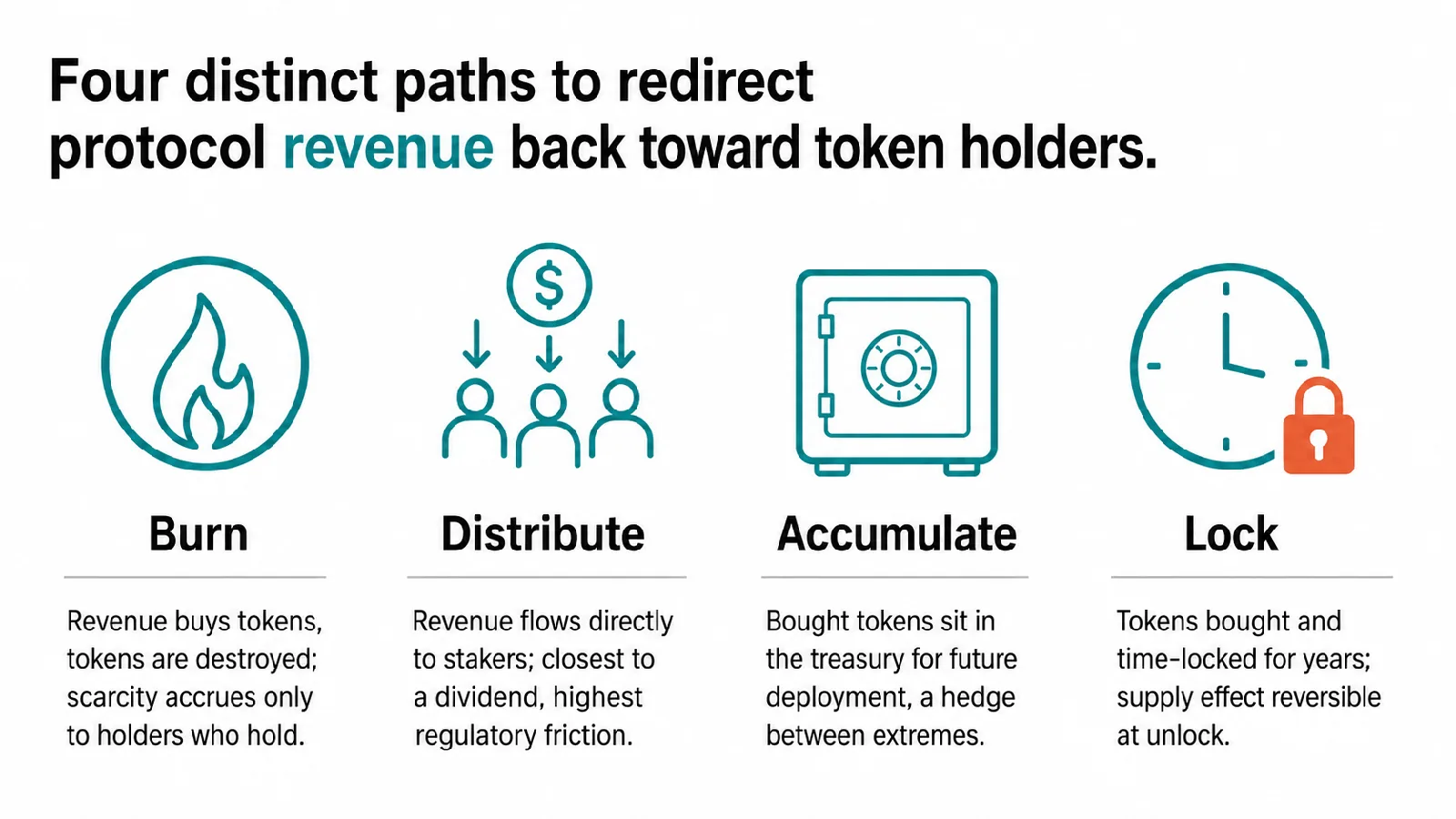
- Burn. Hyperliquid's path. Revenue buys tokens, tokens are destroyed (or socially recognized as destroyed). Value accrues only to holders who do not sell, via scarcity. Cleanest regulatory story in the US, since no holder receives anything they could call a dividend.
- Distribute to stakers. Aave's path with its Anti-GHO mechanism: 50% of GHO stablecoin revenue mints non-transferable Anti-GHO tokens, distributed 80/20 between stkAAVE and stkBPT stakers. Holders receive value directly. This is the model with the most regulatory friction, because it most resembles a dividend.
- Treasury accumulation. Aave's separate buyback program, approved in August 2024 and active since April 2025, allocates roughly $50 million per year to AAVE purchases that go into the ecosystem reserve, not to a burn or to stakers. By March 2026 the program had acquired about 205,000 AAVE, or 1.28% of total supply, sitting on the protocol's balance sheet for future use. This is a hedge between burn and distribute.
- Lock for years. Jupiter's path: 50% of protocol fees buy back JUP and lock the tokens for three years before they can move. This is structurally similar to burn in supply effect during the lock window, but reversible at the end. It also provides a future supply overhang that the next CEO has to deal with.
Then there is the model that does not fit on this list. Uniswap's UNIfication proposal, passed by governance on December 25, 2025, introduces a different mechanism. Protocol fees from v2 and v3 pools (and Unichain sequencer fees) flow into an immutable smart contract called TokenJar. Value can only leave the TokenJar if a UNI holder burns their UNI in a separate contract called Firepit, in which case they can withdraw a proportional share of the jar. This turns the burn from a one-way value-destruction event into a redemption right. UNI is no longer a governance token whose value depends on speculation about scarcity; it is closer to a share that can be exchanged for cash flow on demand. The proposal also includes a one-time retroactive burn of 100 million UNI from the treasury (worth roughly $596 million at vote time), representing approximately what would have burned had the fee switch been on since launch.
Most founders pick a path here without doing the analysis. Picking the wrong one is not fatal, but it is much harder to undo than to design correctly the first time. Working out which fork actually fits your protocol's revenue, your jurisdictions, and your holder base is the core of what we do during a tokenomics audit.
Burns without revenue are theater
The headline data from CoinGecko's October 2025 report has a quieter sentence underneath it that founders should read more carefully than the leaderboard. Even Hyperliquid, the dominant program by spend, had repurchased only about 2.1% of total HYPE supply through October 2025. The next 27 programs collectively bought back materially less than that. Most 2025 buyback announcements that drew attention on Crypto Twitter moved less than 1% of supply.
The ratio that matters is annualized buyback dollar volume divided by fully diluted market cap. Below roughly 2 to 3% per year, you are spending real money to produce a press release, not a supply effect. GMX is the cleanest counterexample I can point to: its program bought back 12.9% of supply for about $20.86 million, which worked because the token was small enough relative to revenue for the math to actually move the float. That is a structural fact about the GMX/revenue ratio, not a clever choice of mechanism.
The implication is uncomfortable for a lot of projects. A burn announcement without sustained revenue large relative to FDV is not tokenomics. It is a content marketing move that briefly bumps price, then fades. Anyone reading this and thinking through their own program should test the ratio before they commit, not after. Most tokenomics, including some of ours from earlier years, fail this test on review.
The regulatory shadow
Burn mechanism choice has regulatory consequences, and the consequences differ sharply by jurisdiction. The single most important distinction is whether holders receive anything from the program. A pure burn distributes nothing; scarcity is the only mechanism. A buyback-and-distribute scheme transfers value directly to a defined set of recipients. The further you move from the first toward the second, the more the program looks like a dividend, and dividends attract securities regulation almost everywhere.
In the United States, the GENIUS Act signed in July 2025 established a federal framework for payment stablecoins, but it does not directly address general protocol token buybacks. The broader Trump-administration crypto policy stance is more permissive than the prior SEC posture, but the Howey test still applies. A program that creates a passive expectation of profit from the efforts of a third party is still SEC-exposed regardless of how the structure is labeled. Burn-and-redeem mechanisms (Uniswap's Firepit) sit in an interesting middle ground because the holder takes an active step to claim, but this has not been litigated yet.
In the European Union, MiCAR has been fully in force since December 30, 2024. The Article 23 transaction-volume thresholds (1 million transactions and 200 million euros per day in a single currency area) apply specifically to asset-referenced tokens used as means of exchange, not to general buyback-and-burn programs. The bigger MiCAR question for a value-accruing token is jurisdictional: under Article 2(4), tokens that qualify as financial instruments under MiFID II fall outside MiCAR entirely and into the existing securities regime. A buyback-and-distribute structure pushes a token toward that classification. Germany's BaFin applies a substance-over-form analysis case by case under existing law (WpPG, KWG); a token whose pitch is "buy this and the burn will make it appreciate" can be classified as a security based on facts, not labels. Working out which fork your protocol fits under MiCAR or MiFID II before launch is far cheaper than litigating it after, which is part of what our MiCA-ready whitepaper service covers.
The contrarian case: a buyback might be an admission of failure
The strongest critique of the 2025 buyback boom is one its participants do not enjoy hearing. TokenData Research argued in March 2025 that buyback programs frequently signal that the project raised too much capital and cannot deploy it productively, so it returns the capital instead of compounding it. The equity-market parallel is direct: Apple's enormous buyback program is cheered by shareholders, and it is also the clearest market signal that Apple is no longer a hypergrowth story.
This critique stopped being theoretical in January 2026. Jupiter's co-founder publicly questioned whether the program should continue, after $70 million of JUP buybacks in 2025 produced almost no price movement (JUP is still about 89% off its all-time high). Helium's founder announced the same week that the team was redirecting buyback spend to user acquisition. Both said the same thing in different words: returning capital to token holders does not appear to be moving the market under current conditions, and the same dollars deployed into growth might create more value than the supply reduction does.
My honest read on when a burn is the right call: a burn is a clean alignment tool when revenue is large relative to FDV (the GMX condition) AND the protocol has run out of profitable reinvestment angles. For an early-stage protocol that condition almost never holds. For a maturing one, it sometimes does. For everyone else, a burn is marketing dressed up as tokenomics, and increasingly the market sees it that way.
More from the 101 series
- Value accrual 101 - burn is one of several ways a token can absorb protocol value, and rarely the cleanest
- Token supply 101 - what circulating, total, and fully diluted actually mean before you start removing from any of them
- Treasury 101 - where treasury burns sit relative to other balance-sheet decisions
- Governance 101 - most non-trivial burn programs need a governance vote, including social burns
Frequently Asked Questions
01Does a token burn always raise the price?
+
02Is buyback-and-burn the same as a stock buyback in traditional finance?
+
03Does Ethereum's EIP-1559 burn make ETH deflationary?
+
04What is a social burn and how is it different from a normal burn?
+