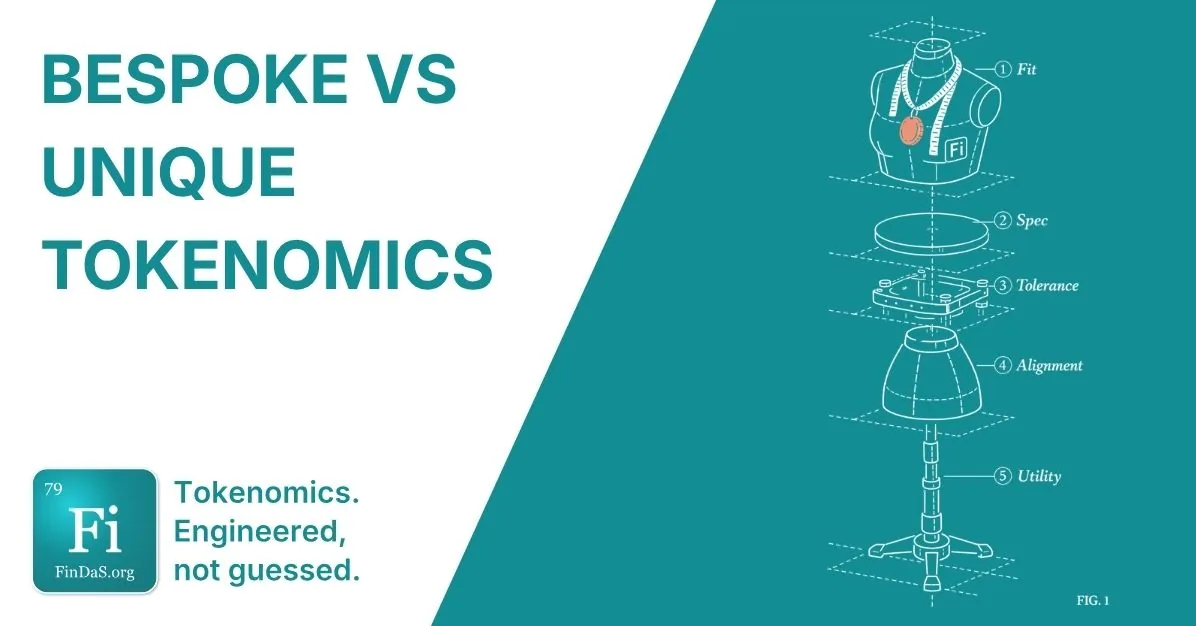
Bespoke tokenomics tailors proven mechanisms to a specific project's model. Unique tokenomics introduces new mechanisms that haven't been tested at scale. For nearly every project, bespoke is the right call; unique is only defensible when the tokenomics itself is the product.
Why "I want unique tokenomics" is usually the wrong ask
The request comes up in almost every discovery call with a new project. "We want tokenomics that are unique, unlike anything else out there." It arrives before the founders have finished describing the product, often before the token's role in the product has been specified at all.
Most of the time, what they're actually asking for is distinctiveness. The fear behind the request is that their token will look generic, that investors will see another staking-and-buyback setup and pass. That fear is reasonable, but the remedy they're reaching for is wrong. Unique tokenomics, in the strict sense, means economic mechanisms that haven't been tested at scale. That is not what you want when you have a $4M raise, a 2-year roadmap, and a product that has to ship.
What the request usually describes is bespoke tokenomics: proven mechanisms tuned specifically for this project's users, its unit economics, its regulatory exposure. That is how the vast majority of projects that survive their first year are actually put together. Unique is a different thing, and it is the correct choice only in a narrow set of cases I'll describe below.
What "unique" actually means in practice
Unique tokenomics means inventing the economic primitive, not assembling from the library. The classic examples are Ampleforth's rebase mechanism, where daily supply adjustments propagate through every wallet to target a CPI-adjusted dollar, and Olympus DAO's protocol-controlled-value model, where bonding discounts funded a treasury that backed the token. Both were structurally novel. Both attracted significant capital during their expansion phases.
Both also exposed what "untested at scale" looks like. Ampleforth is still technically alive at roughly $36M market cap as of early 2026, absorbed as collateral in the SPOT protocol; it survived, but the vision of AMPL as decentralized base money did not materialize. Olympus's (3,3) rebase model ran through an expansion cycle and a collapse from which OHM has only partially recovered. More recently, EigenLayer launched restaking with hotly anticipated EIGEN tokenomics; TVL peaked near $28.6B before slashing went live in April 2025 and then dropped toward $7B in the following months. EIGEN was down 91% on the year by December 2025, and the foundation is now proposing a significant redesign of the incentive model.
None of this means unique is always a mistake. Ethereum's proof-of-stake design, Uniswap's constant-product AMM, and Curve's veCRV vote-escrow were all genuinely novel when introduced, and all became load-bearing for the rest of the industry. The pattern is that unique mechanisms sometimes work, sometimes work for a while and then don't, and sometimes fail on launch. That is not a pattern you want underneath a project where the token isn't the main product.
What bespoke actually means, and why it isn't copy-paste
The second misconception I deal with regularly is that bespoke and generic are the same thing. They aren't. Bespoke tokenomics means starting from the library of proven mechanisms (staking with unbonding, vesting schedules, fee burns, veToken governance, emission curves, LP incentives) and tuning the mix to fit one specific project's economics. The primitives are shared; the configuration is not.
A project with a predictable revenue stream and a capped user base needs different mechanics than one with explosive viral growth and zero revenue in year one. The first benefits from a fee-capture-plus-buyback loop. The second benefits from a burn mechanism calibrated to adoption velocity, with emissions designed to not outpace realistic user growth. Same ingredients, completely different recipes. Getting the recipe right is the substance of tokenomics design, and it's nontrivial work.
The reason this gets confused with copy-paste is that from 30,000 feet most bespoke designs look alike. Everyone has a staking mechanism. Everyone has a treasury. The distinctions live in the numbers: emission half-lives, unbonding periods, fee splits, whether a price floor mechanism is in play, the trigger conditions for governance intervention. Those numbers are what determine whether the token economy survives its first bear market. A project that copies another project's whitepaper verbatim is not doing bespoke, it's doing copy-paste, and the two failure modes (unique-when-bespoke-was-needed, and copy-paste-when-bespoke-was-needed) produce weak tokenomics for the same underlying reason: the design didn't engage with the specifics of the project.
Where bespoke wins: reliability, comprehension, audit surface
The first reason is investor due diligence. A VC reading a bespoke model knows what to check: unlock schedule, emission curve, value accrual mechanism, governance timeline. They've seen the pattern. A VC reading a unique model has to first understand the novel mechanism, then form a view on whether it will behave as intended under stress. Most VCs, faced with that extra work, pass. That isn't unfair; it's a reasonable response to the information asymmetry.
The second is audit surface. Audit firms price and scope work based on what they've seen before. A standard veToken module with standard hooks is a few days of review work. A custom rebase mechanism coupled with a bonding market is two or three weeks, and the residual risk is higher because the auditor is testing novel code paths rather than recognizing patterns. The project pays for that extra scope directly, and the post-audit uncertainty stays larger than it would be for a bespoke design of equivalent complexity.
The third is adjustability. If a bespoke mechanism underperforms, the levers to adjust are known. Emissions can be throttled via a governance vote. Fee splits can be reweighted. Unbonding periods can be extended. A unique mechanism's failure mode is often that nobody, including the designers, fully understands why it's underperforming, which makes the fix itself a second research project. These advantages compound on every non-technical timeline: fundraising, exchange listings, audit scheduling, post-launch iteration.
When unique is the right call
The one case where unique is correct: when the tokenomics itself is the product.
DeFi is the cleanest example. Uniswap's constant-product AMM is not an app with a token attached; the AMM formula is the protocol, and the fee-sharing mechanism that gives LPs and UNI holders their economic claim is intrinsic to the design. You could not implement Uniswap with bespoke-standard tokenomics because there is no standard that describes what Uniswap does. Same with Curve's vote-escrow model. Same, in a different shape, with MakerDAO's original CDP design. In each of those cases, the novelty of the economic mechanism is the reason the project exists at all.
DePIN projects sometimes land here too. If you're designing a supply-side incentive for a physical infrastructure network, where contributors are paid in proportion to verified real-world work and no existing mechanism maps cleanly to the supply function, you may need a new primitive. Stablecoin pegs are another area where unique is often defensible, because each pegging mechanism is effectively a novel monetary design. The cost of doing this well is that novel designs need to be stress-tested exhaustively, usually via Monte Carlo simulation of the mechanism under adversarial conditions, before real users commit capital to it.
What's distinctive about this set: in each case, if you took the token away, the product would cease to function. The token isn't a layer on top, it's the coordination mechanism that makes the product exist. That's the dividing line, and it's a narrow one. A wallet, a CeFi platform, a game with an in-game currency, an AI marketplace, a real-world asset tokenization platform, all of those have products that exist independent of whatever token they attach. They need bespoke.
The test: one question to ask yourself
The question: if I removed the token from my project, does the product still work? If the answer is yes, even if the product is worse or less profitable or harder to bootstrap, you need bespoke tokenomics. The token is a coordination and incentive layer on top of something that has its own reason for existing, and the tokenomics job is to tune that layer for your specific economics, users, and risk tolerance.
If the answer is no, meaning the product IS the token economy, then you're in the other bucket. Unique tokenomics is defensible, often necessary, and the design work becomes significantly harder: you need to model behavior under adversarial conditions, stress-test the mechanism, and usually publish the reasoning so early users can evaluate it before committing capital. That last part matters, because unique mechanisms only survive if the people staking capital into them understand what they're staking into.
In my experience, maybe one in twenty projects I talk to belongs in the second bucket. The other nineteen want distinctiveness and think unique is how to get it. The real source of distinctiveness, in tokenomics as in product, is usually in the details of how well the design fits the specific project, not in whether the mechanism is novel.
Frequently Asked Questions
01Is bespoke tokenomics the same as copying another project's model?
+
02Does bespoke tokenomics cost less than unique tokenomics to design?
+
03Can a project start bespoke and add unique mechanisms later?
+
04How do token auditors and investors react to unique mechanisms?
+