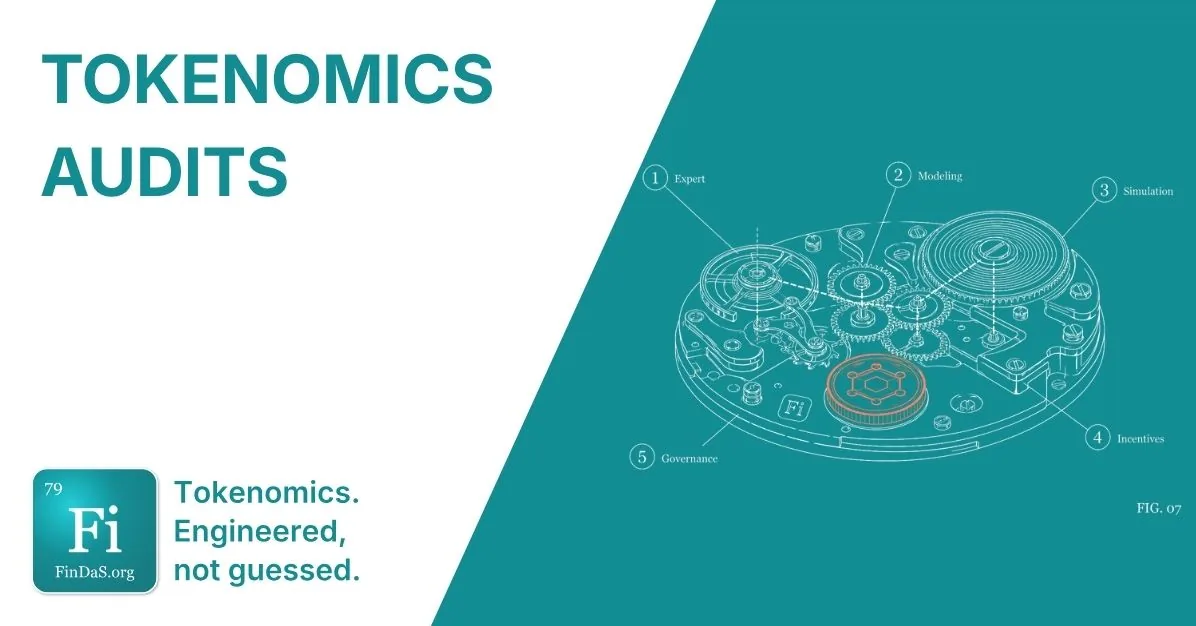
A tokenomics audit is a review of a token economy designed to find flaws before a launch or a design change makes them expensive. Three types exist, and they catch different things. An expert review flags obvious red flags in a few hours at low cost but depends on the reviewer's blind spots. A modeling audit rebuilds the economy mathematically and surfaces structural contradictions between supply, incentives, and demand drivers. An economy simulation runs the model under thousands of randomized scenarios and exposes failure modes that only appear in rare market conditions. Pick the type by stage and stakes: expert review for early design, modeling for anything heading to launch, simulation when real capital is on the line.
What a tokenomics audit actually catches
Token economies fail in predictable ways. Sell pressure outruns demand in year one. An unlock cliff dumps 10%+ of circulating supply in a single week. Staking rewards pay in a token whose emission rate outpaces buyback, so the "yield" is just dilution. These patterns show up across projects, which means they can be caught before launch by the right kind of review.
A tokenomics audit is that review. The output depends on which type you run, and the three types are not interchangeable. An expert review catches obvious red flags in a few hours. A modeling audit forces every moving part into a quantified framework and surfaces structural contradictions between them. An economy simulation runs the model under thousands of randomized scenarios and exposes failure modes that only appear in rare conditions.
The three differ on cost, time, depth, and the kind of problem they catch. That's what this article is about: which one fits which stage of a project, and why substituting one for another costs you the findings you actually needed. Most projects run the wrong type for their stage, which is usually worse than running none at all, because the report on file creates false confidence.
Expert audit: fast, cheap, limited
An expert audit is a pattern-match review. An experienced reviewer reads the whitepaper, the distribution table, the vesting schedule, and the utility model, and compares them against patterns from past projects. Red flags come from recognition, not calculation. "You have a one-year cliff followed by a 25% unlock in month 13? That's going to move the price."
This is the fastest audit you can run. A senior reviewer can work through a whitepaper in a few hours and deliver verdicts the same day. Cost is a fraction of the other two types, which makes it a reasonable sanity check at any stage where the tokenomics is still moving.
The limits are real. Expert reviews are bounded by the reviewer's experience, so a reviewer who has seen fifty GameFi projects will spot GameFi patterns quickly but may miss something specific to DePIN or RWA. Pattern matching also catches the things that look wrong, not the things that are quietly wrong. Two incentive mechanisms can each read as reasonable in isolation and still contradict each other under the full emission schedule, which is exactly the class of problem an expert review tends to miss.
Use an expert audit when the design is still being shaped, when budget is tight, or when you want a fast second opinion before committing to deeper work. Do not use it as the only audit on anything heading to a token launch with real capital behind it. Early-stage tokenomics work is where expert reviews pay best, because the design is still cheap to change.
Modeling audit: the structural layer
A modeling audit rebuilds the token economy as a quantified system. Every component gets explicit values: total supply, emission curve, vesting schedule by allocation group, staking rewards and their source, buy-and-burn mechanisms, demand drivers, liquidity requirements, governance structure. Where the whitepaper says "we will incentivize long-term staking," the model asks: at what APR, from which pool, for how long, and what happens when the pool runs out.
The usual effect is that half the design assumptions turn out to be underspecified. A reward mechanism that looked fine in prose shows up in the model as a pool that empties in month eight. A vesting schedule that seemed reasonable against a static supply looks different once you overlay the emission curve and discover year-one sell pressure exceeds expected trading volume by a factor of three. These are not exotic findings, they are the normal output of forcing the tokenomics to state every number explicitly.
The trade-off is effort. A modeling audit takes roughly the same time as designing the tokenomics from scratch, because the auditor is effectively reconstructing it. Pricing lands in a different band from an expert review. And the findings are only as good as the model, which means a rushed modeling audit with shaky input assumptions can miss things a careful expert review would have caught.
Run a modeling audit when the tokenomics is close to finalized, before the token launches, and when the stakes justify the effort. For anything raising meaningful capital through a token sale, I'd argue this is the floor. If the audit keeps surfacing that the design itself needs rework rather than verification, you are running the audit too early, and you probably need design work before the audit.
Economy simulation: stress-testing under uncertainty
An economy simulation is a modeling audit with a Monte Carlo layer on top. The quantified model from the previous step gets run thousands of times, each run sampling different values for the uncertain inputs: user growth, trading volume, external price shocks, staking participation, governance behavior. The output is not a single answer, it is a distribution of outcomes.
What this catches that a single-run model misses: the failure modes that only show up in the tail. A token economy that looks stable at expected user growth can collapse at the 20th percentile, where adoption underperforms and the liquidity reserve runs out three months before revenue picks up. A buy-and-burn mechanism that balances emissions under normal volume can invert under a market downturn when volume drops 60%. These are the scenarios where the model passes on paper and the project fails in production.
FinDaS runs these simulations in Machinations, testing hundreds of scenarios per model. Machinations has been the default tokenomics simulation environment for years and remains so in 2026. Other tools exist (CadCAD for Python-native workflows, custom Monte Carlo setups for specific use cases), but for most projects Machinations handles the job and integrates cleanly with a modeling audit.
The limits: simulations inherit every assumption from the underlying model. If the model is wrong about user behavior or demand elasticity, running it ten thousand times produces ten thousand wrong outcomes. They also require meaningful compute time and interpretation. A simulation output of "the system survives in 73% of scenarios" only matters once you know what happens in the other 27%.
Use a simulation when the token is live or about to go live with real capital. It also earns its place when the design has meaningful uncertainty that a single-point model cannot capture, for example a new incentive mechanism nobody has seen run through a full market cycle. For specific risks (unlock cliffs, bear-market behavior, adversarial staking), a simulation is how you stress-test them against a range of plausible conditions.
Which audit catches what
| Audit type | Time | Cost band | Best stage | What it catches |
|---|---|---|---|---|
| Expert review | Hours to days | Low | Early design, sanity check | Obvious red flags, pattern-matched risks |
| Modeling audit | 2 to 4 weeks | Mid | Pre-launch verification | Structural contradictions, underspecified components |
| Economy simulation | 1 to 3 weeks on top of a model | High, additive | Live token, imminent launch | Tail-risk failures, rare-condition collapses |
The table hides one thing worth naming. The "what it catches" column is cumulative, not substitutive. A simulation catches the tail cases a model missed, but only because it sits on top of the model. If you skip the middle layer, the simulation has nothing real to run.
Picking the right audit for your stage
The failure mode I see most often is projects running the wrong type for their stage. A pre-token-sale project commissions a full simulation before the core design is stable, and spends weeks modeling scenarios that change the next time someone rewrites the whitepaper. Or a live project with real capital at risk runs only an expert review, on the logic that "we already have a tokenomics document," and misses the structural contradiction that surfaces in week three of mainnet.
The rough rule I use is straightforward. The audit type should track the stage of the project and the stakes riding on the token, not the budget or the calendar someone invented. Here's how it plays out:
- Pre-finalization design: expert review, maybe two rounds as the design moves.
- Pre-launch with real capital: modeling audit, non-optional.
- Live token or imminent launch: modeling audit plus simulation, with the simulation focused on the specific risks that matter for this project.
Stacking works. An expert review before the modeling audit often saves weeks, because the expert catches the obvious things that would otherwise show up as a dozen minor model-level findings. A modeling audit before a simulation is not optional: you cannot simulate a model you have not built.
What doesn't work is treating an audit as a marketing exercise. A report on file that nobody acted on is not an audit, it's a PDF. The value is in the findings being used to change the design, which means running the audit early enough that changes are still cheap. Audits done at the wrong time, by the wrong type, or for the wrong reason are a cost center with no risk reduction attached.
Across 300+ projects the pattern is consistent: the projects that invest in audits early spend far less on post-launch damage control than the ones that don't. The specific audit type matters less than the timing, and the timing matters less than whether anyone acts on what the audit finds. That last piece is the one you control most and audit the least.
Frequently asked questions
01How long does a tokenomics audit typically take?
+
02What does a tokenomics audit actually cost?
+
03Can a tokenomics audit find smart contract bugs?
+
04Do I need an audit if my token hasn't launched yet?
+
05Can one audit type replace the others?
+