Neither exchange type brings you users. A constant-product AMM is transparent but capital-inefficient - holding a price takes roughly four times more liquidity than the buy pressure it offsets - while a tier-1 centralized listing can cost 3-5% of supply plus fees up to $500,000, and delivers speculators rather than holders. The sharpest trap is the market-maker token loan: the strike price pays the market maker to pump and then dump, which is what game theory says it should do. Providing both sides of the liquidity yourself costs more, and is the only structure whose incentives point where yours do.
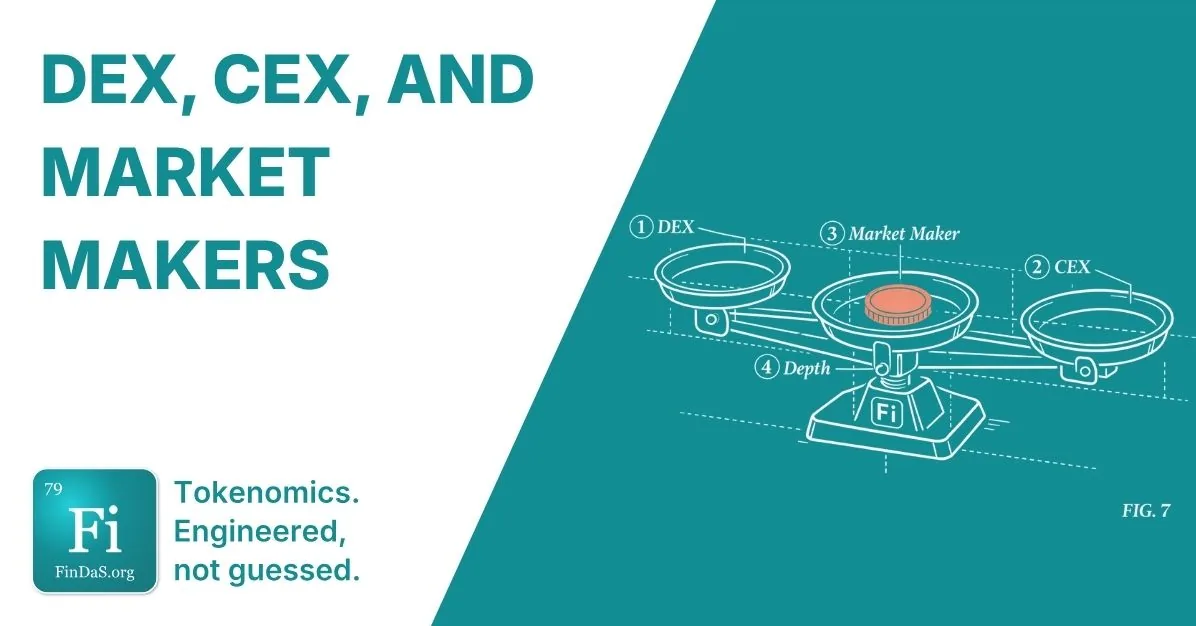
Even if you have the best project, there comes a time when you need to list it on an exchange. The question then becomes: do you list on a DEX or CEX? Should you use a Market Maker? If so, should you use a token loan deal or provide liquidity yourself? At FinDaS, we have worked with over 300 projects and have gained a clear view of the pros and cons of each approach, as well as where things go wrong and where they become outright scams.
Decentralized Exchanges (DEX): Transparency with Inefficient Liquidity and No Added Value
There are several types of decentralized exchanges (constant product, order book, bonding curves, liquidity bands, etc.), but for this article we will focus on the most popular and widely understood type: constant product AMMs. A constant product AMM is a type of automated market maker that maintains a constant product of the reserve balances, ensuring that the price always changes as the balance of tokens in the pool changes. DEXes are great: they do what they promise (provide a place to exchange tokens) in a transparent manner. There are, however, two problems worth flagging.
The first is that they don't bring any additional project exposure. Unlike centralized exchanges, DEXs generally do not have built-in promotional mechanisms, such as featured listings or marketing campaigns, that attract new traders to your project. You need to generate demand independently.
The second is that liquidity is not efficient. Liquidity refers to the ability to buy or sell an asset without causing significant price movement. On a constant product AMM, liquidity is spread along an exponential curve at all price points, meaning that the price always changes with each trade, often quite rapidly. This design means even small trades impact the token price, which makes price stability difficult during periods of high volatility. Liquidity is quite inefficient compared to centralized exchanges or limit order-based systems, where liquidity can be concentrated at specific price points to maintain stability. On average, it takes four times more liquidity to stabilize a token price than it would take buy pressure to achieve the same effect. Exchanges that support limit orders, or projects that employ market-making strategies (alone or as a service), can be a lot more efficient with their capital. Let's walk through an example.
- You list your token on a DEX at a price of $1.
- You want $1,000 worth of selling pressure (or 1,000 tokens at $1) to move the price by no more than 10%.
- To achieve this, you need to post just under $20,000 in USD and 20,000 tokens as liquidity. After a sale of 1,000 tokens you end up with 21,000 tokens and $19,047, or a price of $0.907 per token.
- Alternatively, you could post just $5,000 of each asset, let the price slide to $0.70 per token on the same trade, then use $1,000 to buy back tokens from the pool, bringing the price back to $1.
For an unknown amount of selling pressure, you might be better off with the first scenario (letting the price decrease gradually). But if you know what to expect (and you should, if you have a properly structured tokenomics plan), the second approach is much more efficient in both token price and capital. DEXes do suffer from other issues: liquidity fragmentation, sniper bots, potentially high transaction fees. Those are a much lesser concern.
Centralized Exchanges (CEX): Unregulated Black Box
Listing on a centralized exchange used to be paramount for the success of your project during the 2017 to 2021 period. Centralized exchanges dominated the market, providing access to a larger user base and offering significant liquidity, which helped projects gain credibility and visibility. Most crypto traders were there (and likely still are), and listing on a CEX was considered proof that your project was serious. Times have changed, however. There are many CEXs now, and only a few still carry any real prestige, especially given the skepticism towards centralized exchanges since the wave of CEX collapses.
What's more, CEXs never truly bring real users to projects. People who buy your token on an exchange are likely never going to take it off the exchange, use your protocol, stake the token, or do anything else with it. They are speculators waiting to sell your token for a profit. Just as this buy pressure can be useful upon listing, the sell pressure will definitely come later on.
On the flip side, your real users do not want to use a CEX. It is simply not a good user experience. Imagine being a user, and in order to use a platform, you need to register in two places (the platform itself and a CEX), pass KYC checks, deal with wallets, and wait for block confirmations. It just isn't practical. Your users, if they are going to buy the token at all, want to do it directly on your platform without any extra steps. The easiest way to do this, if they already have crypto, is to grant them access to a DEX via the UI on your platform. If they don't, you would need to facilitate the entire process of on-ramping and exchanging for them.
And now the ugly part. Centralized exchanges usually charge a significant number of tokens (sometimes up to 3-5% of the total token supply) for listings on top of already enormous fiat fees (up to $500,000 for Tier 1 exchanges). Those tokens are not an "investment"; they will be sold at the first opportune moment. And here comes the real kicker: you might be thinking, "I gave the exchange an allocation, but it is locked/vested." This does not matter. An exchange can dump the tokens "on paper" from day one, even if they are locked. This is because they need the on-chain representation of the tokens only when people want to withdraw them, and by the time that they do, those allocations have likely already vested. I have even seen exchanges take this a step further and create a replica of the token on a different chain (without the consent of the project) to honor customer withdrawals. This goes well beyond "questionable" behavior.
Market Makers: Misalignment of Incentives
The official role of a market maker (MM) is to stabilize the token price and provide liquidity support at critical levels. At least, that is what it's supposed to do. The unspoken agreement between some projects and market makers is the expectation that the market maker will generate trade volume and prop up the price. This is why, back in the 2017 to 2020 period, famously 95% of trade volume on centralized exchanges was wash trading (wash trading is when a party simultaneously buys and sells the same asset to create artificial trading activity).
This behavior is further incentivized by the most common deal that market makers offer: a token loan agreement where the project lends tokens to the MM. In exchange, the MM provides liquidity (theoretically, a certain order book depth at any price). On the face of it this looks like a win for the project - liquidity without the need for a FIAT component. The tricky part is that the market maker has the right to purchase tokens at a certain strike price. Here is what an example deal might look like (simplified):
- The market maker receives 10,000,000 tokens as a loan.
- The market maker pays some insignificant interest (e.g., 0.03% per year) on the loan.
- The market maker must repay the loan in one of two ways:
- Give back the entire token amount plus interest after 12 months.
- Repay the loan in USD at the predefined strike price (e.g., the average trading price for the first 5 days plus 30%) at any time.
What does the above mean? Let's imagine the token is originally listed at $0.10. Here is how this plays out for the market maker:
- If the token underperforms, the MM needs to pay back 10,000,000 tokens (which they have) plus 0.03% interest, or 3,000 tokens. Those 3,000 tokens were worth $300 at the listing price, but in reality are likely worth a lot less at the end of the loan.
- If the token performs well (say it went to $0.20, double the price), any sales that happen above $0.13 are pure profit for the market maker. In the best-case scenario, they realize $700,000 profit from this deal.
- The worst-case scenario for the market maker is if the token stays stable in the $0.10 to $0.13 range: no profit, and they need to pay back the loan in tokens. Even there, the max loss is about $300, which was likely already more than covered by their onboarding fees.
Here is an example which is far from the most extreme one. The token price started at $0.064, peaked at $0.14, then slid to $0.01. With a 10 MM token loan (which is on the low side) at a strike price of $0.08:
- If the market maker sold all 10 MM tokens at the strike price and then repurchased them at $0.01, the profit was (0.08 − 0.01) × 10,000,000 = $700,000.
- If they sold at $0.14, they could either repay the loan in USD right away for (0.14 − 0.08) × 10,000,000 = $600,000 of profit, or hold off until end of year and make (0.14 − 0.01) × 10,000,000 = $1,300,000 by buying the tokens back at the end-of-year low.
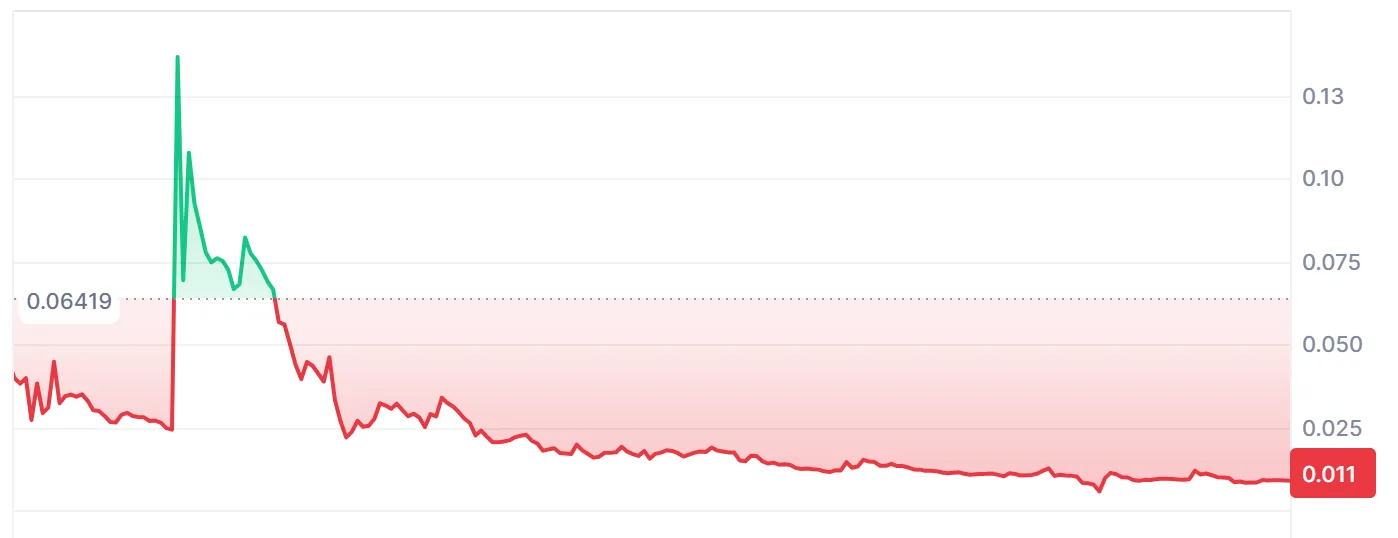
In theory, the market maker is supposed to provide liquidity on both the buy and sell sides, remaining impartial to token price movements: they just need to "create a market." In reality, the market maker is heavily incentivized to let (or even push) the token price pump so they can realize a profit by dumping the token on the market once it reaches a certain point. You might temporarily see an increased token price, but in the end, you also face a lot more sell pressure. This is why we see so many "inverted hockey stick" price charts (like the one above) in crypto. This is the downside to "paying" in tokens; in the end they always become sell pressure. I am not saying that this is what most market makers do in this position. I am saying that in an unregulated environment, this is what game theory suggests they SHOULD do.
So is there a way around this? Yes, there are market makers who allow the project to provide both sides of the liquidity, both the token part and the fiat or stablecoin part. In this scenario, all profits are retained by the project, minus a fee for the market maker. Quite often, the project gets access to all trades being executed and all open positions at all times (which is often not the case with the loan scenario). This is a much better option for the token as a whole, but it is also a lot more expensive. It is not uncommon for a token to need half a million USD in liquidity (or more) to have efficient market-making under those conditions.
So what should you do?
There is no approach that "ticks all the boxes" and gives you everything. Every option trades one kind of risk for another. When it comes to token health and sustainability, the approach I suggest to most projects is:
- List on a DEX with a moderate amount of liquidity.
- Keep a reserve in fiat or stables for price stabilization, either run in-house or via a market maker that offers such a service.
- Link the front end of your application to the DEX so that people can trade directly without leaving your site.
This approach will prevent the most common pitfalls I've discussed in this article. It is, however, unlikely to bring new token holders to the project. It is also one of the most expensive options, but you get what you pay for.
Frequently Asked Questions
01How much liquidity should a token start with on its DEX listing?
+
02Does listing on multiple DEXs improve liquidity?
+
03Can a project exit a market maker token loan early if the deal is going badly?
+
04Do retainer-based market makers exist for smaller projects?
+