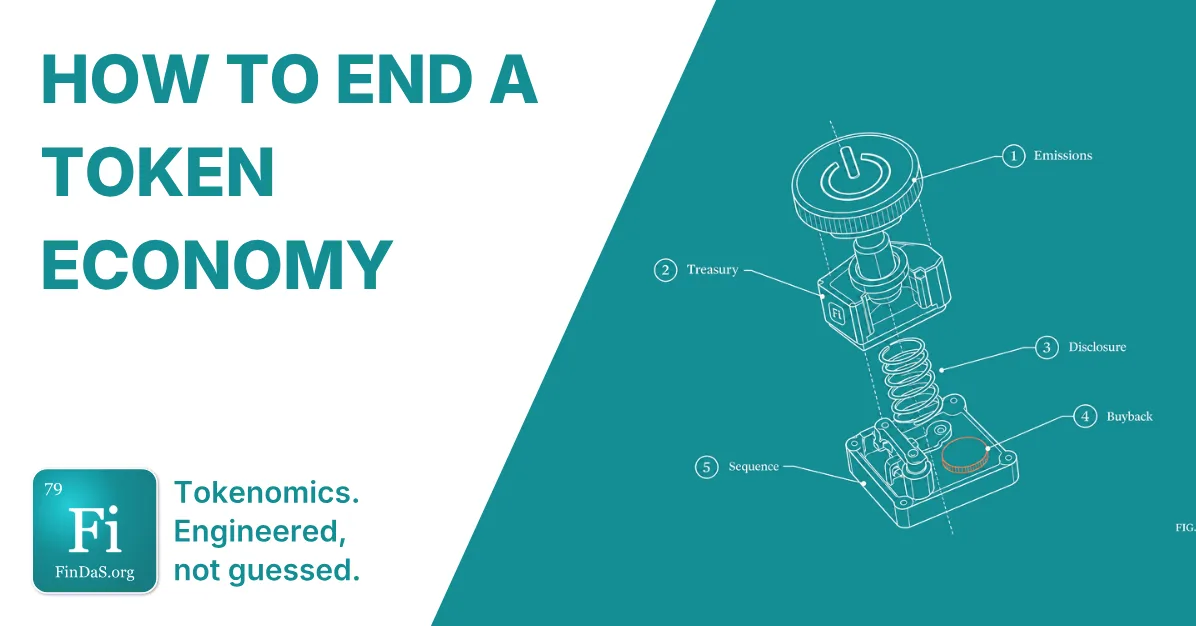
Ending a token economy is a design act, and almost nobody performs it. Most dead projects do not end, they stall: the team drifts off, the treasury drains, and emissions keep running into a market with no bid, so the remaining holders get diluted by a machine nobody is steering. A deliberate wind-down closes issuance first, settles what the treasury owes, and discloses the sequence before it starts. The difference between a wind-down and a rug is not intent. It is disclosure and order of operations.
Most token economies do not end, they stall
There is a large cohort of tokens launched between 2021 and 2023 that are, in every sense that matters, finished. The product has no users. The team has moved on or moved sideways into something else. The Discord is a bot and four people. And yet the token is still there, still trading a few thousand dollars a day, and in a great many cases still emitting.
That last part is the one worth sitting with. Emissions are a contract with the future written by a team that no longer exists. They were sized for a network that was going to grow, and they keep paying out at that size into a market that has stopped absorbing them. Every unlock lands on a bid that is thinner than the one before it. The holders who stayed are not being harmed by a decision anyone made. They are being harmed by the absence of one.
We have written before about the difference between a project failing and a token failing, and they are genuinely separate events with separate causes. What that article does not cover, because at the time we had not seen enough of them, is the case where the project has failed, the token has not yet, and nobody will say so out loud. That gap is where most of the damage in this industry now sits.
Ending deliberately produces better outcomes than drifting, for every party. It is also commercially awkward to write about, which is roughly why you will not find much on it.
Four signals that it is over, and two that only look like it
The hard part is not the mechanics. It is admitting the moment has arrived, and the moment is genuinely ambiguous while you are inside it.
Four signals, and they matter in combination rather than individually:
Revenue has been below operating cost for four consecutive quarters with no product change in between. Four quarters is long enough to survive a bad market and short enough that the treasury has not been spent proving a point. The clause about product change matters: if you shipped something material in the window, the clock restarts, because you have not yet learned what the new thing does.
The token's holding demand is entirely reflexive. Nobody holds it for what it does. They hold it because the price might go up, which is a demand curve with no floor under it. Our piece on value accrual sets out what a real floor looks like, and the test is uncomfortable when applied honestly to a project in decline.
Governance has stopped clearing quorum. Not "votes are close" but "votes do not resolve". A DAO that cannot pass a proposal cannot authorise a wind-down either, which is why this signal is also a deadline: past a certain point you lose the ability to end the thing properly, and the only remaining exits are worse.
The core contributors have stopped being replaceable. When two people hold every key, every relationship and every piece of undocumented context, the project is already a single point of failure wearing a DAO's clothes.
Two signals that look decisive and are not. Price is not one of them. Price tells you what the market believes about the future, and the market is frequently wrong in both directions; a token down ninety percent from an inflated launch may be correctly priced for the first time. And a quiet Discord is not one of them either. Community volume tracks speculation far more closely than it tracks usage, and plenty of infrastructure with real users has a silent chat.
Close issuance first, and do it in one step
The first mechanical act is stopping emissions, and the instinct is to taper. Taper is almost always wrong here.
A taper announces that supply pressure is ending gradually, which gives every holder a reason to sell ahead of everyone else who heard the same thing. You get the exit you were trying to avoid, spread over the taper period, and you spend the treasury's remaining credibility buying nothing. A single announced stop, effective on a stated block, is cleaner: it removes the schedule everyone was trading against and it removes it at a known moment.
Three things have to happen in the same act, and the order inside it matters.
Stop the mint authority in code, not in policy. A multisig that has agreed not to mint is a promise; a revoked mint function is a fact, and the difference is exactly the thing a departing team cannot be trusted on. Second, publish the final circulating supply and the address of every remaining locked allocation. Our guide to token supply design covers why the locked side matters more than the circulating side at moments like this: an unlock schedule that survives the wind-down is a live claim on a dead economy. Third, and this is the one teams skip, state what happens to unvested team and investor allocations. Whether they are burned, returned, or honoured is a legitimate choice. Leaving it unstated is not, and it is the single fastest way to turn a wind-down into an accusation.
Token Emissions 101 covers the design side of this in a healthy protocol. In a dying one, the same levers exist, and the only one you should reach for is the off switch.
What the treasury owes, and to whom
A protocol treasury at wind-down is not a pot of money to be distributed. It is a balance sheet with claims against it, and most of those claims are not written down anywhere.
Work through them in order. Contractual obligations first: audits paid for and not delivered, grants committed and not disbursed, market-making agreements with notice periods, infrastructure paid annually. These are real debts and they survive the project. Then operational runway for the wind-down itself, which teams consistently underestimate. Somebody has to keep the RPC endpoints alive, answer the exchange emails, and file the final accounts, and that person needs paying for six to twelve months after the announcement.
Then, and only then, the holders. This ordering is not generosity toward vendors. A wind-down that stiffs its suppliers to make a larger distribution to token holders converts a commercial failure into a reputational one that follows every person involved into their next project.
Our Treasury 101 piece argues that most protocols diversify too late. The wind-down is where that bill arrives. A treasury still denominated in its own token at the moment it needs to pay obligations is a treasury that has to sell into the market it is trying not to damage, and there is no clever sequencing that makes that painless. If you take one thing from this article into a healthy project, take that one.
Buy back, distribute, or hold
Whatever survives the claims above goes back to holders, and there are three routes. The instinct is always the buyback. The instinct is usually wrong.
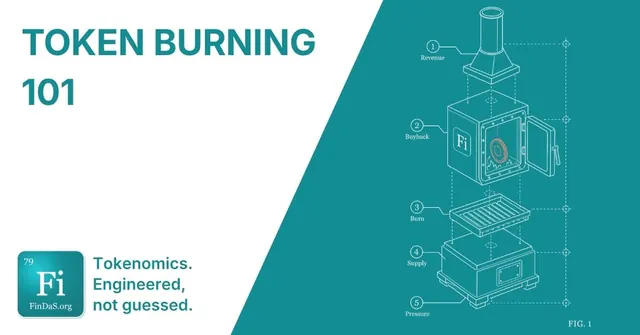
A buyback returns value through the market, which means it returns value to whoever is selling, not to whoever held. In a wind-down the sellers are disproportionately the people leaving, so a buyback systematically pays the least patient holders with money that belonged to all of them. It also props up a price that is trying to find its level, which delays the honest signal and gives late buyers a worse entry. Token Burning 101 is worth reading for the mechanics, and the mechanics are fine. The timing is the problem.
A pro-rata distribution to a snapshot is almost always the right answer. It pays every holder the same amount per token regardless of behaviour, it is arithmetically checkable by anyone, and it does not touch the market price. The snapshot block must be announced in advance and it must be in the future, which costs you some mercenary inflows and buys something worth more: nobody can claim the timing was chosen to advantage insiders.
Holding is legitimate in exactly one case, which is a genuine prospect of a restart or an acquisition inside a stated window. If you take that route, state the window and state what happens when it expires. Re-launching a token is a real option and we have helped projects do it, but "we might relaunch" as an indefinite holding position is how a treasury quietly becomes somebody's salary.
The line between a wind-down and a rug
Here is the uncomfortable part. From the outside, a competent wind-down and a slow rug can look identical. Both involve a team going quiet, a treasury being spent, and a token going to nothing. Two things separate them, and neither is intent.
Disclosure comes before the action, not after. Announce the wind-down, then execute it. A team that stops emissions, distributes the treasury and then explains has done every individual step correctly and still behaved badly, because every one of those steps was information the market did not have while insiders did.
The sequence runs worst-for-insiders first. Team allocations are resolved before holder distributions. The multisig is reduced before the treasury is moved. If insiders exit before or alongside holders, the intent does not matter and never will.
Both of the post-mortems we have published are worth reading here, because neither is a wind-down and both show the shape. In the MELD engagement a strategic pivot broke something the tokenomics had not; in Bridge Mutual the architecture held and the market never arrived. In both cases the design was not what failed, which is exactly the situation where an honest ending is available and a defensive one is tempting.
What survives you
A token economy does not fully stop. The contracts stay deployed, the LP positions stay open, and the token keeps trading as long as one venue lists it. Plan for the part that outlives the team.
Liquidity is the sharpest of these. Protocol-owned liquidity should be withdrawn and included in the distribution, with the withdrawal announced in advance, because pulling it silently is indistinguishable from an exit. Rented liquidity from a market maker simply ends when the agreement does, and the effect on the order book is abrupt, so say when.
Keys and permissions are the second. Every upgradeable contract should be made immutable or handed to a timelock nobody controls. Every admin key that can move funds should be burned. Storage and treasury key management covers the healthy-project version of this, and the wind-down version is stricter: the goal is that no living person retains a permission that could be used, because in five years the question will not be whether anyone did, it will be whether anyone could.
Documentation is the third and the cheapest. Publish the final state: supply, addresses, distribution arithmetic, contract addresses and their status. It costs a day. It is the only thing standing between your next fundraise and a due diligence process that finds a dead token and no explanation.
The design lesson, which is not about endings
Most of what makes a wind-down hard was decided years earlier, in a design that assumed continuation. Perpetual emissions with no termination condition. A treasury held entirely in its own token. Upgrade keys with no plan for their retirement. An unlock schedule running to 2029 for a project whose runway was always going to be decided by 2026.
None of those are wind-down mistakes. They are design mistakes that only present as wind-down mistakes, which is why they survive review: nothing about them looks wrong while the number is going up. We argued in why most tokenomics fail that the pressure to launch produces designs optimised for the launch. This is the same failure at the other end of the life cycle.
The question to put to a token design is not only what happens if this works. It is also what happens if it does not, and who is holding the lever then. A design with a stated termination condition is not a pessimistic design. It is a design that has been thought through twice.
More from the 101 series
This article sits at the end of a life cycle that the 101 series covers from the beginning. The reads below are the ones this piece leans on most directly, and each takes one of the mechanisms above in the healthy-project direction:
- Tokenomics 101: the ground-up walkthrough, for readers who want the frame before the edge cases.
- Token Emissions 101: inflation, deflation and real yield, which is the schedule a wind-down has to close.
- Treasury 101: why most protocols diversify too late, and where that bill arrives.
- Token Vesting 101: schedules, cliffs and unlocks, which are the live claims that outlast a project.
- Value Accrual 101: the holding-demand test that the first signal above applies in reverse.
- Tokenomics audits: the review that catches a missing termination condition while it is still cheap.
Frequently asked questions
01When is it actually over, rather than just bad?
+
02Should emissions be tapered or stopped outright?
+
03Who gets paid first when the treasury is distributed?
+
04Is a buyback a good way to return value at the end?
+
05What separates a wind-down from a rug?
+