Security budget matters more than supply aesthetics
Balancing inflationary and deflationary tokenomics starts with a blunt point: token supply policy is a security budget design problem before it is a branding problem. Bitcoin’s original incentive model explicitly assumes that block rewards distribute new coins first and that, once a predetermined number of coins have entered circulation, security can transition to transaction fees and become inflation-free. Ethereum’s proof-of-stake documentation makes the same budget logic visible from the other side by noting that less new ETH is required to incentivize participation under PoS than under PoW.
A hard-capped or net-deflationary token is not automatically superior. A supply policy looks attractive only if the chain can still pay for validation, liveness, and credible governance once issuance falls. Bitcoin’s design is structurally honest about that trade-off because it makes the long-run handoff to fees explicit. The problem is not inflation itself. The problem is paying too much inflation for too little decentralization.
Low issuance is easier to sustain when consensus is capital-efficient. Ethereum’s post-Merge issuance model illustrates the point. Ethereum’s docs describe issuance and burn as the two main forces acting on ETH supply, estimate that issuance dropped by about 88% after the Merge, and note that the remaining staking issuance fluctuates with the amount of ETH staked. That is a more credible design than promising perpetual scarcity while quietly depending on discretionary subsidies.
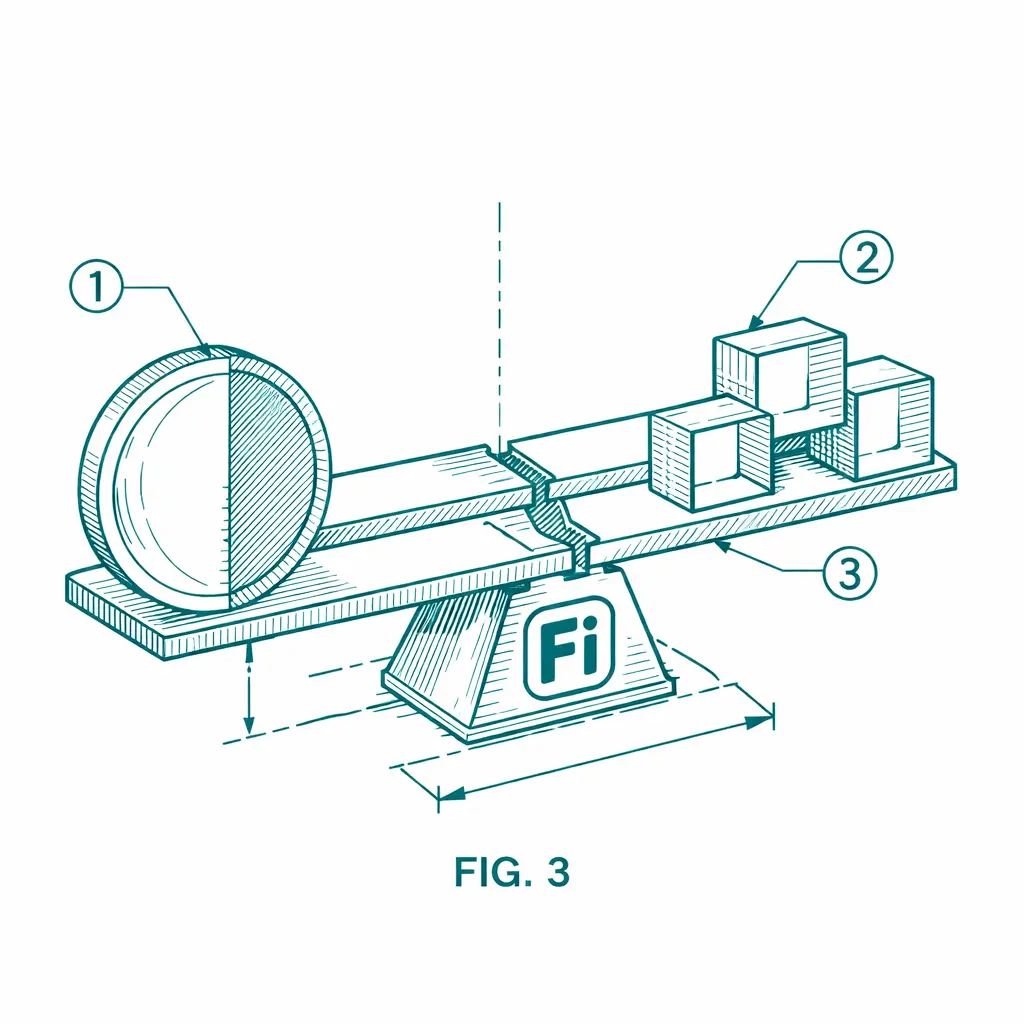
The right question is therefore not “inflationary or deflationary?” The right question is “what minimum issuance is required to secure the network, and what sink can remove surplus tokens without concentrating control?” Everything else is secondary.
Inflation is useful only when it buys distributed security
Inflation is justified when it pays for behaviors that make the system harder to capture. Cosmos SDK’s mint module is a clean example of an adaptive approach: inflation is recalculated each block, targets a 67% bonded ratio on Cosmos Hub, and is capped between 7% and 20%. The mechanism increases inflation when the bonded ratio falls below target and decreases it when staking rises above target. That is not anti-holder by default. It is a programmable attempt to keep enough stake online to secure the chain while preserving some token liquidity.
Solana’s staking documentation says inflation began at 8% annually, decreases by 15% year over year, and converges to a long-run rate of 1.5%. The same docs also state that validator votes are stake-weighted, meaning more delegated stake gives a validator more influence over consensus. That combination is analytically important: emissions are not neutral if reward flows simply compound the voting weight of already dominant operators.
That is where many token designs fail. They model inflation as if all validators were interchangeable. They are not. If rewards scale linearly into the largest operators, the network may become better funded and less decentralized at the same time. A decentralization-first design should ask three questions before setting emissions: how many independent validators can operate profitably, how widely is stake distributed across them, and how much voting power can the largest few entities accumulate through compounding?
Ethereum’s reward curve shows one way to reduce overpayment. Ethereum’s rewards documentation notes that total issuance rises with the number of validators, but only with the square root of validator count, while reward per validator falls correspondingly. That is a reminder that “pay enough for security” does not mean “pay a fixed headline APY forever.” Smart inflation responds to participation. Dumb inflation subsidizes passive capital.
Inflation is healthiest when it is narrow, conditional, and decentralization-aware. It should be conditional on security participation, narrow enough to avoid chronic overpayment, and paired with distribution rules that do not turn every epoch into a compounding machine for the largest stake pools.
Deflation works when the sink is tied to real usage or real surplus
Deflationary tokenomics is strongest when tokens are removed by a rule that is difficult for insiders to fake. Ethereum’s EIP-1559 is the benchmark example. The base fee is burned, validators keep only the priority fee, and the EIP explicitly argues that not paying the base fee to block producers removes their incentive to manipulate the fee mechanism. The result is a sink tied directly to actual blockspace demand rather than to a treasury committee’s buyback schedule.
Ethereum’s supply is therefore intentionally variable. The protocol can be inflationary when issuance exceeds burn and deflationary when burn exceeds issuance. That is a better framing than treating deflation as a permanent badge of quality. The system is really doing something more useful: it lets network usage absorb part of the security budget.
Solana uses a mixed version of the same idea. Solana’s fee structure documentation states that the base fee is currently 5,000 lamports per signature, with 50% burned and 50% paid to the block-producing validator, while 100% of the priority fee goes to the validator. That is not fully neutral like Ethereum’s base-fee burn, but it still creates a usage-linked supply sink rather than relying only on scheduled issuance decay.
Maker offers a different but equally important lesson. Maker’s auction docs describe a symmetric design: surplus Dai can be auctioned for MKR and burned, while bad debt can trigger debt auctions that mint new MKR to recapitalize the system. That is a serious token economy design because the burn is linked to actual surplus and the inflation backstop is explicit. Deflation without a recapitalization path is often theater. Maker at least states the reverse gear openly.
A burn mechanism deserves skepticism when it depends on discretionary treasury timing, opaque off-chain revenue, or governance actors who can easily pause, accelerate, or redirect the sink. A burn mechanism deserves more trust when it is automatic, usage-linked, and bounded by protocol rules.
Governance design determines whether monetary policy is decentralized
Supply mechanics are only as decentralized as the process that can change them. Cosmos makes this especially visible. The Cosmos SDK documentation says mint parameters can be updated by governance or by the address with authority, and the Cosmos Hub governance docs set explicit participation and passage rules rather than hiding them behind a foundation multisig. Current Hub documentation describes a 40% quorum, a pass threshold above 50% of participating voting power, and a veto threshold around 33.4%.
That matters because an adaptive inflation model is not inherently decentralized. If a small coalition can repeatedly retune mint parameters, the network has not solved monetary policy. It has only moved it on-chain. The same applies to burn systems. Maker’s docs state that MKR governance voters determine surplus thresholds, debt limits, and other auction risk parameters. That does not invalidate the model. It does mean the monetary policy is governance-dependent rather than purely autonomous.
A decentralization purist should care less about whether a whitepaper says “progressive decentralization” and more about whether the monetary levers are already constrained by measurable rules. Good rules include narrow parameter ranges, delayed execution, transparent quorum requirements, and clear authority boundaries. Bad rules include open-ended admin keys, vague emergency powers, and treasury discretion over buybacks or validator subsidies.
The core trade-off is operational coordination versus distributed control. Faster coordination can rescue a system during stress. It can also centralize the right to redefine winners and losers through token supply changes. If the inflation or burn dial can be moved quickly by a handful of insiders, the token may be scarce on paper and centralized in practice.
What different token models actually optimize
| Model | Issuance side | Deflation side | What it optimizes | Main structural risk |
|---|---|---|---|---|
| Bitcoin | Declining block subsidy that eventually yields to fees | No protocol burn | High monetary credibility and minimal discretionary tuning | Long-run security budget becomes fee-dependent |
| Ethereum | PoS issuance that varies with validator participation | Base fee burn under EIP-1559 | Lower issuance plus a usage-linked sink | Supply becomes variable and harder to narrate as a simple cap |
| Cosmos Hub-style adaptive inflation | Inflation moves with bonded ratio, bounded by 7% to 20% and targeting 67% bonded | No native burn in the mint model | Security responsiveness and staking participation | Dilution can persist even after security needs stabilize |
| Solana mixed model | Disinflation from 8% toward 1.5% | 50% of base fee burned | Bootstrapped security with partial usage-linked offset | Stake-weighted voting can reinforce validator concentration |
| Maker balance-sheet model | MKR can be minted in debt auctions | MKR can be burned in surplus auctions | Supply responds to realized surplus or realized losses | Key parameters remain governance-controlled |
A practical framework for balancing inflationary and deflationary tokenomics
Set a security floor first. Estimate the minimum annual budget needed for an independently distributed validator set, not the marketing APY needed to excite speculators. If the budget only supports a small cartel of professional operators, the network is under-decentralized even if the chain remains live.
Make issuance respond to security variables, not token price. Bonded ratio, active stake, validator participation, and slashable capital are better control inputs than market cap. Cosmos and Ethereum both show that issuance can adapt to participation conditions rather than remaining fixed forever.
Use burns that are hard to game. EIP-1559’s base-fee burn is compelling because it is automatic and specifically avoids paying the fee component most prone to manipulation back to block producers. Usage-linked burns are generally more credible than boardroom buybacks.
Keep a reverse gear. Maker’s surplus-burn and debt-mint symmetry is worth studying because it recognizes that real protocols face losses, not just upside. A system that can only burn but never recapitalize is usually pretending its downside does not exist.
Reward dispersion, not just stake size. In stake-weighted systems, emissions can consolidate control unless delegation, commission, and validator-selection incentives are designed to spread stake across many operators. Solana’s own staking docs make clear that more delegated stake means more influence. That should shape reward design.
Constrain the governance surface area. If mint and burn parameters are changeable, define who can change them, how often, within what bounds, and under what quorum. Cosmos exposes this issue directly. Systems that leave the authority vague are not balanced. They are discretionary.
What usually works in practice
Early-stage networks usually need some inflation. They rarely need an aggressive burn. When validator economics are still fragile, deflationary signaling often does more harm than good because it underfunds security while pretending scarcity is a substitute for adoption. In that phase, moderate and declining issuance paired with strict unlock discipline and decentralization-aware reward routing is usually the cleaner design.
Mature general-purpose chains can justify lower net issuance when transaction demand is real and persistent. Ethereum shows why this works: once a network has meaningful fee demand and a more capital-efficient consensus design, part of the security budget can be carried by users through burned fees instead of by perpetual dilution.
Balance-sheet protocols should often avoid one-way narratives entirely. Maker’s model is more intellectually honest than most “deflationary governance token” stories because it ties contraction to actual surplus and expansion to actual insolvency pressure. When a protocol has revenues, liabilities, and liquidation mechanics, symmetric tokenomics is usually stronger than permanent-burn theater.
At FinDaS Tokenomics, we usually frame this as a control-system problem inside token economy design, not as a choice between two ideological camps. The best tokenomics design does not maximize scarcity or maximize emissions. It minimizes avoidable dilution, funds security at the lowest credible cost, and keeps the right to change monetary policy as broadly distributed as the protocol can realistically sustain.
If a team has to choose one bias, it should bias toward decentralization of authority rather than toward either inflation or deflation. Inflation can be reduced over time. Burn rates can be tuned. Governance capture is much harder to unwind once the supply policy itself has become another instrument of concentrated control.