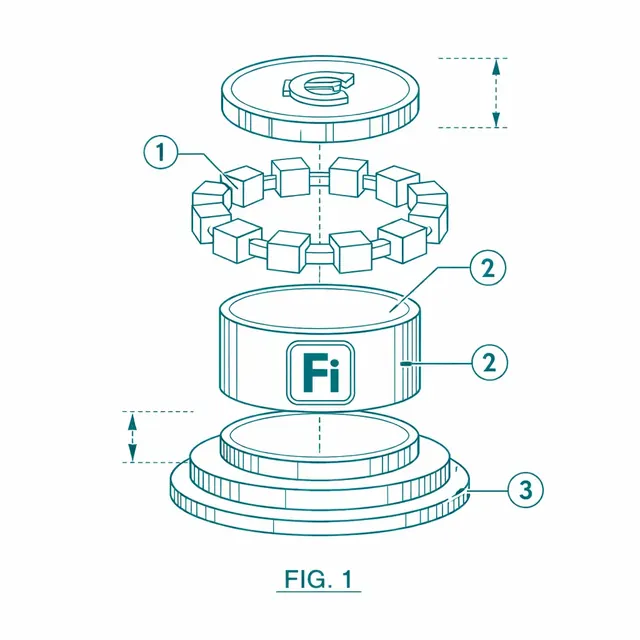
The wrong vesting schedule does not just create sell pressure. It creates a control problem.
Optimal vesting is not a stock answer like “1-year cliff, 3-year linear.” Optimal means the schedule is long enough to keep insiders economically aligned, smooth enough to avoid repeated supply shocks, and constrained enough that operators cannot rewrite the deal when conditions change. For Web3 teams, that last point matters more than most token decks admit. A vesting schedule loses credibility fast if the same insiders also retain broad upgrade rights, admin privileges, or governance power over the contracts that enforce it.
The best public evidence on unlock design is directionally clear, not mathematically complete. In a dataset covering more than 5,000 unlocks across 20 protocols, 6th Man Ventures found that unlocks below 1% of circulating supply had no meaningful relationship to price impact, while larger unlocks showed a negative relationship between unlock size and price. The same research also found that large cliffs create stronger negative price behavior around the event, and it explicitly says there is no reliable way to infer a single globally “optimal” vest length over long horizons because too many outside factors dominate.
That leads to a practical definition. Optimal vesting is a constrained emissions design problem. The first constraint is market absorption. The second is contributor retention. The third is governance credibility. If a schedule solves the first two while failing the third, it is still weak token economy design.
Start with the only threshold that has real evidence behind it
The cleanest empirical rule available today is to keep private unlock events below 1% of circulating supply whenever possible. That does not guarantee price stability, but it is one of the few thresholds with public evidence behind it. The same study argues that daily or weekly unlocks are usually better than quarterly or annual step-ups because they distribute sell pressure instead of concentrating it into a single narrative event.
That finding has an immediate design consequence. A one-year cliff does not need to mean a one-day dump. If legal, exchange, or commercial constraints require a 12-month non-transfer period, the better structure is usually zero liquid unlock during the first year, then linear release beginning at month 13. That preserves the no-transfer objective without releasing 25% to 33% of an insider allocation on one date. 6th Man Ventures makes this point directly when discussing large cliffs and U.S. compliance constraints.
Teams should model this against circulating supply, not total supply. A 50 million token unlock can be trivial for a mature token and destabilizing for a low-float launch. Many 2022-2025 token launches made this mistake by focusing on fully diluted percentages while ignoring the much smaller live float that actually clears in the market.
My base recommendation is simple. Before setting any insider vesting dates, build a month-by-month table of circulating supply, projected treasury emissions, staking issuance, and insider unlocks. If any single month pushes private unlocks above 1% of expected circulating supply, redesign the cadence first. Do not treat vesting as a legal appendix.
What major networks actually did
Public benchmarks do not give a universal answer, but they do show a range. The broad pattern is a 12-month no-transfer period followed by multi-year release, with most mature schedules stretching team exposure to roughly 3 to 4 years from launch. Investor treatment is less consistent. Some networks align investors and contributors. Others let investors vest faster. That inconsistency is one reason market participants price unlock risk so aggressively.
| Network | Team / contributor schedule | Investor schedule | Design implication |
|---|---|---|---|
| Aptos | Core contributors are under a 4-year lock-up from mainnet launch on October 12, 2022, with no APT in the first 12 months, then heavier monthly unlocks in months 13-18, then monthly unlocks through year 4. | Investors follow the same 4-year schedule. | Strong alignment between team and investors. Cadence is smoother than a single cliff dump. |
| Celestia | Initial core contributors receive 33.33% at year 1, with the remaining 66.67% unlocking continuously from year 1 to year 3. | Seed and Series A&B backers also receive 33.33% at year 1, but the remainder unlocks continuously only from year 1 to year 2. | Investors vest faster than contributors. That can be defendable for early capital formation, but it raises narrative risk. |
| Starknet | Early contributors account for 20.04% of supply. Together with investors, they unlock monthly: up to 0.64% of total supply each month from April 15, 2024 to March 15, 2025, then up to 1.27% each month from April 15, 2025 to March 15, 2027. | Investors account for 18.17% and share that same lock-up schedule. | Good cadence discipline. The schedule is explicit and monthly, which reduces step-function shocks. |
| Arbitrum | Team and advisors vest over 4 years with monthly unlocks from March 23, 2023 to March 23, 2027, after a 1-year cliff. | Investors follow the same 4-year, 1-year-cliff monthly schedule. | Equal treatment improves fairness optics, but the initial cliff still creates a major narrative focal point. |
The benchmark table points to a defensible default. For teams, 48 months total exposure with a 12-month no-transfer period and monthly linear release thereafter is still the cleanest base case. For investors, 24 to 48 months total exposure is the realistic market range, but anything materially faster than the team should need a hard justification.
The evidence is mixed, not one-sided. Aptos aligned investors and contributors on a four-year schedule, while Celestia let investors vest faster than core contributors. My read is that faster investor vesting may help fundraising, but it weakens long-horizon accountability unless those investors are taking on real strategic obligations that extend beyond capital.
Team vesting should be long, smooth, and difficult to override
Team vesting exists to align labor with long-duration execution risk. That sounds obvious. The less obvious point is that team schedules should also minimize opportunities for management discretion. A schedule that can be accelerated, waived, or amended by a small internal group is not strong alignment. It is conditional alignment.
The best team schedules usually have five properties.
- A real no-transfer period. Twelve months is still the cleanest default for early-stage protocols.
- Smooth post-cliff vesting. Monthly is acceptable. Weekly is better when infrastructure permits.
- Long enough total duration. Four years from TGE or mainnet launch remains the most credible default.
- Minimal acceleration. Broad acceleration rights convert vesting into a board-controlled bonus pool.
- Hard onchain enforcement. If a small multisig can rewrite the schedule, market participants will price that option.
There is also a governance point that founders often miss. Long economic lock-up does not automatically mean long political lock-up. Starknet explicitly allows voting with locked tokens. Arbitrum’s governance audit also showed that its vesting wallet design allowed the beneficiary to delegate and cast votes with vested tokens, and Trail of Bits flagged access-control issues around the release logic.
That means the real question is not only “when do insiders become liquid?” It is also “when do insiders become powerful?” If locked team tokens can vote, delegate, or influence upgrades from day one, then a long vesting schedule may reduce sell pressure while doing almost nothing to limit governance concentration.
For governance tokens, the cleanest structure is often to separate economic vesting from governance activation. If that is not feasible, at least disclose the control path plainly: who can vote, who can delegate, who can upgrade, and who can cancel.
Investor vesting should reflect role, not just round
Investor vesting is where most token economies quietly lose credibility. Teams often copy venture norms from equity, then bolt them onto liquid token markets that behave very differently. Tokens are not private shares. They trade continuously, they coordinate public expectations, and their unlock calendars become community events.
The core rule is straightforward. Purely financial capital should not receive a more flexible schedule than labor capital. If investors vest faster than the team, the burden of proof should be on the issuer. Sometimes there is a good reason. A strategic market maker, major distribution partner, or ecosystem investor with hard performance obligations may deserve custom timing. But custom timing should be tied to objective milestones, not operator judgment.
I would split investors into three buckets.
- Seed and pre-seed financial investors. Use the longest schedules. These holders bought the most uncertainty and usually need the least special treatment after launch.
- Strategic investors with operating obligations. Time-based vesting can be combined with milestone gates, but milestones must be narrow and auditable.
- Late-stage crossover or treasury investors. Shorter schedules can be justified if the network is already mature and float is deep enough to absorb them.
The market examples above support the range, not a single answer. Aptos treats investors and contributors symmetrically over four years. Celestia releases investors faster than contributors. Starknet uses a shared monthly schedule for both early contributors and investors.
My default is still conservative. Investors should usually face a 12-month no-transfer period and then linear release over 24 to 36 months, unless the project is already post-product-market-fit and circulating float is large. That is not a market law. It is a structural risk preference.
Locked tokens can still leak liquidity and control
Many “locked” schedules leak in two places: staking rewards and transferable claims.
Celestia is a useful example. Its docs state that all tokens, locked or unlocked, may be staked, and that rewards are unlocked upon receipt and added to circulating supply. That is not inherently wrong, but it means the effective liquidity profile is looser than the headline vesting chart suggests. If a project lets insiders stake locked principal while immediately realizing liquid rewards, the emissions model needs to count that as part of insider sellable supply.
Transferability is the second leak. OpenZeppelin’s VestingWallet documentation states plainly that the wallet is ownable and ownership can be transferred, which means unvested tokens can in practice be sold. In other words, “locked” is not always the same as “economically non-transferable.” If the beneficiary can sell the wallet or beneficial claim, the market may still treat the position as monetizable.
This is why vesting design cannot be separated from access control. OpenZeppelin’s TimelockController docs warn that extra proposers and cancelers are risky, that the admin role should ultimately sit with the timelock itself, and that extra governance actors can cancel approved operations or otherwise interfere with the process. If a vesting system is upgradeable, role-heavy, or cancellable by a narrow group, then the real schedule is partly offchain politics.
Arbitrum is a strong reminder of the broader issue. L2BEAT notes that Arbitrum DAO upgrades face meaningful delay, but the Security Council can upgrade the contracts without delay and can cancel upgrades initiated by the DAO. That trade-off may be pragmatic for system safety. It is still concentrated authority. The same logic applies to vesting. Rapid intervention can be useful in emergencies, but it weakens the credibility of any promised emission path unless the scope is narrow and visibly constrained.
A practical vesting framework for founders and token designers
The most defensible default for early-stage networks is below. It will not fit every launch, but it is a better starting point than copying the last successful token in your sector.
| Parameter | Team default | Investor default | Why |
|---|---|---|---|
| No-transfer period | 12 months | 12 months for early rounds | Prevents immediate post-launch monetization and reduces narrative overhang. |
| Post-cliff cadence | Weekly or monthly linear | Weekly or monthly linear | Smoother unlocks are easier for the market to absorb than quarterly or annual cliffs. |
| Total duration | 48 months | 24-36 months, longer for seed | Matches the execution horizon of early protocol building better than short schedules. |
| Single-event unlock cap | Keep under 1% of circulating supply | Keep under 1% of circulating supply | This is the clearest public threshold with empirical support. |
| Voting rights while locked | Prefer no direct voting, or disclose explicitly | Prefer no direct voting, or disclose explicitly | Locked tokens can still carry governance power. |
| Staking rewards on locked principal | Re-lock rewards or model them as circulating leakage | Same | Otherwise the true liquid supply grows faster than the vesting chart implies. |
| Admin and upgrade control | Immutable if possible, otherwise timelocked and role-minimized | Same | Operator discretion is itself a tokenomic risk. |
At FinDaS Tokenomics, this is how we frame vesting in token economy design work. Vesting is not an isolated HR mechanic. It sits inside the emissions model, the governance model, and the contract permission model at the same time. If those three layers are designed separately, founders usually end up with a schedule that looks disciplined in a chart and behaves opportunistically in practice.
The strongest schedules therefore share one final trait. They are boring. They do not depend on side letters. They do not rely on multisig goodwill. They do not hide liquid staking rewards behind a “locked” label. They do not pretend that a long vesting tail solves insider control while admin keys remain concentrated. In Web3, the optimal schedule is the one the market can actually believe.