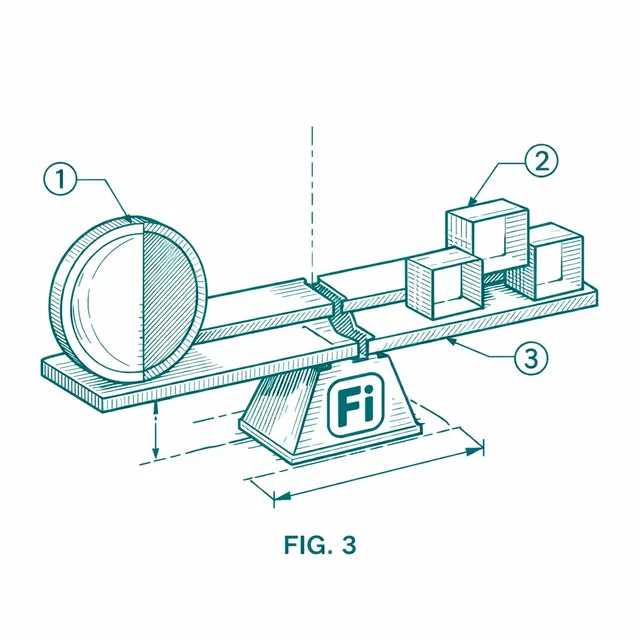
A dual-token economy is easiest to launch when most users can ignore one of the two tokens. That is the recurring pattern in production systems. Neo separates governance from fees through NEO and GAS. VeChain separates reserve value from transaction fuel through VET and VTHO. Maker separates a transactional stablecoin, DAI, from a governance token, MKR. The common success factor is not novelty. It is clean role separation.
User confusion starts when the second token is doing too many jobs at once. A token that is simultaneously described as utility, governance, rewards, treasury exposure, and yield is not simplifying the economy. It is exporting internal token design trade-offs into the user experience. In practice, that also increases legal exposure, because the more explicit the claims on fees, rewards, or governance-controlled distributions become, the harder it is to maintain a purely “utility” framing across jurisdictions.
Role separation is the product
A dual-token system works when each token has one primary user promise. Neo states the split directly: NEO is for governance and GAS is for payment. VeChain makes the same separation in a different form: VET is the value-transfer or reserve token and VTHO is the transaction-cost token. Maker does it again with a stable asset for use and a governance token for policy. Users can build a mental model around that. “Which token do I use?” and “which token do I govern with?” are different questions, and that is precisely why the architecture is legible.
The opposite design is a category error. If token B is required for governance, receives protocol surplus, can be staked for rewards, unlocks treasury influence, and is also marketed as a medium of exchange, users will not know whether to spend it, hold it, or value it like a financial claim. Frax’s documentation is unusually clear on this point: FXS is the non-stable governance token, surplus protocol income is distributed to locked veFXS holders, and in the current model FXS is no longer needed to mint FRAX. That is a useful lesson. Once a token starts carrying policy rights and economic upside, treat it as a specialized instrument, not as generic utility.
The first launch document should therefore be a role map, not an emissions chart. Write one sentence for token A and one sentence for token B. If either sentence needs the words governance, rewards, discounts, staking, liquidity incentives, and treasury in the same breath, the split is still too blurry. From a token economy design perspective, the job is not to maximize token count. The job is to minimize overlap between promises.
Choose an archetype users already understand
Most workable dual-token launches fit one of a small number of archetypes. The safest approach is to pick one archetype and stay inside it. Confusion usually appears when teams combine two archetypes without admitting it, such as launching a gas token model that also behaves like a revenue-sharing governance wrapper.
| Archetype | Example | User-facing logic | Main confusion risk |
|---|---|---|---|
| Governance + gas | NEO/GAS. NEO governs and votes. GAS pays fees. Neo’s initial N3 distribution of generated GAS sends 80% to voters, 10% to holders, and 10% to committee and consensus nodes. | Most users only need to know that GAS is spent when they transact. | Do not force ordinary users to learn validator incentive math just to use the product. |
| Reserve/value token + transaction-cost token | VET/VTHO. VeChain says the model separates transaction costs from speculation and improves cost predictability. Its developer docs also state that developers must manage both VET and VTHO. | Enterprises care about stable operating costs. End users should not have to manually balance both assets. | If both balances are surfaced equally, the fee abstraction benefit disappears. |
| Stablecoin + governance backstop | DAI/MKR. Maker describes DAI as the collateral-backed stablecoin and MKR as the governance token. Surplus DAI from stability fees can be auctioned for MKR, which is then burned. | Use the stable asset. Hold the governance asset only if you want policy exposure. | Users may mistake governance-token upside for a claim that is simpler or safer than it is. |
| Stablecoin + governance/revenue token | FRAX/FXS. Frax states that FXS is the volatile governance token, that surplus protocol income is distributed to locked veFXS holders, and that FXS is no longer needed to mint FRAX in the current model. | The transactional asset and the value-accrual asset are distinct. | Revenue-participation language pushes the governance token closer to an investment-style user expectation. |
| Governance token + high-velocity reward token | AXS/SLP. Axie says AXS is the governance token, that AXS stakers can claim rewards, and that the community treasury receives 4.25% of marketplace transactions plus the AXS portion of breeding fees. SLP is earned in play and consumed in breeding, with SLP cost per parent rising from 900 on the first breed to 15,300 on the seventh. | One token captures ownership and governance. The other token handles repetitive in-product activity. | Players can confuse the “earning token” with the “ownership token” unless the UI keeps them separate. |
The useful pattern across these examples is not that two tokens are inherently better. It is that the second token exists to separate incompatible economic jobs. A stable asset should not absorb governance volatility. A gas asset should not be your main reserve narrative. A gameplay reward token should not be mistaken for the treasury-governed asset. When teams respect that boundary, users learn faster and disclosures become easier to keep consistent.
Design the interface so most users only meet one token
The protocol may need two assets. The end user usually should not. VeChain’s own docs describe a real trade-off here: the benefit of VET/VTHO is more predictable transaction costs, but the implication is that developers must manage both tokens. That is the right way to think about UX. If the team gets operational flexibility from the split, the team should absorb as much of that complexity as possible in the interface, treasury, relayer, or smart-account layer.
Neo shows how abstraction helps. NEO holders receive GAS for holding and more for voting, but GAS is claimed automatically when the native NEO contract is invoked, including transfers and governance actions. Under the hood, the distribution logic is not simple. On the surface, the user story still is. NEO governs. GAS pays. That is exactly the level of detail most users need.
A launch UI for a dual-token economy should therefore follow a strict rule set.
- Only one token should appear in the primary onboarding path.
- Every balance should carry a functional label, not just a ticker.
- Token B should be introduced at the moment of need, not on the landing page.
- If token B is generated automatically, claimed automatically, or subsidized by the protocol, say that plainly.
- If token B is only for governance, remove it from spend flows.
- If token B is only for fees, remove it from brand marketing.
Interface clarity is not just conversion optimization. It is also a legal control. Sky’s user-risk documentation explicitly warns users to interact through the official interface, and its legal terms make clear that reward mechanisms, reward rates, and eligibility can change, are not guaranteed, and may be unavailable in select jurisdictions including the U.S. When token logic is complex, the interface becomes part of the disclosure perimeter.
Treat yield, revenue share, and governance as legal design variables
The fastest way to confuse users is to describe token B as “utility” while marketing it with equity-like language. Frax says FXS is the volatile governance token, that surplus protocol income is distributed to locked veFXS holders, and that FXS is no longer needed to mint FRAX in the current model. Axie says AXS stakers can claim rewards and that treasury inflows include marketplace fees and breeding-fee flows. Sky’s legal terms describe multiple reward-generating contracts, governance-set reward rates, and jurisdiction-specific access restrictions. Those are not neutral details. They are the economic center of the token story.
That matters because classification pressure now arrives earlier in the product cycle. In the EU, MiCA has applied to asset-referenced tokens and e-money tokens since June 30, 2024 and to the broader crypto-asset regime since December 30, 2024. MiCA distinguishes e-money tokens, asset-referenced tokens, and other crypto-assets, and requires public-offer white papers for crypto-assets outside the ART and EMT categories. On December 10, 2024, the ESAs published joint classification guidelines with a standardized test and templates for explaining why a token falls into a given category. “It’s just utility” is no longer a sufficient internal slogan. The classification memo needs to match the actual mechanics.
In the U.S., recent SEC staff statements reduced uncertainty for certain narrow staking fact patterns, not for every dual-token model. On May 29, 2025, the Division of Corporation Finance issued its statement on certain protocol staking activities tied to covered network assets. On August 5, 2025, it issued a statement on certain liquid staking activities, again depending on facts and circumstances. That is materially narrower than a second token that exists to carry discretionary APR, governance-controlled rewards, treasury exposure, or surplus participation. If your tokenomics design turns token B into the place where economic upside accumulates, market participants will read it that way even if the homepage still says “utility.”
A practical compliance rule follows from that. If token B gets any of the following, disclose it as a core function rather than a side effect: fee rebates, treasury rights, protocol surplus, governance over reward rates, jurisdiction-gated rewards, or variable yields. If those features are important enough to sell the token, they are important enough to anchor the classification analysis. The trade-off is simple. More design flexibility usually means more legal exposure.
Launch in phases instead of shipping both narratives at once
Simultaneous launches create two markets before users have learned one product. A phased launch reduces that education debt. The first phase should prove token A’s core job with live utility. The second phase should introduce token B only when its exclusive function is already active onchain. The third phase can widen liquidity, emissions, or governance only after dashboards, docs, and eligibility rules are stable.
Production systems often drift toward simplification for exactly this reason. Frax’s current model removed the need for FXS in FRAX minting and delegated that function to AMOs. Neo automated common GAS claiming behavior rather than making holders perform a separate ritual for ordinary use. Both examples point in the same direction: once a role split is valid, the next job is to reduce how often average users must think about the split. New launches should start from that discipline instead of discovering it after confusion sets in.
- Launch token A with one visible utility and one visible metric.
- Keep token B off the critical path until its role is live and documentable.
- Delay “rewards” messaging until the legal treatment and regional availability are fixed.
- Publish one chart showing sources of token demand, sources of token supply, and who actually needs each token.
- Remove any feature from token B that is not essential to its role.
A working decision rule for founders
A dual-token economy is ready for launch only when 80% of users can complete the primary product flow while understanding just one token. That is the cleanest operating threshold. If your model fails that test, the second token is still an internal optimization masquerading as a public asset.
In tokenomics design work at FinDaS Tokenomics, the highest-leverage exercise is usually not emission tuning. It is deciding which promises belong in which token and which promises should not be tokenized at all. If one token handles usage and another handles governance, the split can work. If one token handles usage while the other quietly accumulates fee exposure, reward discretion, and jurisdiction-specific yield features, the design is already telling users two different stories.
- Can each token be defined in under 20 words without overlap?
- Can a new user succeed with token A alone?
- Does token B have any claim on fees, surplus, or treasury decisions?
- Are any rewards variable, governance-controlled, or region-restricted?
- Would your MiCA classification memo and your marketing copy describe the token the same way?
- If token B were delayed by six months, would the core product still work?
If the last answer is yes, delay token B. The cleanest dual-token launch is usually the one that waits until the second token has a function users can recognize immediately and regulators can classify without interpretive gymnastics.