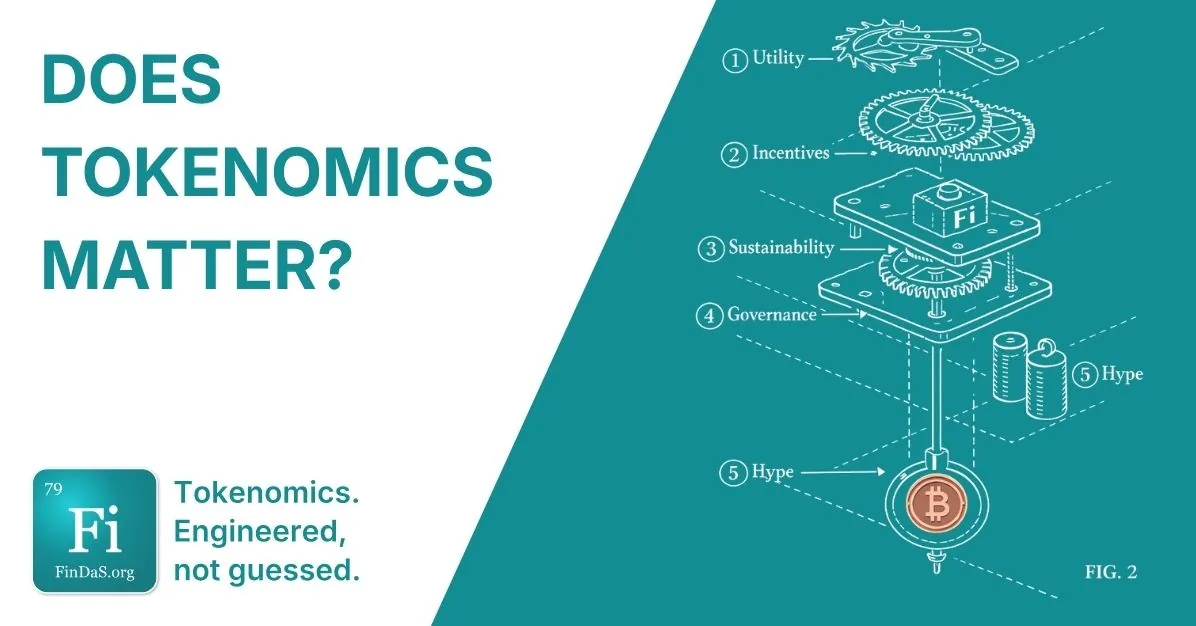
Tokenomics does not matter in the first year of a token's life. Community, hype, and narrative drive price at launch, which is why memecoins with copy-pasted allocations can succeed without any real economic design. Tokenomics starts to matter once the hype fades and the market switches from voting on narrative to weighing fundamentals. Utility, emission controls, and sustainable incentives are what keep a token functional after the initial wave of buyers has sold. The catch is that fixing weak tokenomics later is expensive: some changes require a full token relaunch, and even a redesign inside the same token has hard limits when allocations are already distributed and contracts are immutable.
When tokenomics does not matter (and it is fine)
Almost every founder I talk to eventually asks some version of this question: "Can I just launch without having tokenomics designed by a professional?" The question is not absurd. Scroll through any launchpad and most allocations look indistinguishable from one another, and plenty of those tokens still post a green first week.
There are two clean cases where tokenomics does not matter at launch. The first is when the goal is raising money at TGE and nothing beyond. The second is when the project has no fundamental value drivers, which in practice means memecoins. In both cases, copy-pasting allocations and vesting from a recent successful project is a defensible move. Nobody holding a memecoin bought it because of the vesting cliff.
The underlying math is blunt. Chainplay studied 30,000 memecoins on Solana, Ethereum, and Base in 2024 and found 97% of them dead. CoinGecko put the memecoin market at $150B in December 2024 and $47B by November 2025, roughly a 70% collapse in under a year. Pump.fun's graduation rate, the share of tokens that make it out of the incubator into a real DEX listing, has been under 1% since February 2025. In that environment, copy-paste is rational when the time horizon is short enough that nothing past TGE matters. Professional tokenomics for a token with a one-year median lifespan is mispriced effort.
Benjamin Graham has the cleanest framing: "In the short run, the market is a voting machine, but in the long run, it is a weighing machine." In year one of a token's life, the market votes on community, narrative, and timing. It does not weigh the tokenomics. The parts of tokenomics design that do the real work are the ones the market starts weighing once the voting winds down.
What actually drives token price in year one
What drives price in year one is the same thing that drives any early-stage asset: who is paying attention, why, and how loud the attention is. Community, narrative, and hype do most of the work. This is consistent across crypto and early-stage traditional venture.
A seed-stage VC decision does not hinge on the five-year DCF. It hinges on the team, the vision, the narrative, and current market conditions. Token launches play out similarly. I have watched projects with excellent tokenomics fall flat because nobody was talking about them, and projects with mediocre tokenomics moon because the community showed up at the right time.
The first year of a token's life is usually the most turbulent. Price moves are dominated by attention flows, not by fundamentals. The memecoin market dropping 70% in under a year tracks almost exactly with attention flowing elsewhere, not with any shift in the underlying emissions curves. If tokenomics were the load-bearing factor at that stage, the drop would not have been that clean.
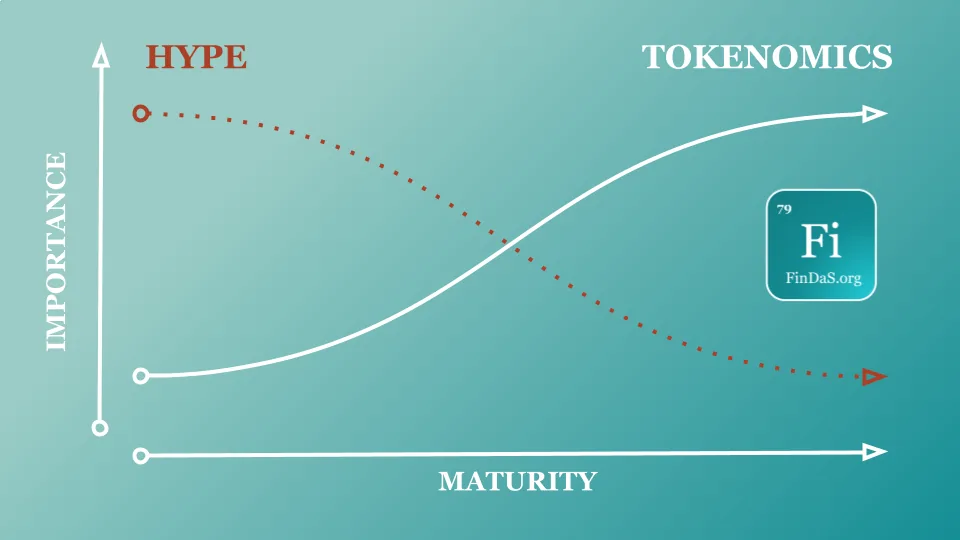
What tokenomics gives a project in year one is a story: a vesting schedule that signals alignment, an allocation that signals fairness, a supply curve that reads as conservative. These are useful, but they are not load-bearing. The load-bearing work happens once the weighing machine starts.
Why tokenomics matters once the hype fades
Year two is when Graham's weighing machine starts running. The question the market was voting on ("does this project feel alive?") gets replaced with something harder: does this token capture value from the project's actual activity? This is where approaches to token valuation start mattering, and where most DIY designs start showing their seams.
The first thing the weighing machine checks is utility. Does the token have a reason to exist inside the system beyond being tradeable? Gas, staking, governance with real decision rights, access to a product that people would pay for anyway. If the answer is "it is how we raised money," the weighing machine will not be kind. I have seen utility bolted on after the fact and it rarely convinces the holders, because the token already trained them to think of it as a ticker, not as a tool.
The second is emissions. How much new supply hits the market each month, and what is buying it back? A project that emits 5% of supply annually to reward providers and has no demand sink matching that emission is running a treadmill downhill. It is the most common failure mode I see on projects that did their own tokenomics. It is also the most expensive to fix, because cutting emissions mid-flight breaks the incentives for everyone already staking.
The third is incentive alignment. Are holders rewarded for behaviors that grow the ecosystem, or for behaviors that extract from it? A staking program paying 40% APY funded entirely by new emissions is extractive by construction. Uniswap's UNIfication proposal, passed in December 2025 and followed by a 100M UNI burn, is the opposite move: after years of debate, the protocol finally turned on the fee switch and started routing swap revenue to token holders. Getting alignment right at TGE is much cheaper than retrofitting it four years later under contested governance.
"Getting alignment right at TGE is much cheaper than retrofitting it four years later under contested governance."
The standard long-term case for tokenomics reads as "utility, scalability, sustainability", three words swappable into any whitepaper and meaning nothing in particular. The practical question is always the same: when the TGE buyers start selling, is there anyone on the other side who wants the token for a reason that is not "it might go up"?
The hidden cost of fixing it later
Projects that did their own tokenomics and reached the weighing-machine phase often find the model is not sustainable and needs a redesign. "Launch fast, fix later" sounds reasonable at TGE. The later-fix has two modes, and both cost more than the original design would have.
The first mode is redesign without a new token. This works when the needed change fits inside what governance can vote on: adjusting emissions, turning on a fee switch, updating staking rewards, rebalancing a burn mechanism. Uniswap's UNIfication is the cleanest recent example. In December 2025, after years of debate, the community finally voted to flip the protocol fee switch. 100M UNI burned in the initial action, the ticker stayed, and UNI holders started receiving actual swap revenue.
The limit on in-place redesign is how much of the system is already frozen. If allocations are distributed, you cannot take them back. If the vesting contract is immutable, you cannot extend it. If the supply cap is a hard constant, you cannot move it. A lot of what makes tokenomics weak in year two is exactly the stuff the contracts have locked in forever, which forces the second mode.
The second mode is issuing a new token and running a migration. Polygon did this in September 2024, swapping MATIC for POL at 1:1, with 99% of MATIC migrated by September 2025. Technically it worked. The non-technical costs were harder. POL has fallen roughly 40% since the migration began and sits about 89% below its all-time high. In November 2025, Polygon's co-founder started publicly asking whether they should reverse the ticker back to MATIC because retail users in emerging markets recognized the old name and did not recognize POL. Two years of ecosystem work on an "upgraded" token, and the founding team is considering rolling back the brand.
That is what a token relaunch actually costs: not the engineering, but the market having to re-learn the asset. The cost of launching a token in the first place is front-of-mind for every founder. The cost of launching it twice is almost never priced into the original decision. If the project has enough at stake that a two-year redesign sounds worse than a design review before TGE, we are happy to do that review before any contracts are locked in.
DIY vs a professional: when each is enough
The fair question is when founders actually need professional tokenomics help, and when they do not. I am not going to pretend the answer is always.
A calculator or template is probably enough in three cases:
- Memecoins with no utility layer
- Projects that will die inside a year either way and everyone involved knows it
- Founders with direct experience running a live token economy who understand both the design space and the implementation traps
In those cases, tokenomics templates cover the basics of supply, allocation, and vesting, and the work is done. Outside those cases, a template is covering maybe 20% of what matters. It handles supply and vesting. It does not handle emission-versus-demand balance for a specific use case, or how token velocity interacts with the fee mechanism, or whether the staking APY you picked is sustainable at your projected TVL. Those are judgment calls that depend on the specific project, and they are also the things the weighing machine checks first in year two.
FinDaS has worked on 300+ projects since launch. The patterns I rely on do not come out of a calculator. They come out of watching what breaks after TGE: which design choices looked fine on paper and became structural problems once live, which emissions schedules got renegotiated by the community under price pressure, which utility claims held up and which did not. Pattern-recognition of that kind is what a consultant is actually selling. If the project has enough at stake that a design mistake would cost more than the consultant costs, the math works. If it does not, copy a template and move on.
For founders still working out whether they even need a token, the step-by-step token launch guide covers the sequencing question first. Tokenomics is one step inside that sequence, not the whole thing. If the project's value proposition gets someone to pay for the product without a token in the loop, the fundamentals will benefit from tokenomics when the weighing machine starts. If the project is only interesting because of the token, tokenomics is not going to save it.
Frequently asked questions
01
How long is the "short term" where tokenomics does not matter?
+
02
Can I launch with copied tokenomics and redesign later without a token relaunch?
+
03
Do governance tokens need tokenomics work the same way utility tokens do?
+
04
If I use a tokenomics calculator or template, what am I actually missing?
+