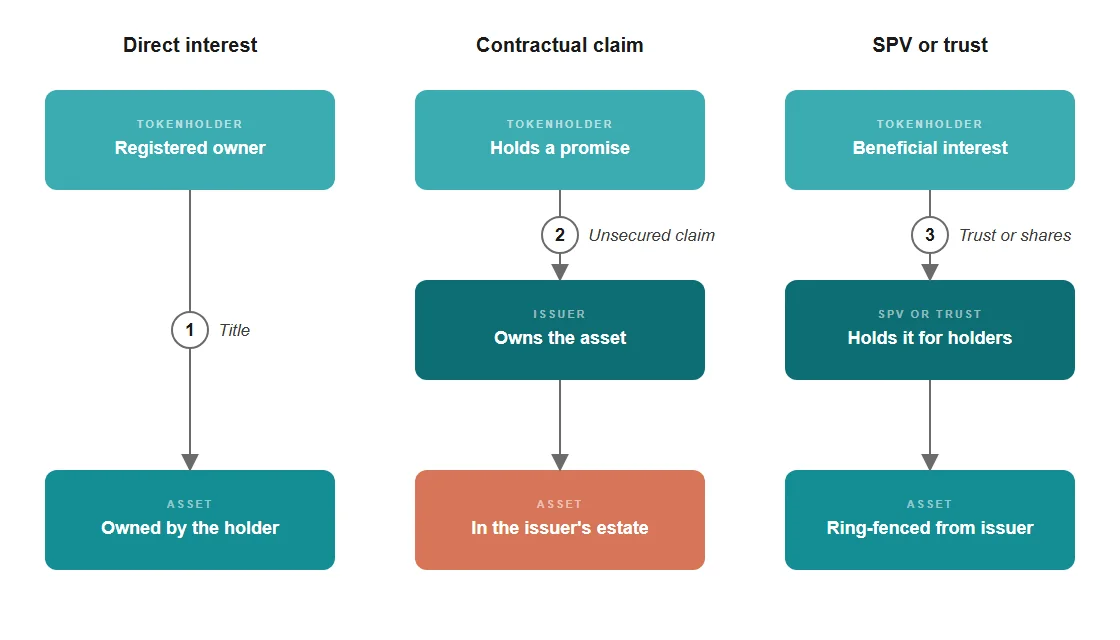
An RWA token is a record. What the holder owns is set by the documents behind it, and there are three common answers: the asset itself, a claim against the issuer, or an interest in an SPV or trust that holds the asset for the holders. The three look identical in a wallet and stop looking identical the day the issuer fails. A direct owner, or the beneficiary of a ring-fenced trust, gets the asset back; the holder of a plain contractual claim joins the queue of unsecured creditors. The smart contract does not move a holder from one group to the other.
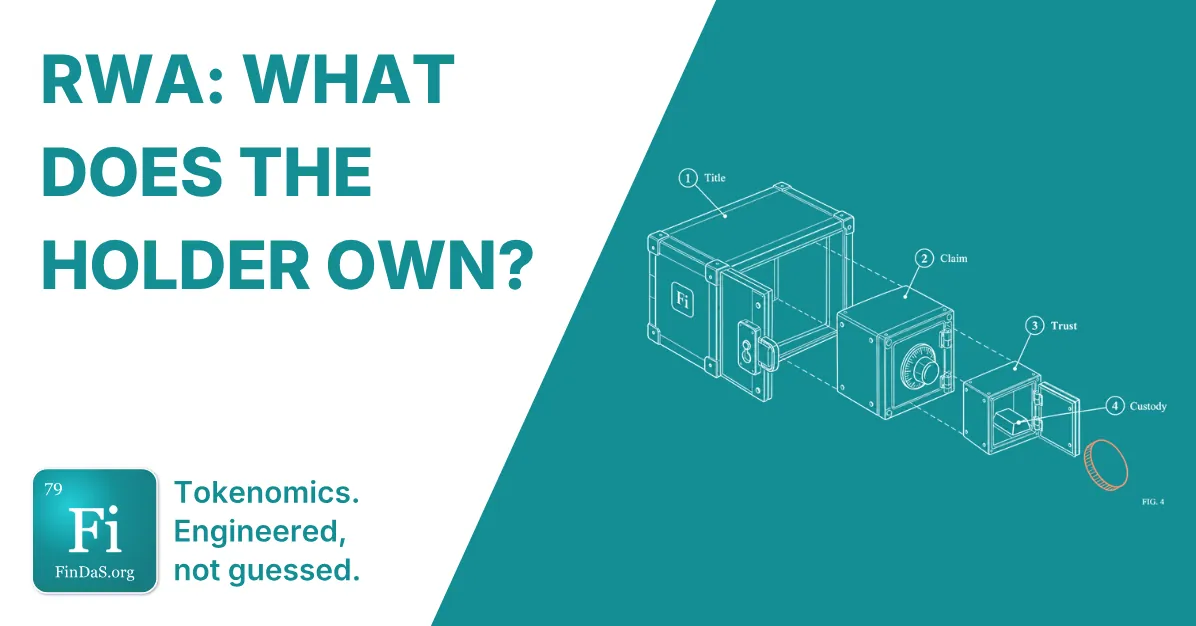
The token is a record, the documents are the right
Every RWA token comes with two things: a balance in a wallet and a stack of documents. The balance is what everyone looks at. The documents (a prospectus, a fund's articles, a trust deed, the terms of use) are what a court reads, and they are the only place that says what the holder actually owns.
Most of the time nobody reads them, and most of the time it does not matter. It matters at two moments: when a holder tries to redeem, and when somebody in the chain fails. Those two moments are what the structure exists for.
Whether an asset should be tokenized at all is the subject of the first part of this series. If the answer is yes, the first design decision is the legal claim, because every later one (what one token represents, how redemption works, what sits in the reserve) is built on top of it.
Three things a token can be a claim on
Strip away the vocabulary and an RWA token is one of three things.
Direct interest. The token is the asset, or the official record of who owns it. A fund unit, a share or a bond put on-chain by its own issuer falls here. BlackRock's BUIDL is an example: the tokens are shares of BlackRock USD Institutional Digital Liquidity Fund Ltd., a British Virgin Islands fund, with Securitize as transfer agent and BNY Mellon as custodian and administrator.
Contractual claim. The issuer owns the asset, and the token is the issuer's promise to pay you what the asset is worth, deliver it, or track its price. You are the issuer's creditor. Robinhood's EU stock tokens are this kind: its terms describe them as derivative contracts with Robinhood Europe that carry no right to the underlying shares, and OpenAI said in July 2025 that the "OpenAI tokens" were not OpenAI equity. A contractual claim can also be secured. Backed's xStocks are tracker certificates issued by a Jersey company, backed one-to-one by shares held with regulated custodians in segregated accounts, and an independent security agent can take and sell that collateral for holders if the issuer defaults. Holders are still creditors, but secured ones, with first call on those shares.
SPV or trust. A separate legal entity, set up for this one purpose, holds the asset, and the holders own that entity or are the beneficiaries of the trust. The sponsor that set it up can fail without the asset becoming part of its estate, which is the whole point. This is what most RWA projects mean by "bankruptcy-remote", and it only works if the documents and the day-to-day operation both keep the asset apart.
The claim also decides which cash flows a holder has. In Morning Line Club, investors hold interests in a fund that owns the horses, and two share types give two different claims on the same animal: one on racing income, one on breeding and the foals it produces.
Which record wins: the chain or the register
For a security there is almost always an official record of who owns it: a share register, a transfer agent's books, a fund administrator's file. The chain can be that record, or it can mirror it. The difference matters the first time the two disagree, because a court reads the official record, not the block explorer.
It also explains features that surprise crypto-native buyers. Permissioned token standards such as ERC-3643, which Dravanti's instruments use, give the issuer's agent functions to freeze an address, force a transfer to another verified holder, and recover tokens to a new wallet when an investor loses a key. To a DeFi user that looks like a backdoor. To a transfer agent it is an ordinary Tuesday: a court order, a death, a lost key or a sanctions hit all require the register to move without the holder signing anything.
If the token is the official record, those functions are how the register does its job. If it only mirrors an off-chain register, the off-chain one wins, and the token is a convenience copy of it.
When someone else tokenizes the asset
Many tokens are issued by someone other than the asset's issuer: a broker tokenizing listed shares, a platform wrapping a fund it does not manage. SEC staff split these cases in January 2026: securities tokenized by or for their own issuer on one side, and third-party tokens on the other, either custodial (a third party holds the security and the token represents an entitlement to it) or synthetic (a tokenized linked security or security-based swap). A third-party token, in the staff's words, "may or may not" give the holder any rights of a holder of the underlying security, and it exposes the holder to the third party, including its bankruptcy.
For the holder the question is who the counterparty is. With an issuer-sponsored token it is the issuer, the same as for the untokenized security. With a custodial token it is the custodian, and the custody terms decide whether the shares are held for you or are simply the custodian's. With a synthetic token it is whoever wrote the contract, and the issuer of the reference asset owes you nothing, which is roughly what OpenAI told the holders of tokens named after it.
What happens when the issuer fails
Insolvency is where the three structures stop looking alike. The question a court asks is whose property the asset is, and it answers from the documents.
The clearest recent lesson comes from a crypto lender. On 4 January 2023, Chief Judge Martin Glenn ruled in Celsius Network's bankruptcy that the coins in its Earn accounts (some 600,000 accounts, about $4.2 billion) belonged to Celsius, because its terms of use, which he found unambiguous, transferred ownership when customers deposited them. Customers who thought they owned their coins were unsecured creditors. The terms had been public the whole time.
For one class of token, lawmakers have since written the ring-fence into law. The US GENIUS Act takes a payment stablecoin issuer's required reserves out of its bankruptcy estate, gives holders priority in those reserves over the issuer's other creditors, and bars the reserves from being pledged or rehypothecated. MiCA requires the reserve behind an asset-referenced token to be legally segregated from the issuer's estate, so that the issuer's creditors have no recourse to it in insolvency, and held by a custodian that is a different legal person from the issuer. Outside those regimes, the protection is whatever the documents and the structure provide.
An SPV only protects holders if it stays separate in practice: its own bank accounts, no commingled assets, independent directors or a trustee, and someone appointed to keep running it (redemptions, reporting, paying the custodian) after the sponsor is gone. A bankruptcy-remote vehicle with nobody left to operate it keeps the asset safe and the holders waiting.
Commodities: allocated or unallocated
Precious metals settled this question long before tokens. In the LBMA's terms, metal in an allocated account is specific, physically segregated bars to which the client has full title, held by the dealer as custodian. Metal in an unallocated account is a general entitlement, and the holder is an unsecured creditor of the dealer.
A commodity token inherits the split. Paxos's terms describe each PAXG as one fine troy ounce of London Good Delivery gold held for holders on a segregated basis, compare the token to a warehouse receipt for a share of allocated gold, and keep every token mapped to serial-numbered bars. That puts PAXG on the allocated side, with two details worth knowing: a holder owns a pro rata share of a bar unless they hold a whole one, and physical bars are delivered only from 430 PAXG upwards. A token backed by a share of an unallocated pool, or by an issuer's promise to deliver, sits on the other side, whatever its website says.
Dravanti shows a version of the same split inside one project. Its spot commodity token is a fixed quantity of one grade (one token is one gram of 99.9998% copper powder), minted only against certified reserves and redeemable against the metal itself. Its basket token is a security with a proportional claim on a managed pool of metals that do not share a grade. One issuer, two different answers to what the holder owns (the Dravanti case study has the design).
Seven questions that tell you what a token is
Before buying, structuring or advising on an RWA token, answer these from the documents rather than the website:
- Who is the issuer, and under which law is it set up?
- Who holds the asset: the issuer, a custodian, an SPV or a trust?
- Is the asset segregated, and from whose creditors?
- Which record is the official one, and who keeps it?
- Who can redeem, for what (cash or the asset itself), and on what notice?
- What does a holder get if the issuer fails, and if the custodian fails?
- Which law governs the documents, and where would a dispute be heard?
None of these is a token question. They are the questions your lawyers will ask anyway (and this article is not legal advice), and their answers set what the token is worth.
If the claim is clear
Once the claim is settled, the next decision is what one token represents: a fixed quantity, a share of a pool, a grade. Until the series closes with its 101, our overview of RWA tokenomics covers the ground at a higher level.
- Should you tokenize that asset?: the business case, which comes before the legal one.
- RWA tokenomics: the overview of claims, redemption and classification this series builds on.
- Dravanti: one issuer, two instruments, two different claims.
- Morning Line Club: one horse, two share types, two sets of cash flows.
- Tokenization of assets in the contemporary financial system: our review of a paper setting out four ways a token can be tied to its asset, from direct title to under-collateralized.
- MiCA-ready whitepapers: our service for token structures that will be classified and offered in the EU.
Frequently asked questions
01Does owning an RWA token mean owning the asset?
+
02What happens to RWA tokens if the issuer goes bankrupt?
+
03Is a tokenized stock the same as owning the share?
+
04What is a bankruptcy-remote SPV?
+
05Can an issuer freeze or move my RWA tokens?
+