Three handoffs break most tokenomics between the design phase and the listing: VC term sheets that erase the vesting schedule, ARR forecasts inflated to chase competitor FDV claims, and advisors who push for bigger insider allocations and faster unlocks. The token that goes to market is usually not the token the spreadsheet described. The remedies are boring: defend the vesting, anchor the projections, and publish the unlock schedule.
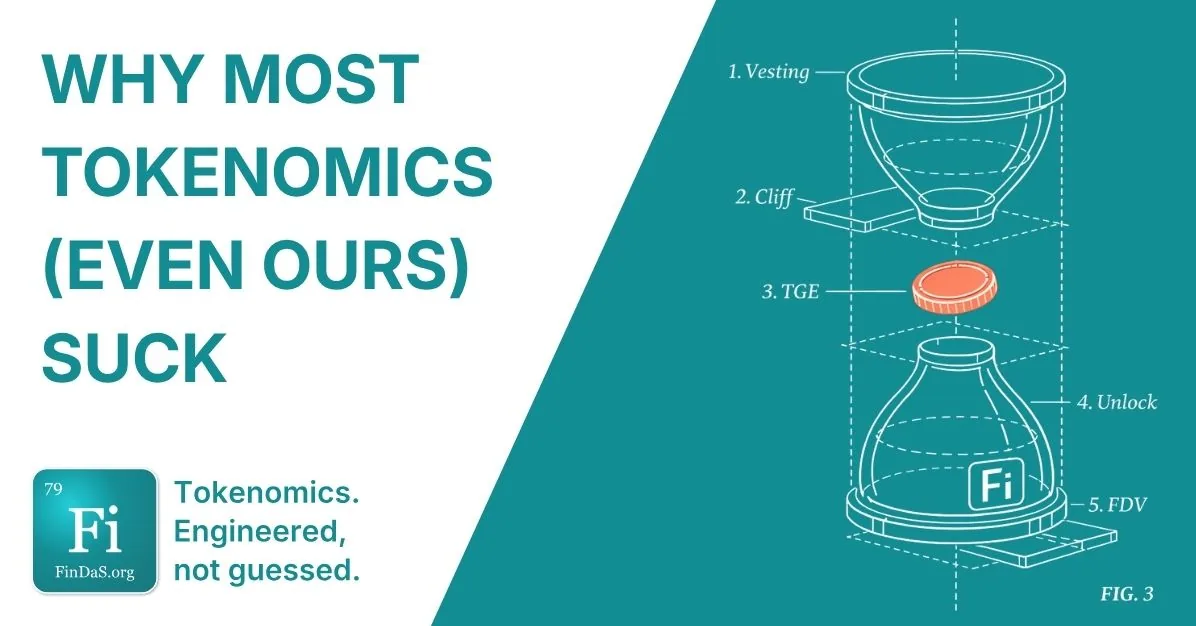
Most tokenomics look sound at the design stage. You see a reasonable float, a one-year cliff followed by three-year linear vesting, inflation curves tied to network usage, and a community allocation big enough to matter. The version that actually gets to market is usually a different animal. Somewhere between the founder's spreadsheet and the token generation event, three forces pull the design apart: venture capital term sheets, inflated financial projections, and advisors chasing the last cycle's billion-dollar comparable. I have watched variants of this play out across 300+ projects, including our own.
VC term sheets quietly erase the vesting schedule
The pressure shows up in the term sheet. Crypto VCs, especially funds late in their cycle with underperforming LPs, are incentivised to get liquidity fast. They ask for zero cliffs, immediate linear vesting, 5 to 10 times discounts against the public round, and tranche OTC structures that let them exit before the chart settles. Some will say it plainly behind closed doors: break even at TGE day one, hold anything left over as upside. In practice, that means day-one dump.
Founders face a forced choice. Agree to terms that bake in short-term sell pressure, or walk away from the round. Most projects cave, because the alternative is no fundraise at all. The term sheet wins, the vesting schedule loses.
This is not one bad actor. It is a pattern the public market now sees plainly. Cobie's May 2024 post on private capture argued that most new launches are effectively uninvestable at market; Dragonfly's Haseeb Qureshi wrote a long counter-analysis; Binance publicly shifted its listing strategy toward smaller-cap projects. The structural pressure never left, it just got named.
The benchmark I would hold to: investors vest at least 2 to 3 years from TGE, with a minimum 6-month cliff, and no OTC carveouts. Team gets a 1-year cliff and 3 to 4 years linear. If your lead VC refuses that and has real leverage, you have a different problem than tokenomics.
Inflated projections turn into inflated FDV
The FDV math is simple: total supply multiplied by token price. When circulating supply is 5 to 10% of the total at launch, a small amount of buying pressure produces a price that, extrapolated to full supply, prints a very large number. That number becomes the pitch. If a comparable project claims $500M ARR at year 5, you are told by your VCs, your advisors, and your own team that you cannot list at a valuation that implies less.
So the projection inflates, 10x, 30x, 50x off a defensible base, and the FDV follows. Realistic valuation work gets replaced with reverse-engineered justifications for whatever headline number the pitch deck needs. The spreadsheet stops being a model and becomes a marketing artifact.
The public examples are everywhere now. Worldcoin lists with about $800M circulating market cap against a $34B FDV, roughly a 50x gap. Berachain (BERA) launched in February 2025 at a $1.4B market cap, touched a $2.7B FDV, and was down 63% from peak within weeks. Monad (MON) debuted in November 2025 at a $3.2B FDV on roughly 10% float.
None of these are outliers. A 2025 recap from Memento Research tracked 118 launches that year and found 84.7% trading below their TGE valuation, with a median drawdown of 71% on FDV and 67% on market cap. The pattern is not one bad quarter. It is a launch structure that produces forced sellers at scheduled unlock dates, into a market that never agreed with the original FDV to begin with.
Influencer advisors reshape the cap table
Advisors show up late in the process with the least accountability and the most persuasion. Often they are not experienced token designers. They are founders of projects that launched at a billion-dollar FDV in the last cycle, or influencers with a following that sounds useful for launch marketing.
The conversation goes the same way every time. Project X launched at $1B FDV and traded at $3 per token, the advisor says. You have the same narrative. Why would you list lower? Suddenly the team allocation expands, the advisor pool grows from 1% to 3% to 5%, the treasury gets bigger, the cliffs shorten. Each individual change sounds reasonable in the room. Added together, the tokenomics now produces more insider supply hitting the market faster, measured against a larger FDV claim.
The vetting test I use: has this advisor ever worked on a token that held real value past year two? Token designers who have seen their own advice play out at scale give you boring advice. Advisors whose portfolio is a list of projects that pumped and faded give you exciting advice. The exciting advice is usually what you are being sold. A good audit catches most of this at the term-sheet stage, not the unlock calendar, which is why we push projects toward a design-phase review before any serious paper is signed.
The standard path from clean design to broken launch
Put together, the forces produce a standard trajectory. I have watched variants of this play out too many times to call it anything other than the default path. The specific numbers change. The shape does not.
- Design. Clean vesting, reasonable float, proportional community allocation. The spreadsheet looks defensible.
- VC round. Investors push for zero or shortened cliffs, discounts, and OTC rights. Some of this gets baked in.
- Pitch prep. ARR projections inflate to match competitor claims. FDV expands to match the projections.
- Advisor influence. Team and advisor shares grow, cliffs shorten, community allocation absorbs the cuts.
- Launch. TGE prints the large FDV, early unlocks hit the market, retail is the exit liquidity.
The result shows up in the 84.7% figure above, not in individual projects. The structure produces it. Individual team intent does not matter much once the structure is in place.
Where a team has to hold the line
None of this is new. The playbook for avoiding it is also not new, which is part of why it is frustrating that it keeps happening. Five holds, in the order they tend to come up.
- Defend the vesting, especially for investors. Minimum 6-month cliff for investors, 2 to 3 years linear. Team gets a 1-year cliff and at least 3 years linear. If a VC will not take these terms, the capital costs more than it is worth.
- Anchor projections in usage, not comparables. Real user counts, real revenue, real cost structure. If the model needs 50x assumptions to justify the FDV, the FDV is wrong, not the model. The actual value drivers are easier to defend than comparables.
- Reject advisor-driven reallocation. Advisors exist to serve product-market fit and launch execution, not to retrofit the cap table to look like the last cycle's winners. If an advisor's first contribution is to push allocations upward, replace the advisor.
- Run simulations before the TGE. Monte Carlo models show where the token economy breaks under sell-pressure scenarios, unlock shocks, and demand slumps. Most of the hidden issues surface in the simulation, not in the spreadsheet.
- Publish the full unlock schedule. Not a summary. The actual calendar, every cohort, every tranche, in one document, before TGE. Transparency that arrives after the price starts slipping is not transparency.
An independent tokenomics audit does most of this in one pass. It will not agree with your VCs, your advisors, or your CFO on every point, which is the point. Teams that skip it save a line item on the budget and usually lose it back multiple times over at launch.
Tokenomics do not have to suck. The tokens that build community value rather than burn it tend to share a boring profile: long vesting enforced on everyone including insiders, projections tied to usage, a transparent unlock calendar, and advisors who have actually held a token through a full cycle. None of that is hard to do. It just has to be held through the three or four moments in the fundraise where the pressure to abandon it is highest.
Frequently Asked Questions
01How can a founder tell whether a VC is aligned with the project or positioned for a day-one dump?
+
02What does a reasonable FDV actually look like for a pre-launch project in 2026?
+
03Should advisors be paid out of the team pool or get their own allocation?
+
04If a team can only publish one thing for transparency, what should it be?
+