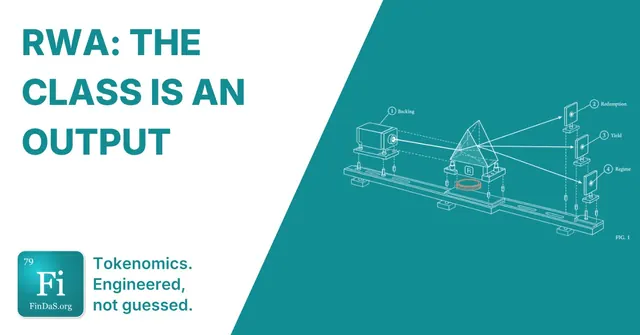
Tokenization changes how an asset is held, moved and used. It does not change who wants it. A token earns its cost when it makes an asset easier to distribute, faster to settle or usable as collateral for buyers who already want the exposure. It does not create liquidity: most tokenized real-world assets barely trade, and the ones that do, tokenized gold above all, had a deep market long before they had a token. Before any design work, test who would hold the token that cannot hold the asset today, why the asset is illiquid now, and whether the issuer's own P&L works at a size you can actually raise.
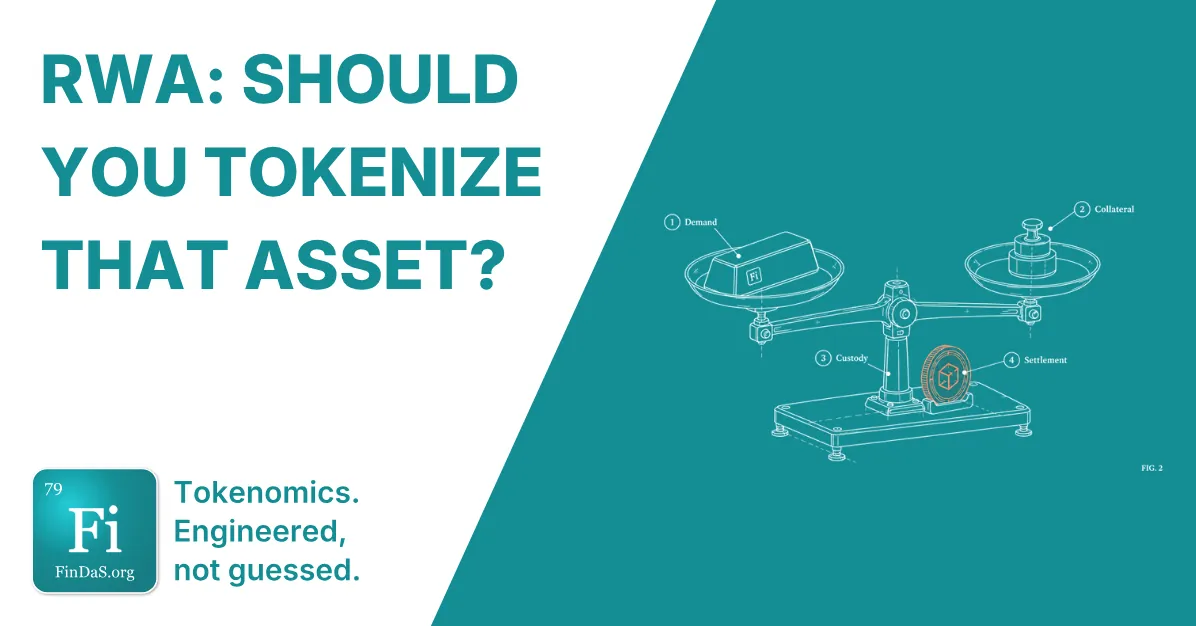
Almost anything can be tokenized
Almost anything can be tokenized. Treasury bills, private credit, gold, copper powder, rental houses, racehorses. Issuing a token against an asset is a solved technical problem, and it is cheap next to the legal, custody and audit work that sits around it. So "can we tokenize this?" is the wrong first question, and it is usually the first one asked.
A token is infrastructure. It moves value, it does not create it. Applied to real-world assets, the token inherits everything about the asset underneath (its yield, its risk, its legal restrictions and its buyers) and adds a few properties of its own. If the asset was hard to sell before, you now have a hard-to-sell asset with a smart contract attached.
The useful first question is whether the token changes something a buyer actually cares about.
What a token actually changes
Distribution. A token can reach holders the current wrapper cannot: smaller tickets, investors who keep everything in a wallet, other time zones, weekends. That is a real gain only if those holders want the asset and are allowed to buy it. Accreditation and offering rules travel with the asset onto the chain, so the reachable market of a tokenized private credit fund is the market of the fund, plus whoever already sits on-chain and qualifies.
Settlement. Transfers settle in minutes instead of days, payment and delivery can happen in the same transaction, and the register is the ledger, so there is less to reconcile. This matters in assets that change hands often and in size, and to whoever funds the gap while a trade is pending. A building valued once a quarter gains close to nothing from settling in a minute.
Collateral. An on-chain asset can be posted as margin, borrowed against in a lending protocol, or held in another protocol's reserve without a custodian moving it between accounts. SEC Commissioner Peirce named the collateral use as one of the things tokenization does well. It is probably also the main reason most tokenized treasury funds exist: on-chain dollars need somewhere to earn a yield that they can still post as collateral.
Operations. Distributions, corporate actions, transfer checks and the cap table can run in code. This is where most tokenization has happened so far. rwa.xyz counts $388.6 billion of "represented" assets, where the chain is only a record-keeping layer and investors cannot move the token themselves, against $38.7 billion that investors can subscribe to and hold directly on-chain (October 2026).
Notice who gets what. Settlement and collateral are gains for the holder. Distribution and operations are gains for the issuer. A business case that rests only on the issuer's two is a cost-saving project, which is fine, as long as nobody expects it to bring in new buyers.
The one thing it does not change: who wants the asset
The pitch that tokenization adds liquidity is everywhere, including in the academic literature: one paper we reviewed lists improved liquidity first among tokenization's benefits. The on-chain data does not support it.
Rischan Mafrur pulled one month of on-chain activity for the largest tokenized assets from rwa.xyz in mid-2025 (our review of the paper).
| Token | What it is | Holders | Monthly active addresses | Monthly transfers |
|---|---|---|---|---|
| BUIDL | BlackRock tokenized money market fund | 85 | 30 | 104 |
| JTRSY | Janus Henderson Anemoy treasury fund | 6 | 2 | 2 |
| BENJI | Franklin Templeton treasury fund | 890 | 3 | 0 |
| USDY | Ondo yield-bearing dollar token | 15,460 | 979 | 13,189 |
| XAUT | Tether gold | 9,407 | 2,735 | 23,897 |
| PAXG | Paxos gold | 69,164 | 5,678 | 52,140 |
Source: Mafrur (2025), Table 2, from rwa.xyz data, mid-2025.
BUIDL, then the largest tokenized real-world asset by market value, moved about $1.8 billion in those 104 transfers: a few institutions moving large blocks. An earlier study of 58 tokenized rental houses on the RealT platform, cited in the same paper, found that each token changed hands about once a year on average. The ones listed on Uniswap traded about 25% more, which is still almost nothing.
Gold is the exception, for reasons that predate the token. Gold has had a global market open to anyone for centuries. Anyone can buy PAXG or XAUT on an exchange, centralized or decentralized, while the treasury funds above are whitelisted to approved holders and are bought to be held. Neither gold token created its demand. Each gave demand that already existed a new place to sit.
Liquidity follows demand and access. The wrapper supplies neither.
Why is the asset illiquid today?
If the plan is to tokenize an illiquid asset to make it liquid, start by asking why it is illiquid. There are usually two answers, and a token fixes neither.
The first is legal. The asset is a security sold under an exemption, holders must be accredited, transfers need the issuer's approval, there is a lockup. Every one of these follows the asset onto the chain and comes back as a whitelist or an identity check on every transfer. Commissioner Peirce put it in five words: "Tokenized securities are still securities." SEC staff added in January 2026 that recording ownership on-chain rather than off-chain does not change how securities law applies. Mafrur found the same in the data: many RWA transfers need off-chain approval, which turns a nominally on-chain asset into a permissioned system with low turnover.
The second is demand. The asset is small, hard to value, or its yield does not pay for its risk. A token makes it easier to buy. It does not give anyone a reason to.
There is a narrower third case, and it is the one tokenization actually solves: buyers exist and want the asset, but the minimum ticket is too large, settlement is too slow, or the asset cannot be posted anywhere as collateral. If you can name those buyers, you have the start of a business case.
Four tests before any design work
Four questions to settle before anyone discusses token mechanics. They follow the same logic as the simple tests for whether you need a token at all: a token can improve a system, it cannot patch one.
- Who holds this asset today, and who would hold the token that cannot hold the asset now? Name them. "Global retail investors" is not a name. "Stablecoin treasuries looking for a yield they can still post as collateral" is.
- Does anyone holding this asset care about settlement speed or 24/7 transfer? If the asset reprices quarterly, the honest answer is no.
- Will anyone accept the token as collateral, and at what haircut? If no lending venue or counterparty will take it, the collateral argument is a hope.
- Does the issuer's P&L work at the size you can actually raise in year one?
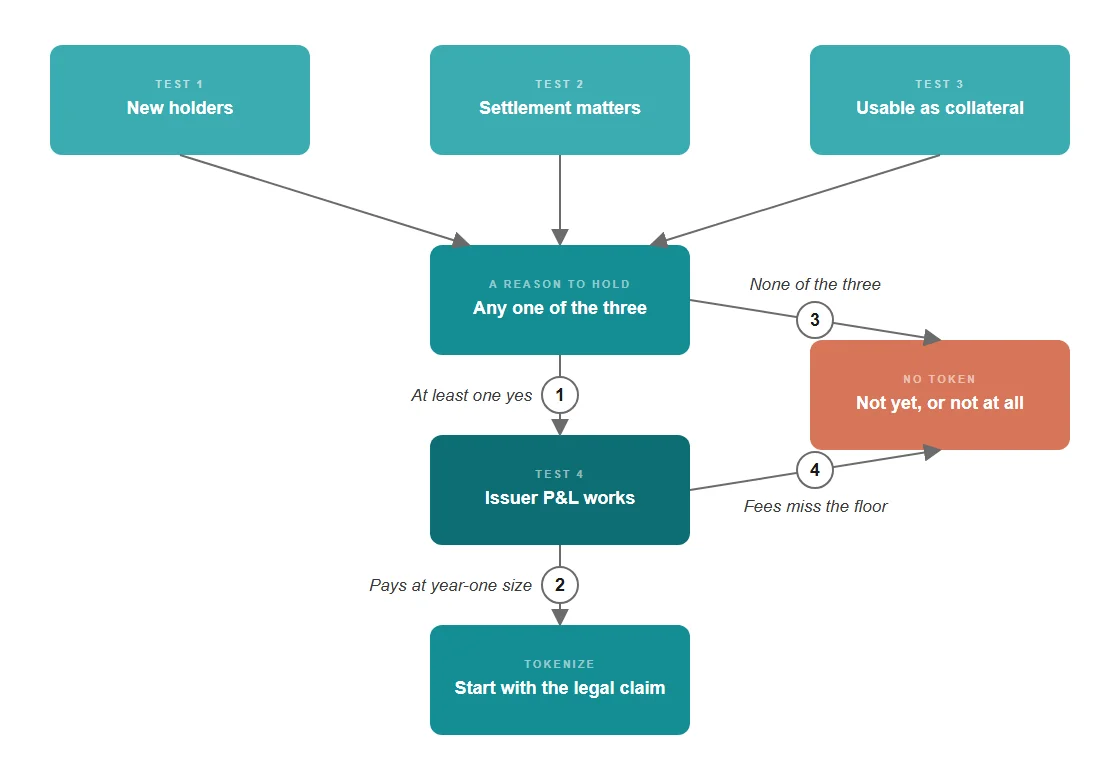
A no to all of the first three, or a no to the fourth, means the asset does not need a token, at least not yet. It may still be a perfectly good asset.
The issuer's P&L
Tokenizing an asset is a business, and it has a cost base before it has a single holder. A legal wrapper, usually an SPV, a trust or a fund. Legal opinions in every jurisdiction you sell into. A custodian for the asset, an administrator or transfer agent for the register, an auditor or attestation provider for the reserve. A price feed you can defend. Identity checks on every holder. Smart contracts and their audit. Someone to make a market, if you want one. Many of these have a floor, a minimum fee, a fixed retainer or a one-off build, and below a certain size the floors are the whole cost.
The revenue side is shorter. A management fee on assets, mint and redemption fees, the spread on whatever the reserve earns, and in some designs new tokens sold at or above the value of the asset behind them. Every one of these scales with assets under management. So there is a minimum size below which the fees cannot carry the fixed costs, and the first thing to establish is whether you will clear it.
Run it the way you would run any business plan: what the vehicle costs per year to keep alive, what it earns at the assets you can realistically raise in year one, and how many years the gap lasts (our token launch cost breakdown is the same exercise for a different product). If the plan only works at the size of the largest treasury funds on-chain, it does not work. And if the revenue is mostly the spread on a T-bill reserve, the plan carries a rate assumption, because that spread is worth a lot less when rates fall.
Dravanti: the brief was a token launch
Dravanti is a good example of the order these questions should come in. It is a liquidity provider: it buys high-purity industrial metal, starting with copper powder at 99.9998% purity, has it independently appraised and issues claims against it. It earns from redemption fees and from selling tokens at or above the value of the metal behind them.
It came to us with the industry default in mind, a high-value, low-float token launch. For this business a low float solves nothing. An asset-backed token's value has to come from the appraised metal, and engineered scarcity works directly against the one property such a token must have: a price that tracks what backs it. A utility token was also on the table, and I advised against it, because the business had no genuine utility case to hang one on.
What Dravanti needed was an instrument. We designed two: a spot commodity token, where one token is exactly one gram of one grade of copper powder, and a security token for a basket of metal holdings that do not share a grade (99.9% and 99.99% purity copper powder trade as different assets, so one token cannot stand for both). Most of the engagement went on choosing the instrument, which is where it should go. The Dravanti case study has the full design. Dravanti has since moved its platform to an equity-share structure on a Nasdaq central securities depository.
Where it already works
Three categories pass the tests today.
Fiat-backed stablecoins are the largest tokenized real-world asset that people actually hold and move: rwa.xyz counts USDT at $183.2 billion and USDC at $73.1 billion (October 2026). The demand for dollars was there long before any of these tokens, and holders get something a bank deposit does not give them: a dollar that moves at any hour and plugs into every protocol.
Tokenized treasury and money market funds serve on-chain dollars that want a yield they can still post as collateral. The holders are few and large, as the table shows, but the demand behind them is real.
Tokenized gold sits on a centuries-old global market and adds a version that settles on-chain and works in DeFi: Mafrur lists PAXG integrations with Aave and MakerDAO.
The shared feature is that demand existed first, and the holder gets something from the on-chain form that the old form did not give them. Private credit and real estate show the opposite pattern so far, bought and held and rarely traded, which fits the second answer to why an asset is illiquid.
If the answer is yes
Then the design starts, and the first decision is the legal claim. The decisions after it, in the order we take a client through them, are what the holder actually owns, what one token represents, how minting and redemption work, what sits in the reserve and who checks it, who keeps the yield, which regulatory regime the design lands in, why the secondary market is thin, and what happens when the backing falls short. Each gets its own article in this series. Until the series closes with its 101, our overview of RWA tokenomics covers the same ground at a higher level.
- RWA tokenomics: the overview of claims, redemption and classification this series builds on.
- What can a token do for your business?: the good and bad reasons to launch any token.
- What does it take to launch a token?: what a token launch costs, line by line.
- DEX vs. CEX and the role of market makers: what it takes to keep a market in a token once it exists.
- Dravanti: a commodity RWA structured for three regulators.
- REAL: an RWA chain that backstops counterparty losses on-chain.
- Tokenize Everything, But Can You Sell It?: our review of the liquidity study behind the table above.
Frequently asked questions
01Does tokenizing an asset make it more liquid?
+
02Do you need a token to sell an asset in small pieces?
+
03Does tokenizing an asset change how regulators treat it?
+
04Is tokenizing cheaper than a traditional fund or securitization?
+
05What is the smallest asset worth tokenizing?
+