An issuer does not pick its token's regulatory class. The design does: what backs the token, what a holder can redeem, who holds the reserve, whether a return reaches the holder, and what the marketing promises. Each regulator runs those facts through its own rules, so one structure can be an asset-referenced token under MiCA, an asset-referenced virtual asset in Dubai and a security in the United States. European, US and Singapore regulators all say they look past the issuer's label to what the token is and what was promised.
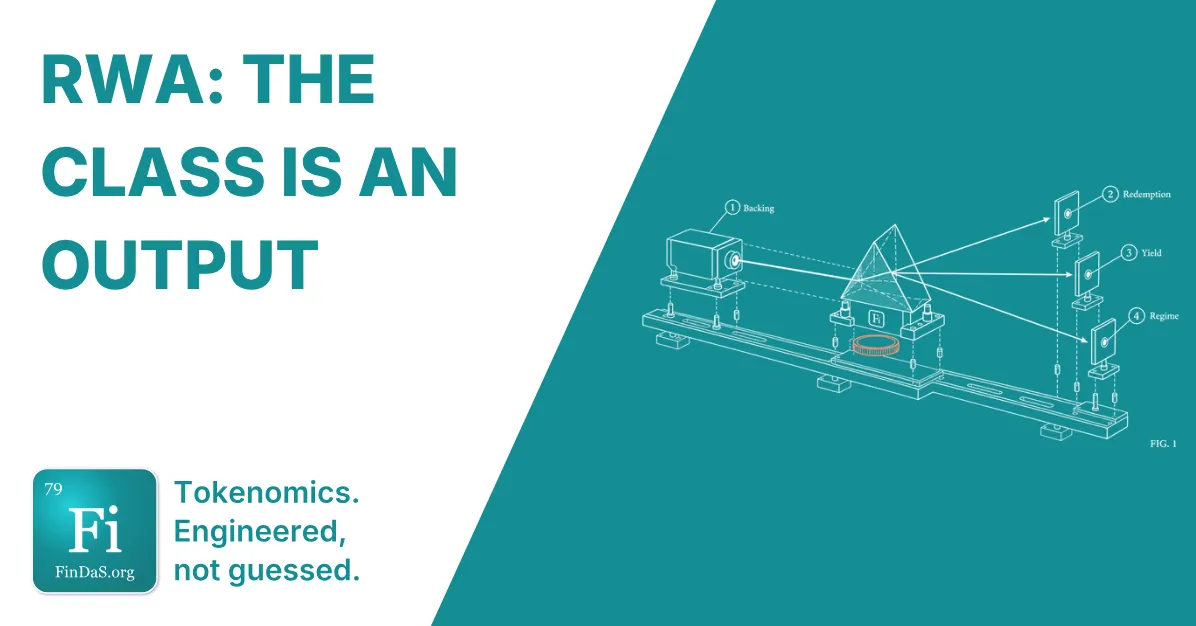
You do not choose the regime
Part 6.2 of Tokenomics is Easy listed what decides how an asset-backed token is treated: the jurisdiction, the backing structure, the redemption rights, the custody structure and the marketing. Same underlying asset, completely different regulatory interpretation.
The earlier parts of this series set those inputs one at a time. The legal claim, the unit, the redemption terms, the reserve and its custody and who keeps the yield are design decisions. The regulatory class is what comes out once they are made, and each regulator runs the same facts through its own rules.
How each regime sorts a token
MiCA sorts a token in a fixed order, and makes the issuer show its working. An applicant for an asset-referenced token must file a legal opinion that the token is neither outside MiCA nor an e-money token, and any other white paper must explain why the token is none of the three.
Is it a financial instrument?
Then MiCA does not apply and securities law does (Article 2(4)). ESMA's guidelines tell supervisors to put "a crypto-asset's inherent attributes over the labels provided by issuers", and a tokenised financial instrument stays a financial instrument.
Does it reference one official currency?
Then it is an e-money token, the class of a dollar or euro stablecoin.
Does it reference anything else?
Another value or right, a commodity, several currencies, or a combination of them: then it is an asset-referenced token, which is where the metals structure in the case below landed.
None of these?
Then it falls into MiCA's catch-all, the other crypto-assets of Title II, sold with a white paper notified to the regulator.
The US asks a different question. Under the Howey test a token sold as an investment contract is a security: money put into a common enterprise, with profits expected from the efforts of others. The SEC's interpretation of March 2026, issued with CFTC guidance and reviewed here, sorts crypto-assets into five categories (digital commodities, collectibles, tools, stablecoins and digital securities), says a buyer's expectation of profit depends on the issuer's representations or promises, and holds that "a security is a security" whether it is issued on-chain or off.
A token backed by metal does not fit its digital-commodity category, which is defined by a working crypto system, so the question for it is still whether it was sold as an investment contract; the metal itself is a commodity under the Commodity Exchange Act. Payment stablecoins from a permitted issuer will be excluded from both "security" and "commodity" once the GENIUS Act takes effect, by January 2027 at the latest.
Singapore, Hong Kong and Dubai write their own versions. Singapore's MAS treats a token as a capital markets product when it falls within the Securities and Futures Act, and its guide weighs the token's characteristics, intent, structure and rights, marketing materials included. Hong Kong's SFC calls tokenised securities "traditional securities with a tokenisation wrapper", and since 1 August 2025 issuing a fiat-referenced stablecoin there needs a licence. Dubai's VARA has a category of its own, the asset-referenced virtual asset: a token representing ownership of a real-world asset or a right to its income, under issuance rules in force since 19 June 2025 that require a licence and an approval for each token.
One structure, three readings
Our Dravanti engagement is the clearest example we can show. Dravanti, a liquidity provider, tokenizes reserves of high-purity industrial metals. The same structure read as an asset-referenced token under MiCA, as an asset-referenced virtual asset under Dubai's rules, and as a security in the United States. Nothing about the token changed between those readings; only the regulator did. Each reading carries its own obligations for issuance, marketing, custody and who may hold the token.
Change the design, change the class
The design moved the class as much as the map did. Copper powder of 99.9998% purity is one exact grade, so Dravanti's first instrument is a spot commodity token: one token is exactly one gram, minted only against certified reserves and redeemable for the metal. Its other holdings came in varying forms and grades, which no fixed-quantity token can represent, so they back a second instrument, a security token over a basket, issued by a valuation formula. Same company, same metal, two designs and two classes. That was the unit decision, and it settled the regulatory question too. The other inputs push the same way: a return paid to holders out of the issuer's efforts moves a token towards securities rules, which is why the yield is so tightly restricted, and pegging it to one currency makes it an e-money token under MiCA.
Marketing is an input too, and unlike the others it keeps changing after launch. The SEC's 2026 interpretation puts the issuer's promises at the centre of the investment-contract test, and lets a token leave it once those promises are kept or abandoned. Ripple shows it in a courtroom. In 2023 the court held that XRP sold to institutions under written contracts, and pitched to them as an investment tied to Ripple's own efforts, was sold as an investment contract, while XRP sold on exchanges in blind bid and ask trades was not. Both sides dropped their appeals in 2025, and the 2024 judgment, with its $125 million penalty, stands.
Compliance moves into the token
Once the class is known, its rules have to be enforced, and permissioned token standards do it inside the contract. ERC-3643, a final Ethereum standard, checks every transfer against an identity registry and a compliance contract and reverts if the receiver is not eligible; an agent can freeze wallets, force a transfer and recover the tokens of a holder who loses a key. BlackRock's BUIDL can be transferred only to pre-approved investors. A whitelist is the classification written into the token.
It also splits the market. Dravanti's instruments sit on ERC-3643 for verified holders, and a 1:1,000 ERC-20 wrapper carries the exposure to the open market, retail and DeFi. Two layers and two sets of holders, which is where the next part of this series, on liquidity, begins.
Questions that settle the class
- Where will the token be offered, and to whom? Each jurisdiction is a separate reading.
- Does the token reference one currency, a basket, a commodity, or a pool of securities?
- What can a holder redeem, at what price, and from whom?
- Does any return reach the holder, and from whose efforts?
- What do the website, the white paper and the sales deck promise?
- Who is allowed to hold the token, and does the contract enforce it?
- Has a lawyer in each target jurisdiction confirmed the class the design produces?
If the class is settled
The yield, the reserve, the primary market, the unit and the legal claim are the inputs, and the business case decides whether the token should exist at all. Until the series closes with its 101, our overview of RWA tokenomics covers the ground at a higher level.
- Dravanti: the case behind the figure: one structure, three readings, two instruments.
- Federal securities laws and crypto assets: our review of the SEC and CFTC's 2026 interpretation.
- MiCA-ready tokenomics: how the MiCA categories shape a white paper.
- RWA: Who keeps the yield?: the input most likely to move a token into securities rules.
- RWA tokenomics: the overview this series builds on.
Frequently asked questions
01Is an asset-backed token a security?
+
02What is the difference between an asset-referenced token and an e-money token?
+
03Can the same token have a different classification in different countries?
+
04Does marketing change a token's classification?
+
05What is ERC-3643?
+