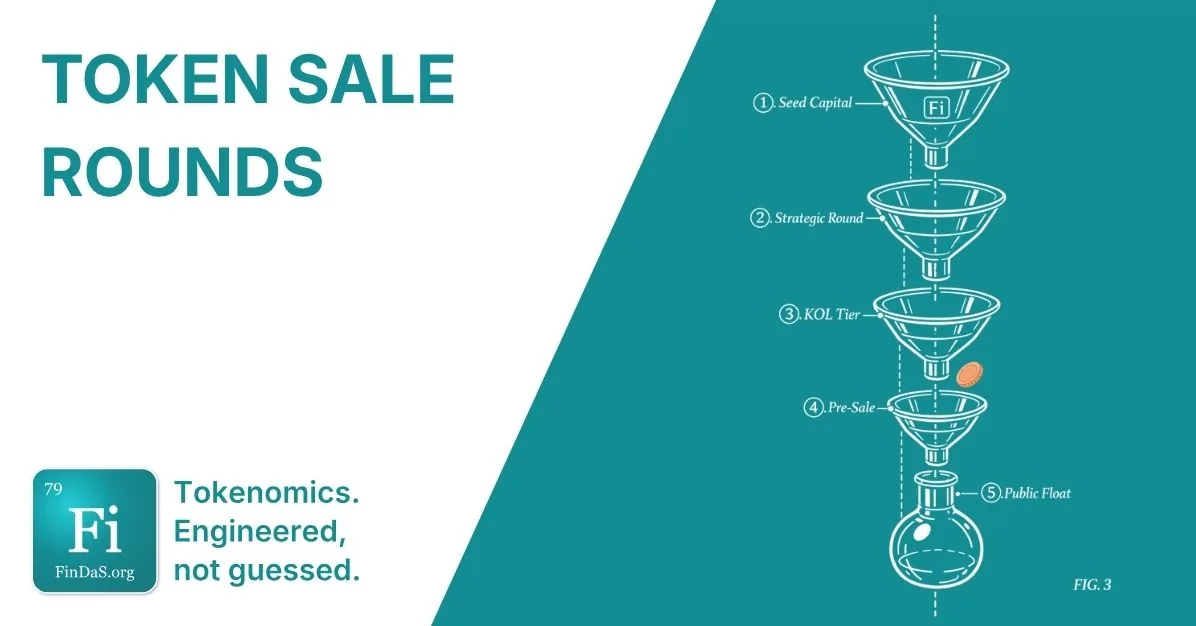
Token sale rounds are separate fundraising events where a project sells its native token to different investor groups at different price points and on different terms. Most projects combine three to six rounds, opening with private rounds (seed, strategic, KOL) where capital buys discounts, and closing with a public or semi-public event (IDO, IEO, ICO, or ILO) that hands price discovery to the market. The right mix depends on how much capital you need, which investors you want holding tokens, and how ready the project is to list.
Why projects run more than one round
A token launch almost never gets funded in a single step. Capital needs, the investor profile you can realistically attract, and the project's readiness to list all shift across the eighteen to thirty-six months between first line of code and token generation event, and no single round covers all three. Early on you need patient capital from people who will tolerate no product, no token contract, and no liquidity. Later you need demand broad enough that the token actually trades once it lists.
Rounds solve that staging problem by splitting the raise into tranches, each one targeting a different investor type at a different price. The discount ladder is the feature, not the bug: early buyers accept the most risk and take the deepest discount, public buyers accept almost none and pay closest to the listing price. Done well, the ladder ends with strategic investors pulling on your network, retail holders defending a price floor, and treasury runway long enough to survive the first full market cycle after listing. Done badly, it ends with unlocks that all fire in the same month and a listing chart that never recovers.
The full taxonomy of token sale rounds
Here is every round type a token project realistically runs, grouped into three buckets by who shows up and what they pay. Private rounds sell access to institutions and strategics at a steep discount in exchange for patient capital. Launchpad and community rounds sell small-ticket access to Web3-native users in exchange for launch-day distribution. Public market rounds sell to anyone who wants to buy, at or near the listing price, to establish price discovery and liquidity.
| Round | Purpose | Typical participants | Typical discount | When it fits |
|---|---|---|---|---|
| Friends and Family / Founders | First pre-seed capital to hire and build a prototype | Personal network, founders themselves | 70 to 90 percent off listing | Pre-product, pre-brand, need runway for the first hires |
| Seed (and Pre-Seed) | Build the product, get to MVP, open strategic conversations | Angels, early-stage crypto funds, some generalist VC | 50 to 80 percent off listing | Prototype exists or team is credible enough without one |
| Private / Strategic | Bring in investors who provide distribution, infrastructure, or credibility | Institutional funds, ecosystem funds, strategic partners, exchanges | 30 to 60 percent off listing | You need more than money from the cap table (listings, node operators, co-marketing) |
| KOL round | Buy launch-day voices and retail distribution | Influencers, traders with audience, content creators | 20 to 40 percent off listing | Retail-facing project that depends on launch-day awareness |
| IDO / Launchpad | Web3-native allocation as marketing leverage | Users of the launchpad tier system | 10 to 30 percent off listing | You want small capped tickets across thousands of wallets for day-one distribution |
| Pre-Sale | Anchor raise bridging private end to public start | Warm list, waitlist, pre-KYC retail | 10 to 25 percent off listing | Need working capital in the final ninety days, with community signal |
| Community sale | Reward early supporters and seed long-holder demand | Testnet users, points-program participants, Discord and Telegram natives | Token bonus or small discount (5 to 20 percent) | Community-first project where engagement predates the sale |
| ILO (Initial Liquidity Offering) | Price discovery and initial liquidity on a DEX | Open market, anyone with a wallet | None | Letting the market set the price on day one |
| Bonding curve / LBP | Decentralised price discovery with built-in price mechanics | Open market via the curve or pool | Built into the curve; early buyers effectively discount, late buyers effectively pay up | Fair-launch posture without a CEX counterparty |
| IEO | Distribution and listing on a centralised exchange | KYC'd users of the CEX | None | You have the CEX listing and want the first trade to happen on it |
| Public sale / ICO | Broad retail raise and holder base | KYC'd retail via the project's own site or a Sonar-style self-hosted sale | None | Your regulatory posture supports a public retail offering |
Not every project runs all eleven. A fair-launch protocol might run two or three; a venture-backed infrastructure play can burn through six or seven. What matters is that the rounds stack in a way where discounts, lockups, and investor type each step down in sensible gradients as the project approaches TGE. For a deeper sequencing playbook, I've written a step-by-step token launch guide that walks through the timing of each round.
How rounds actually sequence in practice
The combination that works depends mostly on what kind of project you are. Four archetypes cover most real token launches I see.
Venture-backed infrastructure play
An L1, an oracle, or a piece of middleware with real VC interest usually runs the longest sequence: pre-seed or friends-and-family, then Seed, then Strategic and KOL rounds close together, then an IDO to Web3-native audiences, and finally an IEO on a major CEX at or around TGE. The whole thing takes two to three years, and the round-by-round discount falls from around 80 percent at Seed to zero at the IEO, with Strategic and KOL slotted in the middle. Total dilution into investors tends to sit in the 20 to 35 percent range of supply.
Consumer and gaming projects
A consumer app or game needs distribution, which is mostly a KOL and launchpad story. The typical pattern is Seed from crypto-native funds, Strategic from gaming-aligned partners (a publisher, a guild, a chain ecosystem fund), an aggressive KOL round with thirty-plus names, IDO on one or two tier-one launchpads, then IEO with immediate CEX listing. Discount structure compresses compared to infrastructure, because capital risk at Seed is lower when the team has something to demo; KOL and launchpad allocations often end up larger than Strategic in percentage terms because the goal is launch-day volume, not balance-sheet capital.
DePIN and community-first launches
DePIN projects, points-program graduates, and community-native launches lean on a different structure: a Strategic round to cover infrastructure cost, a long testnet with a points program that seeds the eventual community, then a community sale or airdrop-hybrid event to hand early supporters priced allocation. Plasma's XPL sale on Echo's Sonar product in 2025 and Gensyn's English auction at a $1M to $1B FDV band in late 2025 are recent examples of this shape, where the community sale effectively replaces the traditional IDO and IEO pair. The trade-off is that the raise amount becomes harder to forecast, because community sales clear on demand you did not book in advance.
Fair launch and protocol tokens
Protocols that want to stay decentralised and avoid the optics of a VC-stacked cap table often skip the private ladder entirely. The sequence is a small strategic round for runway, then an LBP or bonding-curve sale for price discovery, then organic secondary trading. The design buys credibility at the cost of predictability: without discounts, the raise amount depends on how the pool fills, which is mostly outside the founder's control. The fair-launch playbook used by memecoins is the extreme version of this pattern.
The ladder ends well if your first investors can afford to wait, and your last investors can actually trade.
Picking the right rounds for your project
Given the menu, the choice of which subset you run and in what order comes down to five decision levers:
- Project stage. Pre-product with a credible team can run Friends and Family and Seed; a working prototype unlocks Strategic and KOL. A fair-launch protocol can skip the private ladder entirely, at the cost of the runway cushion those rounds provide.
- Capital needed. Under $1M can usually be closed in Friends and Family plus one small Seed. $3M to $10M typically needs a Seed, Strategic, and KOL combination. Above $15M pulls in institutional Seed or Strategic, and sometimes a Pre-Sale to cover the last mile.
- Investor profile you want on the cap table. KOL round buys distribution, Strategic round buys ecosystem access, Public sale buys a retail holder base. You pick the mix by working backward from what you will need after listing, not from who will write you a cheque today.
- Regulatory posture. EU-facing retail offers now require a MiCAR-compliant whitepaper filed with a national competent authority; a MiCAR-ready whitepaper is the gate, not an optional add-on. US retail still sits in securities-law grey zone. KYC and AML capacity gates IEO and ICO much harder than Private or KOL.
- Your fundraising strengths. Strong VC network favours Seed and Strategic. Strong community favours Community sale and IDO. Strong content and personal brand favours KOL. Running a public ICO without any of these is usually how projects end up with a thin holder base.
Most founders overweight the first two levers and ignore the other three, which is how a project ends up with $5M raised, a cap table of passive allocators who disappear the week after TGE, and a listing price that sets the ceiling rather than the floor. Most of this sequencing work happens before a single round contract gets signed, and a properly scoped tokenomics whitepaper forces those decisions into writing early enough to matter.
What has changed in the 2024 to 2026 market
The menu is the same. Several things around it are not.
MiCAR is no longer optional in the EU. The Markets in Crypto-Assets Regulation has been in full application since 30 December 2024, with national transitional periods expiring across member states through 1 July 2026. Any public offer of a non-asset-referenced, non-e-money crypto-asset to EU retail now requires a compliant whitepaper filed with a national competent authority under ESMA's framework, plus a MiCAR-authorised CASP for any service layer. Projects still run ICOs to EU buyers, but the document and the gatekeeping are real. US teams avoiding the EU still need to gate their public sale by jurisdiction at the smart-contract or KYC layer.
Public token sales came back through a different door. Coinbase acquired Echo for approximately $375 million in October 2025, folding in its Sonar product for self-hosted public sales after Echo had facilitated over $200 million in raises across roughly 300 deals since March 2024. Binance opened its own ICO platform, selling Rainbow's RNBW at a $100M FDV, a 33 percent discount to its last private round with a one-year cliff. The shape is different from 2017: smaller rounds, mandatory lockups, and mostly accredited-only in the US, but the public-sale channel is open again in a way it was not from 2020 to 2023.
Launchpad ROI is now bimodal, not average. Current-cycle data from tracked launchpad ROI across twelve platforms shows Binance Wallet at 12.69x current and 78x all-time-high ROI, MetaDAO on Solana at 4.15x, and Echo at 17x ATH before the Coinbase acquisition. Below the top four, five of the twelve tracked launchpads are trading below 1x, meaning the median IDO buyer is underwater. Sequencing an IDO in 2026 is now a question of which launchpad, not whether.
Long-duration discounts widened. Secondary-market research from The Block in early 2026 puts average discount on locked-token secondaries at 40 to 46 percent, with 13 to 24 month positions around 50 percent and 36+ month locks widening from a 50 percent median pre-2025 to 60 percent and a growing tail above 70 to 80 percent. Gaming tokens have printed 80 percent discounts. What that means for primary-round design: unlock schedules longer than two years are now penalised in the OTC market, which feeds back into how Strategic investors price the risk in the first place. If you want to discuss how this affects how rounds should be priced, the framing starts there.
Common sequencing mistakes
Most bad token launches do not fail at any single round. They fail because of how the rounds interact with each other.
- Cliff vesting that all unlocks in the same month. Seed at twelve months, Strategic at twelve months, KOL at six, team at six - all concentrated into one quarter - creates a cliff the listing chart cannot absorb. Stagger by round, not by calendar. See sell-pressure mitigation for the concrete design.
- Private round discounts the listing price cannot absorb. An 80 percent Seed discount on a token that lists at 2x FDV means the Seed allocation can dump the market to half its listing price with a few percent of supply. The discount ladder has to be reconciled against the listing valuation before any contract is signed.
- Running an IEO without any strategic social proof. CEX users filter deals by whose name is on the cap table. An IEO with no strategic or recognised angel investor draws thin subscription, which the CEX notices and prices into future listings.
- Treating the community sale as free money. A community that received an airdrop and a discounted allocation will sell first if those allocations vest at TGE. A community sale is only worth running if the community is actually community, not airdrop farmers; otherwise the IDO or a direct DEX listing with managed liquidity is cleaner.
- Running a KOL round where the KOL list does not earn it. A thirty-name KOL round at 30 percent discount only pays off if those names post at launch and the posts reach new buyers. Paper KOLs with dead audiences are a worse deal than no KOL round at all, because they compete with the Strategic allocation for unlock capacity without contributing any distribution.
There is no single correct sequence, but there are sequences that work for a given project shape and sequences that do not. The categorical errors above are the ones I see repeated across deals, and they are almost always visible in the cap-table spreadsheet months before TGE. The fix is to model the full round-by-round flow (price, allocation, vesting, unlock date) against the listing scenario before the first Seed term sheet is signed, not after.
Frequently asked questions
01How many token sale rounds should a project actually run?
+
02Can a project skip private rounds and go straight to a public sale?
+
03How long does a full token sale fundraising sequence take?
+
04What happens to earlier-round investors when a later round prices higher?
+