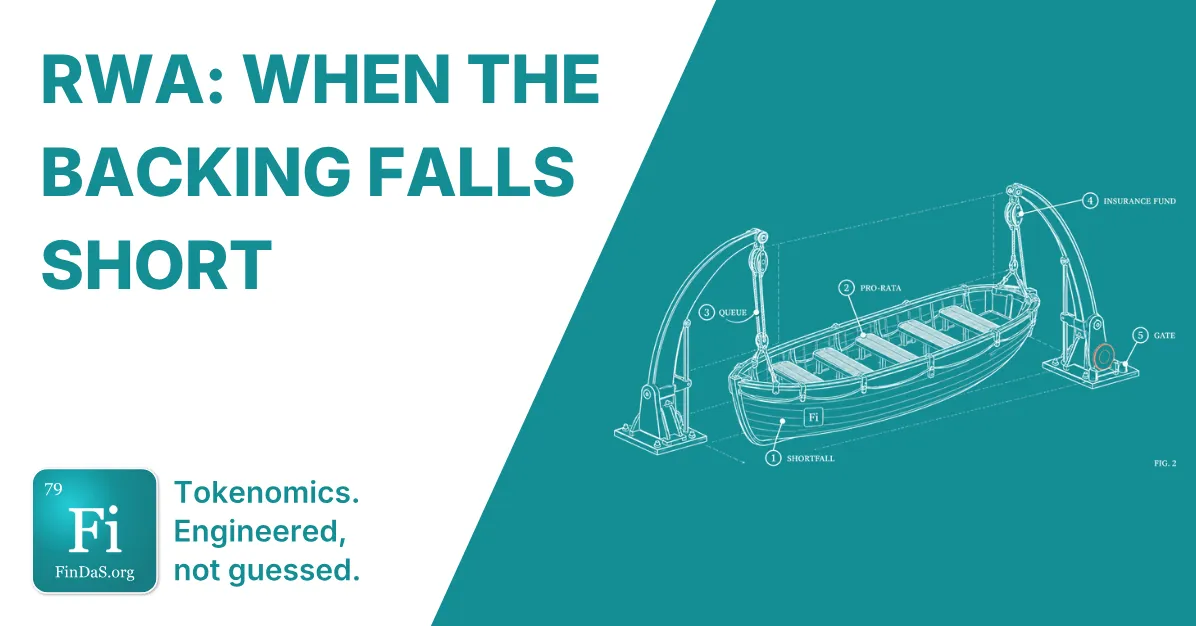
When an asset-backed token's reserve is worth less than its supply, holders are paid by a rule, and the rule decides whether they run. First come, first served pays the early in full and the late nothing, so everyone runs. Pro-rata gives everyone the same haircut, a first-loss layer or insurance fund narrows it, and a gate spreads the exits over time. The US GENIUS Act already shares a failed issuer's reserves ratably among holders, and MiCA requires recovery and redemption plans. Write the rule before launch.
Decide it before launch
Part 7.1 of Tokenomics is Easy ended on the question every asset-backed token gets asked eventually: what happens when the reserve is worth less than the supply? Pro-rata redemption, a queue, an insurance fund, or a very awkward blog post. Its answer was to decide it before launch, because after launch it stops being a design decision.
The earlier parts of this series made a shortfall less likely: a reserve of assets that turn into cash fast, held apart from the issuer, and a door that lets arbitrage hold the price. None of it makes a shortfall impossible. This part is about the rule that applies when one happens.
How backing falls short
Backing has fallen short in four recurring ways. The assets lose value: Goldfinch's Lend East pool expected to recover about $4.25 million of a $10.15 million loan, a loss of about 58% shared by its backers and the senior pool, and Maple lenders took the losses when Orthogonal Trading defaulted after the FTX collapse in December 2022. The assets get stuck: USDC's $3.3 billion at Silicon Valley Bank, which Circle said it would cover from corporate resources if the bank did not return it, and TrueUSD's stuck reserves.
The custodian fails: Prime Trust, a crypto custodian, lost access to its legacy wallets in late 2021, used customer money to meet withdrawals from them, and went into receivership in 2023 owing clients $85.7 million in cash while holding $2.9 million. And the issuer fails: when Celsius went bankrupt, the court held that the assets in its Earn accounts belonged to the estate, leaving their holders unsecured creditors, the outcome part two warned about. RealT, which sold tokenized shares of Detroit rental homes, told investors in July 2026 that it was entering voluntary liquidation, according to Outlier Media; it has published nothing on what they will get.
Four rules for sharing a loss
Once the reserve is short, the remaining money has to be shared, and there are four common rules for it. Each gives a different answer to the question every holder asks first: is it better to be early?
First come, first served is what tends to happen when nobody wrote a rule: redemptions keep being paid at par until the money runs out. It rewards whoever leaves first, so it turns a shortfall into a run. Pro-rata removes the reward: everyone takes the same haircut, whenever they ask. It needs two things written in advance, a point at which individual redemptions stop and a snapshot of who holds what, or it becomes first come, first served while the issuer works out the numbers.
A first-loss layer puts someone in front of the holders. Centrifuge's original pools split investors into a junior and a senior tranche, and the contracts make the junior tranche take losses first. Maple's pools had cover posted ahead of lenders: when a $10 million loan to Babel Finance defaulted in 2022, the cover was liquidated first, capped by its own rules, and lenders absorbed the remaining $7.85 million evenly, a 3.2% loss on a $244 million pool. An insurance fund does the same job from a pool of the protocol's own money: Ethena's reserve fund held about $62 million at the end of June 2026 against about $4.46 billion of USDe, and had received nothing new since December 2024. A backstop is only as good as its size and its funding, and both are design choices. Our REAL engagement built one on-chain.
A gate limits how much can leave in a period and makes the rest wait. It slows a run without changing what the reserve is worth. Closed-end interval funds in the US are the template: each periodic repurchase offer is for between 5% and 25% of the shares, bought back pro rata when more is tendered, and Apollo's tokenized credit fund, ACRED, sits on top of one. A gate fits assets that genuinely cannot be sold quickly, and only if holders knew about it before they bought.
What the law already decides
For payment stablecoins in the US, part of the answer is now law. Section 11 of the GENIUS Act puts holders ahead of the issuer and every other creditor, on a ratable basis, with respect to the required reserves, which sit outside the bankruptcy estate; any part of a holder's claim the reserves do not cover gets first priority over every other claim, up to the reserves the issuer should have held. The court is to use its best efforts to start distributions within 14 days of the required hearing. Ratable is pro-rata, so the US has chosen one of the four rules for its stablecoins.
MiCA makes issuers of asset-referenced and e-money tokens write both halves in advance. The recovery plan must include liquidity fees on redemptions, limits on how much can be redeemed in a working day, and the suspension of redemptions. The redemption plan must treat all holders equitably and pay them in a timely manner from the sale of the remaining reserve; the EBA's guidelines have holders rank pari passu and individual redemptions stop once the plan is triggered. That is pro-rata with a pause, written by law.
An orderly ending
A shortfall is not the only reason a token ends, and a planned ending shows how calm one can be. When Paxos was ordered to stop minting Binance's BUSD in February 2023, it kept redemption open and paid out $7.9 billion in 32 days, nearly half the supply, without market disruption by its own account. Our guide to ending a token economy sets out the order that keeps it that way: disclose first, close issuance, settle claims, and distribute pro-rata to a snapshot announced in advance.
Questions to settle before launch
- Which events count as a shortfall, and who declares one?
- Does redemption stop, slow or continue when it happens?
- Is the remaining reserve shared pro-rata, and against which snapshot of holders?
- Is there a first-loss layer or insurance fund, how large, and who funds it?
- Can redemptions be gated, by how much per period, and for how long?
- Who holds the reserve if the issuer fails, and what do holders rank behind?
- Is the rule written into the terms and the contract, or only in a blog post?
The end of the components
This is the last component. The market decides whether the token trades, the classification who may hold it, the yield and the reserve what it is worth, the primary market who can get out, the unit and the legal claim what is being held, and the business case whether it should exist. The 101 that closes the series puts them in order; until it ships, our overview of RWA tokenomics covers the ground at a higher level.
- How to end a token economy: the order a deliberate wind-down follows.
- REAL: an RWA chain built with an on-chain insurance backstop.
- Stablecoins under stress: our review of how flows actually behaved in three crises.
- RWA: Reserves, custody and proof: the reserve whose shortfall this part is about.
- RWA tokenomics: the overview this series builds on.
Frequently asked questions
01What happens to holders if an RWA token's reserve is worth less than its supply?
+
02What is pro-rata redemption?
+
03Why is first come, first served dangerous for a token?
+
04Do stablecoin holders get priority if the issuer goes bankrupt?
+
05What is a redemption gate?
+