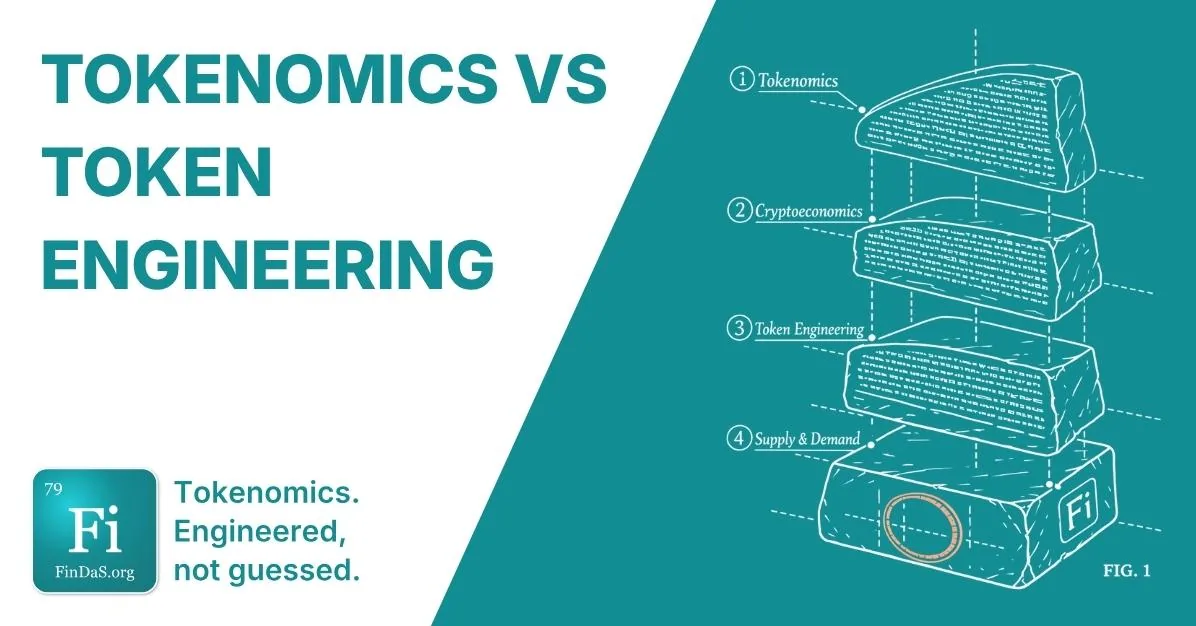
Tokenomics, token design, cryptoeconomics, token engineering, and token economies all refer to the same field: the economic design of tokens and cryptocurrencies. No formal taxonomy distinguishes them, and practitioners use the terms interchangeably. The one useful pattern is that a speaker's preferred term often hints at which aspect of the work they emphasize.
Why the same thing has five different names
Each of these terms was coined at a different moment in the crypto industry's growth, by a different community, to signal a different kind of rigor. Cryptoeconomics entered common use in the Ethereum developer community around 2014 to 2015, and the earliest recorded citation is a 2015 talk by Vlad Zamfir titled "What is Cryptoeconomics?". The label usually gets attributed to Vitalik Buterin, though the concept drew heavily on incentive-design patterns already present in the Bitcoin protocol. Tokenomics grew in parallel, as a broader and more colloquial term used by the wider Web3 community after ERC-20 made issuing a token a few lines of Solidity.
Token engineering came later. Trent McConaghy's March 2018 article Towards a Practice of Token Engineering is the commonly cited origin point, and BlockScience subsequently became the consultancy most associated with the methodology, with an emphasis on simulation and state-space modeling. Token design is mostly used as a close synonym of tokenomics, sometimes with a mild product or UX flavor. Token economies shows up more in academic papers and formal research than in day-to-day industry talk. If you want every variant collected in one place, our tokenomics dictionary has the full glossary.
What is happening underneath is simpler than the vocabulary suggests. Each new term arrived when a subsection of the industry wanted to differentiate its approach, signal a higher bar, or just avoid the baggage the older label had accumulated. The content converged long before the labels did, and no official body has ever attempted to standardize the taxonomy. Nothing about the current situation suggests one ever will.
What each term informally signals about the speaker
Even though the terms are formally interchangeable, community usage has patterns. Which label a practitioner reaches for tends to correlate with where they came into the field and what they emphasize in their work. These are priors, not rules, and people use the terms differently in different settings. Still, the priors are useful when you are trying to translate a conversation with someone whose background you do not know.
- Someone who says "cryptoeconomics" usually came up through the Ethereum community. They tend to care about consensus mechanisms, incentive attacks, and protocol-layer game theory more than token distribution or go-to-market.
- Someone who says "token engineering" is most often borrowing from the McConaghy and BlockScience tradition. Simulations, cadCAD-style state-space models, and stress-testing are usually in scope.
- Someone who says "tokenomics" is most often talking to founders, investors, or a general crypto audience. Supply, allocations, vesting schedules, and emission curves are the first things they will want to show you.
- Someone who says "token design" tends to lean toward utility and product questions. How does the token actually work inside the application, and what does the user do with it.
- Someone who says "token economies" tends to be academic or research-facing. The term shows up more in papers and formal write-ups than in investor pitches.
I want to stress that these are loose associations, not categories. I have seen operators advertise "token engineering" and deliver a spreadsheet of vesting cliffs, and I have read academic papers that use "tokenomics" without apology. Treat the label as a weak signal about what the person probably prioritizes, then ask about deliverables and case work to find out what they actually do. If you are new to the whole space, our tokenomics design 101 walks through what goes into a proper model regardless of the name on the title page.
The actual work underneath is the same
Strip the label away and a competent economic model for a token project covers the same ground regardless of what the practitioner calls it. You get supply design (how many tokens exist, released when, and to whom), demand design (what drives people to buy, hold, or use the token), distribution (who gets allocations and under what vesting), utility (what the token actually does inside the product), sustainability (can the system fund itself past year three), and regulatory exposure (what the token looks like to a classifier in the relevant jurisdiction). A proper engagement produces models and documentation against each of these, and the rigor comes from how well they interlock, not from which umbrella word sits on top. The components of a token economy do not change depending on what the engagement is labeled.
This is why "which term does your consultant use" is a weak filter for quality. A firm advertising cryptoeconomics can still produce an allocations-only deck. A firm advertising tokenomics can still run six-month simulation studies. I have done rigorous simulation-based engagements labeled "tokenomics", and I have seen shallow allocations-only spreadsheets labeled "token engineering". The relationship between label and quality is noisy, and if you want a structured way to check whether a firm's methodology matches what they are selling, a tokenomics audit is one concrete way to test it.
Ask about what the consultant actually delivers and what decisions their work supports. A one-page allocation table costs a day. A full model with supply, demand, stress scenarios, and regulatory framing is a different scope entirely. If you cannot get a clear answer about deliverables, the terminology on the sales page is telling you less than you think.
Which term to use, and why it barely matters
If you are writing your own whitepaper, pitch deck, or landing page, pick the term your audience already uses and stop there. Investor-facing materials should say "tokenomics", because that is the word investors expect to see in a section header. Academic or technical research fits better with "cryptoeconomics" or "token engineering", because those are the terms that carry weight in papers and at technical conferences. General audience content works with "tokenomics" or "token design". None of these choices are materially better than the others.
What matters is that you do not invent a sixth term, and that you do not stack three of them in the same sentence to sound more rigorous. "Our tokenomics and token engineering and cryptoeconomics framework" is a red flag in exactly the same way that stacking "AI and machine learning and deep learning" is a red flag in a pitch deck. The proliferation of terms is a feature of the field, not a differentiator anyone actually cares about.
If you are on the other side of the table, hiring a consultant, the vocabulary tells you a little about prior and almost nothing about quality. Read the deliverables list, look at case studies, talk to past clients. Those signals are stronger than any label a firm attaches to its work. The harder question is whether tokenomics matters at all for your specific project, and that one is worth more of your attention than the vocabulary debate.
Frequently Asked Questions
01Is token engineering an actual engineering discipline?
+
02Does the vocabulary matter when hiring a tokenomics consultant?
+
03Is cryptoeconomics only about consensus mechanisms?
+
04Are there any academic programs for this field?
+