Each type of adjacent vendor (marketing, development, VC, market maker, exchange-linked, legal) has a different optimization target, and tokenomics is the cheapest place to express that bias in the allocation and unlock numbers. The result is a token economy calibrated to that vendor's interests, not the project's. A dedicated tokenomics firm exists to strip that bias out, because tokenomics is its only product.

Tokenomics is the cheapest lever on a crypto project. Smart contracts take months and six figures to get right; a token economy is a spreadsheet that takes a week, and almost nobody audits it. That asymmetry is why founders routinely hand tokenomics to whichever existing vendor is closest at hand.
The problem is that every adjacent vendor has a different KPI, and a token economy has dozens of levers to play with: allocation shares, cliff length, vesting pace, emission rate, utility depth, unlock cadence, staking terms, governance weight. Almost any KPI can be expressed by moving a handful of those levers, which means whoever owns the spreadsheet gets to quietly optimize the project toward their own incentive structure instead of yours. The rest of this article is a type-by-type account of how that happens and what the tell is in each case.
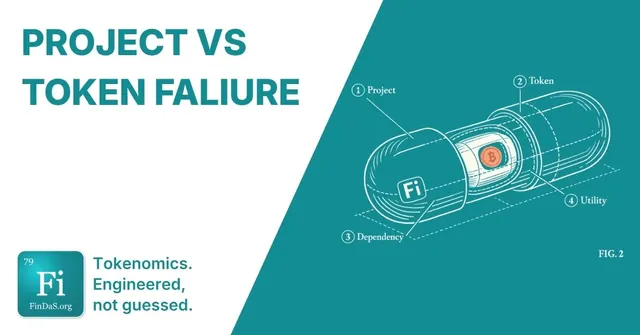
This is not a bad-faith move on their part. The default vendors are competent at what they actually do; they just aren't optimizing the thing you think they are. A token failure is a different failure mode from a product failure, and the people optimizing the product are structurally the wrong people to design the token economy that sits next to it.
The two conflicts you cannot walk back
Seven types of vendor routinely end up doing tokenomics work they should not. Two of them sit in a different tier of danger: market makers and VCs, because their bias is expressed in the allocation and unlock schedule, and that part of a token economy is effectively frozen the moment mainnet goes live. The others produce reversible damage. These two lock in the failure mode.
VCs want liquidity on a fund-life schedule. A typical fund has a ten-year clock and an IRR target, which translates into shorter cliffs, faster unlocks, and higher pre-public round allocations than the project actually needs for healthy price discovery. The polite version of the pressure is "aligned with institutional demand." The real version is that the first investor to cliff is also the first to sell, and the distribution schedule is quietly written to let them.
Market makers are less visible and more creative. The arrangement looks like liquidity provision, but the commercial structure often includes a loan-and-option clause: the project lends tokens, the market maker holds a strike-price call, and if the token price crosses the strike they exercise and exit. That is a trading strategy dressed as a market-making agreement. Opaque wallet addresses and unlabeled treasury flows make the actual exposure hard to trace from outside. A transparent fee-only engagement is a fine thing. A price-linked options deal is a quiet short position against the token, paid for by the project.
Both biases show up in the tokenomics document as unremarkable numbers: a 12-month cliff instead of 24, a 7% private allocation instead of 4%, a market-maker contract with a price-linked strike instead of a flat monthly retainer. Any one of these, individually, looks like a reasonable parameter choice. That is why they survive review.
Dev teams optimize for what their contracts can handle
Dev shops produce tokenomics that routes around whatever their smart-contract framework does not handle cleanly. In practice that means a transfer-and-balance-check token with no meaningful vesting logic, no slashing, and no dynamic emissions. Those mechanics require serious contract work and careful state management on-chain, and the easiest way to avoid the work is to leave them out of the token economy entirely.
The result reads as simple and clean in the model, which is usually how it gets justified: let's keep the mechanics minimal for the MVP. I have seen that framing produce tokens that function as a payment rail the project already had before tokenizing anything, with utility hooks promised in the whitepaper and never actually deployed. If there is no mechanism anchoring demand to the protocol, the token price is doing a random walk, and everyone involved learns that the hard way at the first unlock cliff.
Dev teams are also the most likely to declare a simulation "out of scope." A live token economy behaves like a closed dynamical system under stress, not like a spreadsheet at launch. If no one has stress-tested inflation shocks, unlock dumps, or a sustained demand collapse, the first real one finds the weakness that was always there.
Marketing agencies calibrate for the launch week
Marketing-agency tokenomics optimizes for one thing: the launch window. That means fast unlocks, heavy influencer and airdrop allocations, and holder count as the visible KPI instead of any measure of protocol engagement. The approach works exactly once, which is why the post-launch chart on a marketing-led token is usually indistinguishable from any other attention-driven launch.
The fast-unlock choice is the tell. A marketing-led model treats vested supply as an obstacle to the campaign, because illiquid tokens cannot be talked about using momentum metrics. A tokenomics-led model treats vested supply as load-bearing structure that prevents price collapse under early sell pressure. Those two framings produce completely different schedules, and readers of a marketing-led launch are looking at one of them without knowing it.
The fix is not to fire the marketing agency. It is to let them market the product and the community story, and not let them write the allocation tab. Those are two different crafts, and confusion between them is the first symptom that the tokenomics is downstream of someone else's KPI.
Exchanges, legal advisors, and full-stack consultancies
The remaining three categories produce smaller biases, but the mechanism is identical: the tokenomics reflects the adviser's primary product. Exchange-linked advisers optimize for listing metrics, which means short vesting and frequent unlocks to generate on-chain volume the exchange can point at in marketing materials. That boosts early trading activity and usually harms long-term holder behavior. If the tokenomics advice comes free with a listing package, assume the listing is what is being optimized.
Legal advisors optimize for regulatory classification, which is a real concern but a narrow one. Ultra-conservative models strip out staking, governance, and dynamic rewards because those mechanics raise the hardest questions under most securities frameworks. The resulting token is legally defensible and economically inert. Compliance matters; it is not a substitute for incentive design. This bias has a clearer anchor in EU jurisdictions under the MiCA utility-token rules, but the failure mode is the same: a token that passes the regulatory test and fails the demand test.
Full-stack consultancies carry whichever bias dominates their revenue mix. A firm that also runs marketing produces marketing-calibrated tokenomics. A firm that also runs dev produces dev-calibrated tokenomics. There is no pure full-stack bias; the bias belongs to whichever service pays for the partnership.
The tokenomics firms worth hiring show you the simulation output. The ones that aren't show you the pitch deck.
What a dedicated tokenomics firm actually looks like
A firm that does only tokenomics has one product to sell, and the test is whether the deliverable matches that product or whether it looks suspiciously like something else the firm also sells. Independence from adjacent services is the actual mechanism that makes a tokenomics firm worth hiring, because it removes every bias I have described up to this point. If you are already mid-design and want a second read on your allocation and unlock mechanics from a team whose only product is tokenomics, that is the work we do at FinDaS.
In practice, the firm should model the token economy as a closed system with inflation mechanics, sinks, velocity assumptions, and stress tests. It should size the allocation and unlock schedule against the project's expected demand curve, not against a fundraising target. It should engage market makers on fee-only terms with no price-linked options in the contract, and push back on VC vesting demands that conflict with the demand curve. It should produce a simulation that shows where the economy breaks, not a set of charts that show where it works. That is what a proper tokenomics audit looks like.
Ask any prospective tokenomics firm to walk you through their last three engagements. The ones worth hiring will show you the simulation output. The ones that aren't will show you the pitch deck. That is the entire test, and you do not need a tokenomics expert to tell which version of the meeting you are in. I have sat through both.
Choosing a tokenomics partner is the same decision as choosing a smart-contract auditor or a security researcher. It is the kind of work where independence from the implementation team is a feature, not a coordination tax. A dedicated firm has that independence built in; an adjacent vendor, by definition, does not.
Frequently Asked Questions
01How do you tell a real tokenomics firm from a marketing or dev shop that rebranded the offering?
+
02What is the clearest red flag in a vendor-designed token model?
+
03Can vendor-designed tokenomics be fixed after launch?
+
04Does this mean market makers should not be involved in tokenomics at all?
+