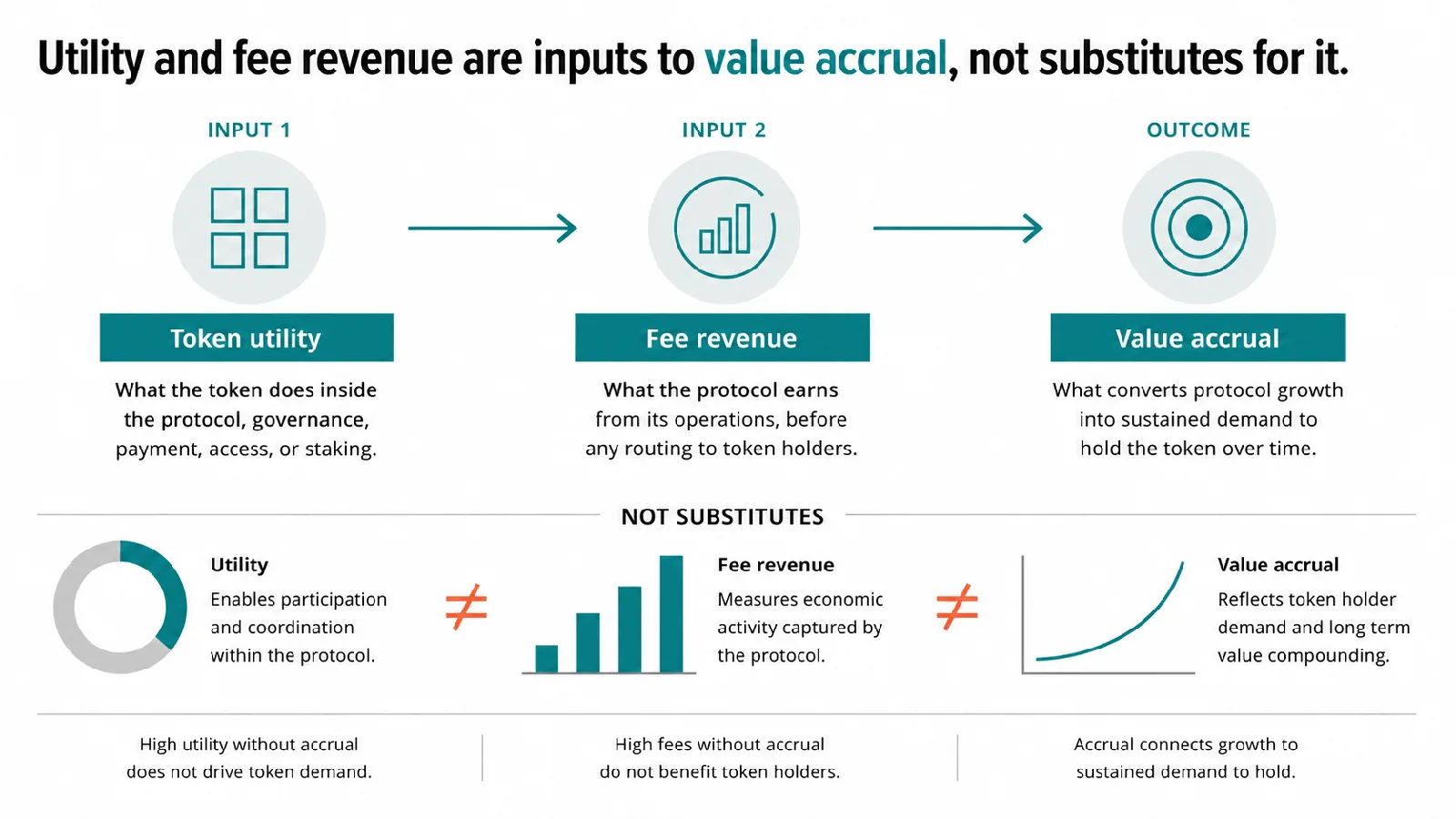
Value accrual is the mechanism that causes a token's holding demand to grow as the protocol grows. It is distinct from utility (what the token does) and from fee revenue (what the protocol earns). A token can have both and still accrue zero value, which is why the design question every founder needs to answer is: when my protocol grows by 10x, what specifically routes that growth into demand to hold the token?
What value accrual actually is, and what it isn't
Value accrual is the answer to one question: when the protocol grows by ten times, what causes the token's holding demand to grow with it? It is distinct from utility (what the token does) and from fee revenue (what the protocol earns). A protocol can have both and still have a token that accrues nothing.
Uniswap from 2020 to 2025 is the canonical case. UNI had governance utility, the protocol generated billions of dollars in fees for liquidity providers, and UNI's price was effectively decoupled from Uniswap's market dominance because no mechanism routed any of that value to token holders. The decoupling lasted five years before the December 2025 UNIfication vote turned on the fee switch and introduced the Token Jar burn mechanism. The lesson holds regardless of the eventual fix: utility and revenue are inputs to value accrual, not substitutes for it.
The test every founder needs to answer in one sentence: when the protocol grows by 10x, what causes the token's holding demand to grow? If there is no mechanical answer (a sentence that names a specific contract, a specific lockup, a specific buyback, a specific cash flow), the token has no value accrual. The marketing deck does not count as a mechanism. Most projects we see come in with a beautifully designed answer to "what will the token do" and a vacuum where the answer to "what will make the token worth holding" should be.
The velocity problem, in plain English
The classical framing comes from the equation of exchange: market cap times velocity equals price times quantity, or in tokenomics terms, the total dollar size of a protocol economy is supported by some combination of market cap and how often each token changes hands per year. Solve for market cap and the implication is uncomfortable: for any fixed economy size, higher velocity means a smaller required market cap to support it. A pure payment token (acquire, spend, seller converts to fiat) can hit a velocity of 100 or more per year. Even a large transactional economy can be served by a small market cap if every token rotates through the system that fast.
The practical version of this for founders: any token whose holders have no reason to hold beyond the moment they need to use it will have high velocity and low value accrual, by construction. The question is not "will users transact with the token". The question is "what will make them hold it for longer than the transaction takes". For a deeper read on payment-style tokens specifically, see the payment tokens explainer; the velocity problem is the structural reason why pure-payment designs are so hard to make accrue value.
Every single project that comes to us has a great idea on how they want to spend the token. Almost none have an idea on how to make sure the tokens they spend are worth anything. That gap is usually 90 percent of our work: ensuring the value stays in the asset, not just the rails.
Six mechanisms, six tradeoffs
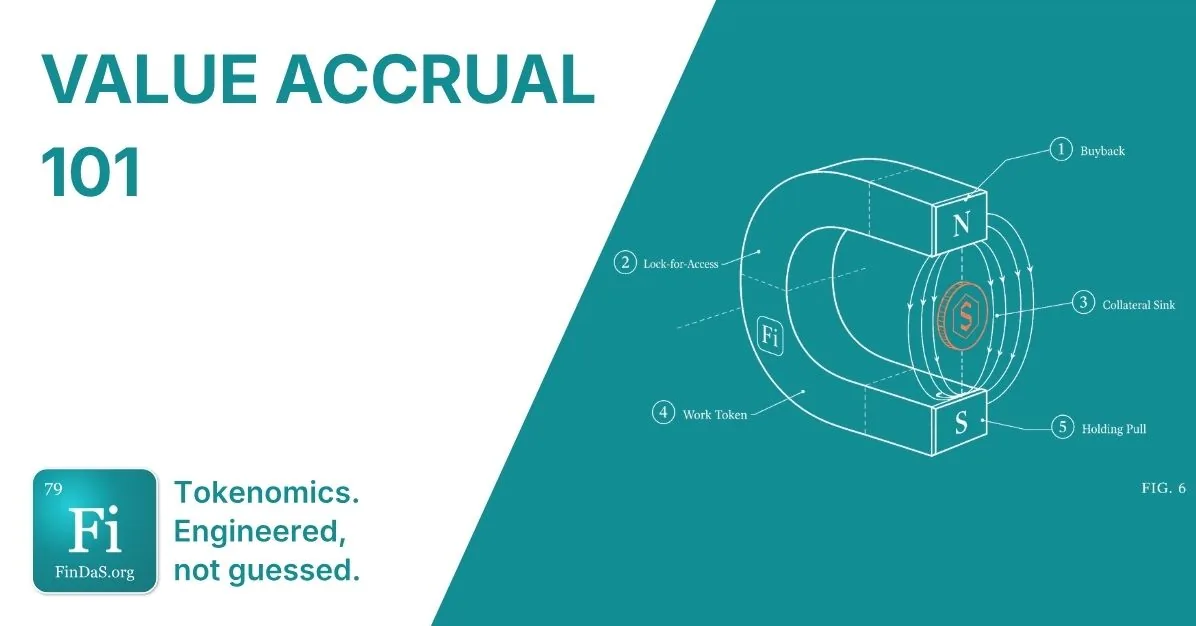
There are six direct mechanisms that route protocol activity into token-holder value. Each comes with a real tradeoff, and most failed tokenomics designs try to use all six and end up implementing none of them well. Pick one or two and design them deeply, rather than scattering shallow versions across the whole stack.
| Mechanism | How it works | Tradeoff |
|---|---|---|
| Buyback | Protocol revenue repurchases tokens from the open market | Direct buy pressure, but capital intensive and dependent on real revenue |
| Burn via buyback | Repurchase, then destroy, removing tokens from supply permanently | Supply reduction without ongoing holder cash flow |
| Distribute to stakers | Protocol fees paid to stakers in stablecoins or another asset | Hidden dividend, with the largest regulatory exposure of any mechanism |
| Lock for access | Tokens must be staked or held to access protocol features | Reduces circulating supply, but the demand floor is capped by the size of the user base |
| Collateral sink | Tokens posted as collateral for protocol operations (margin, market creation, voting weight) | Reduces effective float, but collateral is returnable, so the sink is not permanent |
| Work token | Token must be held to perform revenue-generating work for the protocol | Strongest accrual mechanism, but only fits protocols where the token genuinely gates productive work |
The right mechanism depends on the protocol's revenue profile, regulatory exposure, and whether the token has a credible operational role. A high-revenue exchange can run a buyback. A protocol with no fee revenue has no honest way to do that and should be looking at lock-for-access or work-token designs instead. Burn via buyback is the most popular 2025 default because it is the cleanest from a securities-law standpoint, but it is not a free lunch. See our deeper write-up on burning for the cases where it works and the cases where it produces the visible flame and no actual scarcity.
Why pure governance tokens fail the test
From 2020 to 2023, hundreds of projects launched tokens with governance-only utility. The pitch was that governance rights are valuable because the protocol is valuable. The market disagreed. Governance rights without fee capture or revenue claim are an option on future value accrual, and markets price options on uncertain future cash flows at near zero in expected value terms.
The Uniswap UNIfication vote in December 2025 was a belated industry acknowledgement of this. UNI holders had voted on protocol parameters for five years while capturing exactly none of the fees those parameters governed. The Token Jar / Firepit mechanism passed with near unanimity, partly because the alternative had become structurally indefensible: a non-zero share of the DeFi market had concluded that pure governance was a packaging exercise, and the token price reflected it. For founders, the operational lesson is direct. Marketing "governance" as utility without a value-capture mechanism sells an option, not an asset. Be honest about that framing internally, or build the accrual in. Governance design is a real domain with real choices; it just is not a substitute for value accrual.
Real yield versus the subsidy in disguise
A protocol paying 40 percent APY out of its own token emissions is not accruing value to stakers. It is diluting non-stakers to pay stakers. A protocol paying 3 percent APY out of fee revenue is accruing value. The post-2022 market learned this distinction, sometimes painfully, and "real yield" became the framing for the difference.
The honest calculation: net yield equals gross APY, minus token inflation rate, minus token price depreciation over the period. Any program where this number is negative is a customer acquisition subsidy dressed as yield. That is fine as a launch tactic if it is honestly understood internally, and disastrous if the protocol has convinced itself that the nominal APY is what holders are receiving. Emissions design is downstream of this distinction: the question is not "how high is the APY" but "is the APY a transfer or a creation". I have seen both, and I have seen teams be honest about which one they were running roughly a third of the time.
The buyback math: ratio against FDV, not market cap
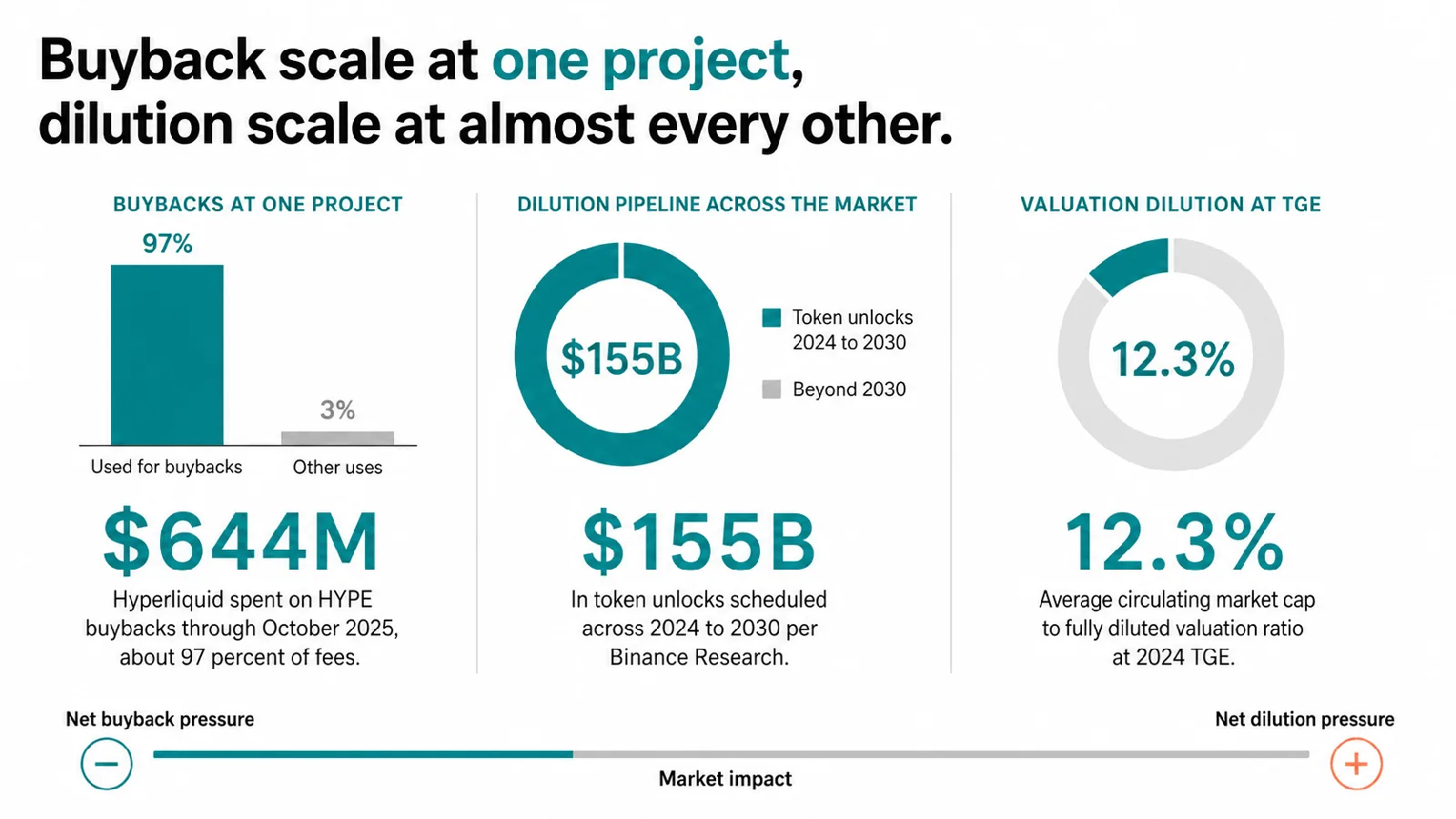
2025 was the year buybacks went from controversial to consensus, with cumulative on-chain repurchases crossing the billion-dollar threshold by Q3. Hyperliquid alone spent roughly $644M on HYPE buybacks through October 2025, allocating about 97 percent of trading fees to its Assistance Fund, which buys HYPE from the open market and accumulates it; the fund's holdings were formally proposed for burning via governance vote in December 2025. At a pace approximately equivalent to 13 percent of circulating supply per year, that is the aggressive end of the spectrum, and it works because the underlying derivatives exchange genuinely produces the fee revenue.
For evaluating any buyback program, the metric is annualised buyback dollars divided by fully diluted market cap, not circulating market cap. Most teams quote the ratio against circulating because the number looks better, and most analysts let them. Below 2 to 3 percent annualised, a buyback is symbolic and gets swamped by emissions and unlocks. Between 5 and 10 percent it materially returns value to holders. Above 10 percent it is aggressive and worth modelling against the vesting schedule, because the buyback has to outrun the next four years of unlocks before it produces net buying interest. Discuss your project's accrual design with us
Outrunning dilution: the vesting curve no one budgets for
Binance Research estimated roughly $155B in token unlocks scheduled across 2024 to 2030, with 2024 launches averaging a 12.3 percent ratio of circulating market cap to fully diluted valuation at TGE. The other 87.7 percent vests in over the following four years. For these projects, the harder design problem is not capturing protocol growth. It is absorbing incoming dilution from supply that has already been promised but is not yet circulating.
The math is unforgiving. A protocol with $100M circulating market cap, $1B FDV, and a four-year linear vest faces roughly $225M of new circulating supply per year on average. To merely hold price flat, the accrual mechanism needs to absorb $225M per year of selling. Most projects never model this number against their accrual mechanism, because doing so honestly forces a confrontation between what was promised at TGE and what the mechanism can realistically deliver. Vesting design belongs upstream of accrual design; the cleanest vesting schedule does not save a token whose accrual mechanism cannot keep pace.
The five-year holder test
The cleanest single test for value accrual: would a rational investor hold this token for five years, and what is their thesis? For Bitcoin, yes, because credible scarcity and network effects. For ETH, yes, because staking yield combined with EIP-1559 burn. For HYPE, yes, because buyback-driven supply reduction combined with platform revenue. For a pure governance token with no fee capture and ongoing emissions, no, because the token earns nothing and dilutes through emissions.
I ask founders to subject their own token to this test honestly. If a rational five-year holder has no compelling thesis (one that does not depend on selling to a greater fool), the token is designed to be traded, not held. Markets will price it accordingly, and over a long enough horizon "designed to be traded" and "trends to zero net of inflation" tend to be the same outcome. The fix, if there is one, is at the design layer, not the marketing layer. Value accrual is built into the contracts or it is not built at all.
More from the 101 series
This article is part of FinDaS's 101 series on tokenomics fundamentals. The series covers the major design domains separately, and value accrual sits closest to a few of them in particular. A few directly adjacent reads if you want to dig further into the topics this piece touched on:
- Tokenomics 101: the ground-up walkthrough of what tokenomics actually covers, for readers who want the broader frame before specialising.
- Token Utility 101: the distinction between utility and value accrual, taken in the other direction.
- Token Supply 101: how supply schedules interact with accrual mechanisms, and the standard mistakes in setting them.
- Treasury 101: where the buyback dollars actually come from, and how to size the protocol-owned reserve that funds them.
Frequently asked questions
01Is value accrual the same as token utility?
+
02Can a token have value accrual without being classified as a security?
+
03How do you measure value accrual quantitatively?
+
04Why do venture-backed tokens often fail the value accrual test?
+
05Should smaller protocols copy Hyperliquid's 97 percent fee buyback model?
+