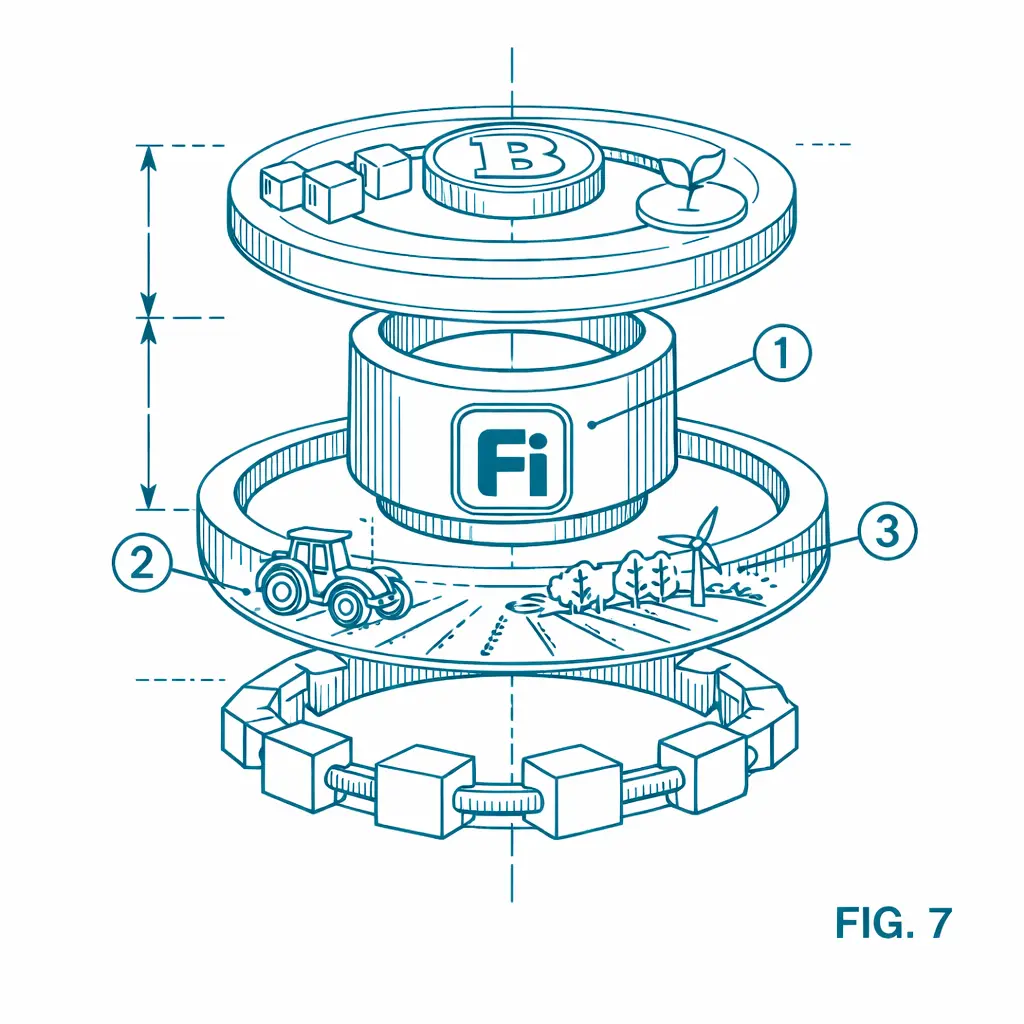
Agriculture is one of the few Web3 domains where distributed ledgers can solve a real operating problem. The problem is not bringing speculative tokens to farms. The problem is making fragmented data auditable across growers, aggregators, processors, shippers, certifiers, and regulators. GS1’s supply-chain guidance is explicit that blockchain implementations work only when participants share identifiers and event data standards such as GTIN, GLN, and EPCIS, and the FDA’s traceability framework is similarly organized around records, key data elements, and retrieval rather than any mandated chain choice.
The economic case is also real. FAO says roughly 14% of food is lost between harvest and retail, and the World Economic Forum has cited research suggesting that emerging traceability technologies, including blockchain, could cut food loss by 85 million tons by 2030 if deployed effectively (FAO, WEF).
Traceability is the real Web3 wedge in agriculture
Traceability is where Web3 has the cleanest product-market fit in agriculture. A ledger can preserve who handled a batch, when a transformation occurred, which lot moved where, and what supporting documents or sensor records existed at each step. That matters for produce recalls, export compliance, sustainability claims, and proof that premiums or subsidies reached the intended beneficiaries (GS1 US, IFAD). That same operating logic also appears in broader Web3 x Supply Chain systems.
FAO’s own framing is broad. It lists blockchain applications in agriculture that include farm inventory, land records, agricultural supply chains, fair pricing, remittances for small farmers, and modernization of farm management software (FAO). But the strongest operating evidence in the public record is narrower. It clusters around food traceability, due-diligence workflows, and auditability rather than open-ended agricultural token economies (FDA FAQ, ICE CoT).
That distinction matters. A farm-to-consumer QR code is a user interface. The actual system value sits deeper in the stack: item identification, event capture, reconciliation across firms, and data retrieval under audit or recall conditions. Without that layer, “traceable” often means little more than a marketing claim (GS1 US).
Standards and compliance matter more than chain choice
Standards matter more than whether a network is public, private, or permissioned. GS1 warns that launching a blockchain program without shared standards risks putting bad data on a permanent ledger. Its guidance highlights EPCIS as the mechanism for capturing and sharing supply-chain event data such as shipments and receipts, which is exactly the sort of structure agricultural networks need if multiple organizations must trust the same record (GS1 US press release, GS1 US guideline). That same governance problem also appears in ethical supply chain management.
Regulation is reinforcing that standards-first logic. In the United States, the Food Traceability Rule does not prescribe a specific technology. Records can be paper or electronic, and covered entities can even have another party maintain records on their behalf, so long as the data can be provided within 24 hours when requested. As of February 19, 2026, the FDA FAQ also states that FDA intends not to enforce the rule before July 20, 2028 following a proposed extension and a congressional directive.
In Europe, the pressure is even more specific. Regulation (EU) 2023/1115 defines geolocation as latitude and longitude coordinates using at least six decimal digits, and for plots larger than 4 hectares used for relevant commodities other than cattle, the data must be provided as polygons describing the perimeter of each plot. In the consolidated text dated December 26, 2025, the main application date is shown as December 30, 2026, with qualifying micro and small operators applying from June 30, 2027.
Market infrastructure is already adapting around those requirements. ICE Commodity Traceability now supports cocoa and coffee workflows with three distinct data layers: farm-plot data with geolocation, lawful-production and compliance-risk data, and parcel traceability data linking consignments back to farm plots. It also tests uploaded data against validation methodologies and supports due-diligence statement creation for the EU (ICE CoT).
The practical implication is blunt. Agricultural Web3 systems are being pulled toward compliance-grade recordkeeping. That favors boring infrastructure over maximalist crypto design. From a treasury perspective, that is healthy. Compliance budgets are recurring. Speculative incentive budgets are not.
Fair trade verification is valuable, but the physical world still sets the ceiling
Fair-trade verification is a real use case for digital ledgers, but it has a physical-world ceiling that many tokenized narratives ignore. Fairtrade states that the majority of its products, including all Fairtrade coffee, bananas, and flowers, are fully traceable from field to shelf. But it also says that full physical segregation is difficult and costly for cocoa, tea, sugar, and fruit juices, where centralized processing and routine mixing make strict separation commercially hard.
Fairtrade’s answer in those categories is mass balance. Companies may mix Fairtrade and non-Fairtrade ingredients during manufacturing, as long as the certified volumes sold on Fairtrade terms are tracked and audited through the supply chain (Fairtrade). It is the same integrity problem explored in Web3 x Climate Change and Sustainability.
This is where a lot of Web3 agriculture design goes wrong. It treats on-chain provenance as if it automatically creates physical provenance. It does not. If a commodity is blended in the real world, the digital system has to represent that honestly. Anything else is just cleaner-looking opacity.
There is, however, a broader verification opportunity beyond the crop itself. IFAD’s TRACE initiative uses blockchain for fund traceability, showing that agricultural finance flows can also benefit from tamper-evident records. That matters in rural development programs, climate funding, and premium distribution, where the integrity question is often “did the money arrive and under what conditions?” rather than only “where was the crop harvested?” (IFAD).
Smallholder economics are the bottleneck, not ledger throughput
Smallholder economics are the hardest constraint in Web3 x Agriculture. A 2024 study on the Peruvian cocoa supply chain found two major challenges for digital sustainability tracing: the required investments did not appear justified by corresponding income gains, and farmer-supplied data created accuracy risks because of limited capacity and incentives to distort information. The authors conclude that stronger cooperation across the supply chain is needed if farmer-side costs are to earn an adequate return.
That finding is consistent with broader review literature. A systematic review in Frontiers in Sustainable Food Systems identifies cost, security, and scalability as leading technology factors in adoption, while firm size, limited knowledge, management capability, regulation, and stakeholder participation are major organizational and environmental factors (Frontiers). Another systematic review focused on smart and sustainable agriculture also emphasizes barriers and enablers around adoption readiness rather than simply technical possibility (MDPI).
The treasury implication is straightforward. If data capture creates new labor for farmers, cooperatives, or field agents, someone must fund that labor every season. Pilot grants can hide that cost for a year. They do not remove it. An agricultural network that relies on volunteer data submission, vague token upside, or a discretionary ecosystem reserve will usually discover that the expensive part is not settlement. It is verified data acquisition. That cost stack is easier to map with clear token economy design components.
Resource-management use cases face the same discipline. FAO includes farm inventory, land records, and management software in the blockchain opportunity set (FAO). But the public evidence base is still much stronger for traceability and compliance than for open agricultural token systems managing irrigation, inputs, or land use at scale. The burden of proof is therefore higher for any project that wants to tokenize water savings, carbon claims, or farm operations before it has solved the measurement problem.
What architecture usually works in agri supply chains
The most credible architecture for agricultural Web3 is usually hybrid. Keep high-volume operational data in conventional systems. Use open identifiers and event standards for interoperability. Anchor proofs, attestations, or selective records on-chain only where immutability, multi-party auditability, or shared access rights materially improve the workflow. That design matches what regulators ask for and what supply-chain operators can actually maintain (GS1 US, FDA FAQ, ICE CoT).
| Design model | Best fit in agriculture | Main strength | Main treasury risk |
|---|---|---|---|
| Standards-first off-chain system with on-chain anchoring | Produce traceability, recall readiness, retailer and exporter workflows | Lower operating cost while preserving auditability where needed | Underfunding field data capture and supplier onboarding |
| Permissioned consortium ledger | Known trading partners, certification bodies, lenders, and logistics firms | Clear access control and easier governance for commercial data | Governance concentration and cost-sharing disputes |
| Public chain with transferable token | Only where independent validators, open market settlement, or tokenized external financing are genuinely required | Credibly neutral settlement and composability | Dilution, speculative volatility, and oversized discretionary reserves |
The table is an analytical inference, but it follows directly from the source pattern. GS1, FDA, Fairtrade, EUDR workflows, and ICE CoT all point toward standards, evidence, and governed data sharing. None of them imply that a freely traded token is the default answer (GS1 US, FDA FAQ, Fairtrade, ICE CoT).
When an agricultural network should issue a token
Most agricultural traceability systems should not issue a token. If the participants are known, fees can be invoiced in fiat, and governance can be enforced contractually, a token often adds volatility without solving the core operating problem. That is not anti-Web3. It is a recognition that agricultural systems live or die on seasonal cash flow, onboarding cost, and data integrity. It is also the same gating question in deciding when to launch a token.
A token becomes more defensible when three conditions hold at the same time:
- the network needs independent third parties to validate or store records,
- those parties require a transparent compensation mechanism, and
- the token is tied to a real demand sink such as transaction fees, financing access, or redemption into a clearly governed service.
Even then, treasury design is the deciding factor. Large unbounded ecosystem reserves are especially dangerous in agriculture because sector margins are thin and adoption cycles are slow. If token incentives must exist, they should be milestone-based, budget-capped, and governed by explicit disclosure on who receives emissions, under what performance criteria, and with what clawbacks if data quality fails. The alternative is familiar: dilution first, utility later, if ever.
For teams doing token economy design in agri supply chains, the first serious question is usually not validator APR or secondary-market liquidity. It is who pays for farmer onboarding, field verification, polygon mapping, device maintenance, and exception handling in year three. That is usually where tokenomics design services begin.
Web3 x Agriculture works when it behaves like infrastructure. It fails when it behaves like a treasury-funded narrative in search of a crop. The evidence favors systems that improve traceability, document integrity, and payment or premium accountability under real operating constraints. The systems most likely to last are the ones that budget for those constraints up front.