When a run comes, the reserve is the only part of an asset-backed token anyone reads. Three questions settle it. What sits in the reserve, and can it be turned into cash as fast as the token promises redemption? Who holds it, and can the issuer's creditors reach it? And how often does anyone check, and what does the check actually show? An attestation, an audit and an on-chain proof of reserve answer different questions, and none of the three proves on its own that the assets exist and are free to pay holders.
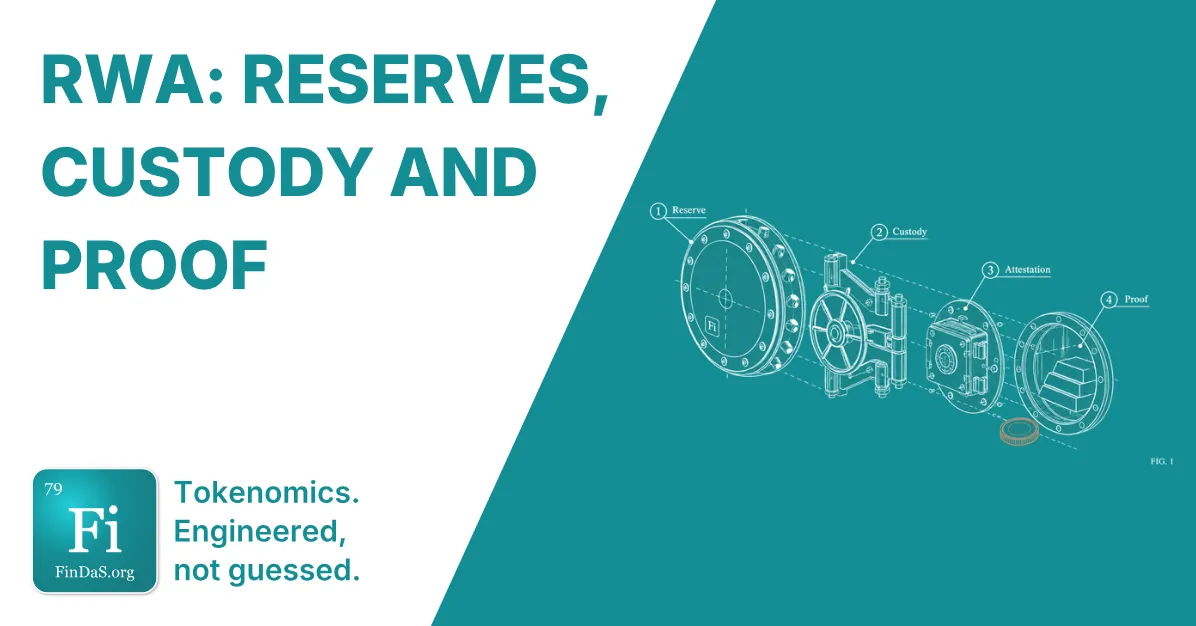
The reserve is the only part anyone reads in a run
Part 7.1 of Tokenomics is Easy put it bluntly: when the bank run comes, the reserve is the only part of the design anyone reads. The minting and redemption rules decide who can get out. The reserve decides whether there is anything to get out to.
Three questions settle it: what sits in the reserve, who holds it, and how often anyone checks.
What sits in the reserve
The test for a reserve asset is the redemption it has to meet. A token that promises same-day redemption at par needs assets that become cash the same day at close to their book value: money in bank accounts, very short Treasury bills, overnight repo, government money market funds. Anything longer, riskier or harder to sell turns a redemption promise into a bet that markets stay calm.
Regulators have written that test into law. The US GENIUS Act, once it takes effect, limits a payment stablecoin's reserve to at least one-for-one backing in cash, insured bank deposits, Treasury bills with 93 days or less to maturity, overnight repo backed by Treasuries, and government money market funds that hold only those assets. MiCA allows issuers of asset-referenced tokens to invest the reserve only in highly liquid instruments with minimal market, credit and concentration risk, and requires issuers of e-money tokens, the category dollar and euro stablecoins fall into, to keep at least 30% of the funds in bank deposits.
The two largest dollar stablecoins show how far apart reserves can sit. Circle holds most of USDC's reserve, about 86% at the end of March 2026, in the Circle Reserve Fund, a registered government money market fund managed by BlackRock, and the rest as cash at large banks. Inside the fund, overnight Treasury repo was a bigger line than the Treasury bills at that date. Tether's report for 30 June 2026 shows $187.75 billion of assets against $183.64 billion of liabilities: about 61% of the assets in US Treasury bills, and alongside them $18.84 billion of gold and $5.8 billion of bitcoin. Both can be sold the same day, at whatever the market pays that day, against a token that still promises a dollar.
For a commodity token the reserve is the metal itself, and the questions change: which vault, which bars, and whether they are allocated to the holders or merely owed to them. Paxos keeps PAXG's gold in LBMA vaults in London, publishes a monthly attestation, by KPMG since February 2025, and runs a lookup that shows the serial number, weight and vault of the bars behind a wallet address on Ethereum or Solana. Tokens held at an exchange are not covered by it.
Who holds it
A reserve held by the issuer is a reserve the issuer's creditors can reach. The standard answer is a separate custodian holding the assets in segregated accounts for the holders, which MiCA now requires for asset-referenced tokens: the custodian must be a different legal person from the issuer, and the reserve is protected from the custodian's own creditors. The legal side of that is part two; the operational side matters as much. Whose name is on the account, who can move the assets, and how many people have to sign?
Custody also comes in layers. A bank holds deposits that are its own liabilities, a custodian holds Treasury bills in a segregated account, and a sub-custodian may hold them for the custodian. Each layer is one more party whose failure or mistake stands between the holder and the asset.
TrueUSD shows why the questions matter. Techteryx, its issuer, alleges in litigation in Hong Kong that about $456 million of reserves, held through the custodians First Digital Trust and Legacy Trust, went to a Dubai company, Aria Commodities DMCC, instead of the Cayman fund they were meant for, and became illiquid. A Dubai court has frozen up to $456 million while that case runs; no court has ruled on the merits.
Three ways to check
There are three common ways to check a reserve, and they are routinely confused with each other.
Attestation
An accountant's report that, on a stated date, the reserve held what the issuer says it holds. Circle's monthly reports are examinations by Deloitte; Tether's quarterly report from BDO is an assurance report under ISAE 3000, a standard for engagements other than audits. It covers one day, and says nothing about the days in between.
Audit
An opinion on the issuer's full financial statements for a year: every asset and every liability, not only the reserve. Circle, a listed company, files audited accounts with the SEC. Tether announced its first full audit, by KPMG, in August 2026.
On-chain proof
A data feed that publishes a reserve figure on-chain, often continuously, so that a contract can read it. Chainlink's Secure Mint lets an issuer's token contract refuse any mint that would take supply above the reported reserve. The figure still comes from a custodian, an auditor or the issuer itself.
Each answers a different question, and a design that relies on one of them should say which questions it leaves open.
MiCA already sets how often, and the GENIUS Act will. MiCA requires issuers of asset-referenced tokens to publish the reserve at least monthly and to commission an independent audit of it every six months. The GENIUS Act will require a monthly public report of the reserve's size and composition, examined each month by a registered public accounting firm and certified to the regulator by the chief executive and chief financial officer, and a yearly audit from issuers with more than $50 billion outstanding that do not already file with the SEC. In the US, the AICPA published criteria for stablecoin reports in March 2025.
What on-chain proof can and cannot do
On-chain proof of reserve is often presented as the end of trust. In practice it moves the trust to whoever supplies the figure. A feed is only as good as the party feeding it, or, as our REAL case study puts it, an oracle is a trust assumption wearing a technical costume.
The RWA-PoB paper we reviewed makes a sharper point. Proof of reserves compares total assets with total obligations and stops there; it does not say whether the assets are eligible, unencumbered, consistently valued or sellable within the redemption window. In one of the paper's test scenarios, a synthetic reserve of about $2.49 billion against $2.16 billion of token obligations passed a gross proof-of-reserves check. Once the ineligible positions were zeroed and haircuts applied, it covered 96% of the obligations, and minting was refused. The authors also state that their framework does not independently prove the off-chain assets exist.
What on-chain proof does well is the dull part: making the check continuous, and wiring it to the mint so that no tokens can be created against a reserve nobody has reported.
Questions to ask of any reserve
- What exactly is in the reserve, and how fast can each part become cash at close to its book value?
- Does that match the redemption the token promises?
- Who holds each part, in whose name, and segregated from whom?
- Who can move the assets, and with how many signatures?
- How often is the reserve checked, by whom, and against which standard?
- Is there an audit of the issuer, or only attestations of the reserve?
- Does anything stop minting when the reserve has not been reported?
If the reserve is clear
The primary market decides who can redeem, the unit decides what they redeem, the legal claim decides what they are owed, and the business case decides whether the token should exist. Until the series closes with its 101, our overview of RWA tokenomics covers the ground at a higher level.
- RWA: Minting and redemption: the door the reserve sits behind.
- RWA: What does the holder actually own?: why segregation decides what holders get back.
- Proof-of-backing for tokenized U.S. Treasuries: our review of a paper on what proof of reserves misses.
- REAL: an RWA chain designed so that defaults do not depend on an oracle.
- RWA tokenomics: the overview this series builds on.
Frequently asked questions
01What is the difference between an attestation and an audit?
+
02What should back a stablecoin?
+
03Does an on-chain proof of reserve prove the assets exist?
+
04Why does it matter who holds the reserve?
+
05How is a gold token's reserve checked?
+