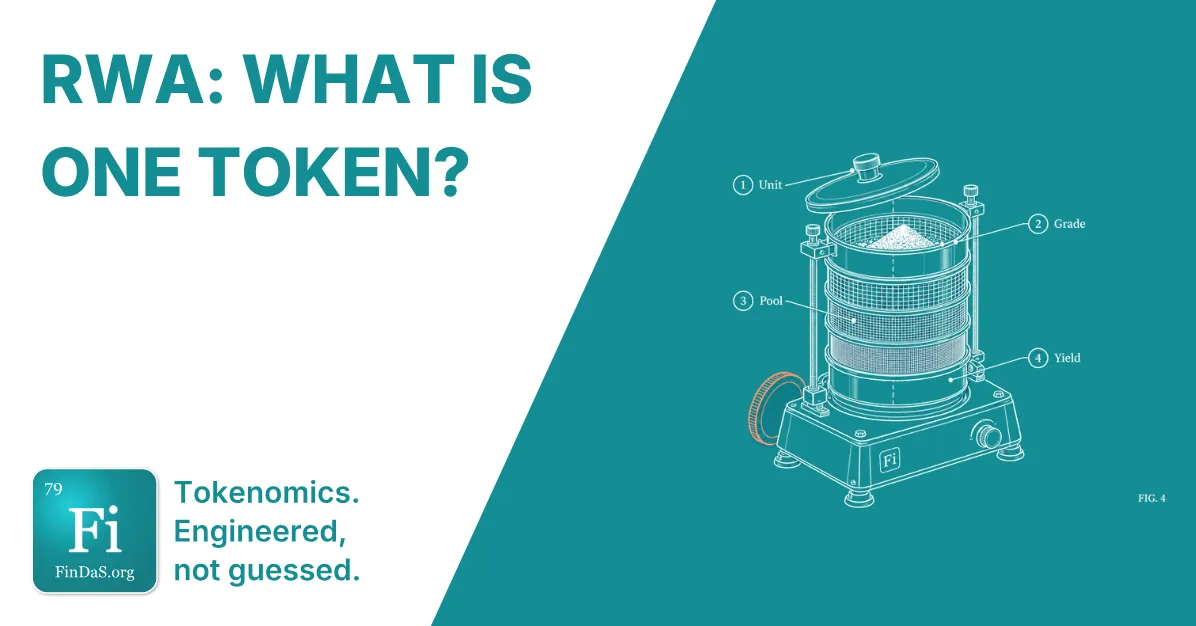
Once the legal claim is settled, the next decision is what one token stands for. There are two basic answers: a fixed quantity of one specified thing (an ounce of gold to a stated standard, a gram of a stated grade) or a share of a pool. A fixed quantity is easy to check and redeem, and hard to apply to assets that are not standardized; a share of a pool fits anything but means nothing without a valuation. Income adds a third choice, whether yield arrives as new tokens, a rising price or a growing balance, and each of those breaks something different.
One token is a promise about a quantity
Every RWA token answers one question before any other: if I hold one of these, how much of what do I have? The answer sets how the token is priced, how it is redeemed, what an arbitrageur compares it with, and whether two tokens are worth the same.
It comes after the legal claim, which settles what kind of right the holder has, and before minting and redemption, which settle how units enter and leave. Get it wrong and every later mechanism is defending a number nobody can check.
A fixed quantity, or a share of a pool
A fixed quantity is the simplest unit there is. One PAXG is one fine troy ounce of London Good Delivery gold, and so is one XAUT; Dravanti's spot token is one gram of copper powder of one stated purity. A holder can check the claim against a weight and a standard, and an arbitrageur can compare the token's price with the spot price of the metal without a model.
A share of a pool is the answer when the assets are not interchangeable. A fund share, a unit in a property vehicle or Dravanti's basket token gives the holder a pro rata slice of whatever the pool holds. It works for anything, including assets that come in different grades, sizes and ages. The price of that flexibility is that one token means nothing without a valuation: someone has to say what the pool is worth, how often, and by what method, and that number becomes the thing the market argues about.
The choice is rarely free. If the asset is standardized (an exchange-traded commodity, a currency, a government bill), a fixed quantity is almost always the better unit. If it is not, forcing it into a fixed quantity means picking one grade and refusing everything else, and a pool is the honest answer.
The grade problem
Copper powder is the example I keep coming back to (it first came up on LinkedIn), because it looks standard and is not. Powder at 99.9% purity and powder at 99.99% purity trade as different products, so "one gram of copper powder" is not a unit until the grade is in the definition. Once it is, everything outside that grade cannot back the token.
Gold solved the grade problem a long time ago. A London Good Delivery bar holds between 350 and 430 fine troy ounces at a minimum fineness of 995 parts per thousand, a standard the whole market already prices. A token that references Good Delivery gold inherits that standard, which is part of why gold tokens are easy to price.
Real estate sits at the far end. No two buildings are alike, so a token cannot be one building's worth of anything else. The usual answer is one company per property, with tokens as equal shares of it. RealT tokenized rental homes this way, each property held by its own LLC or corporation with its own set of tokens, interchangeable with each other and with nothing else. (RealT itself stopped paying rent to token holders in February 2026 and announced a voluntary liquidation that July; what happens to holders when the operator fails is the subject of a later part.)
How big is one token
Denomination looks cosmetic, but it sets two things that matter. A token worth an ounce of gold is a large ticket for a retail buyer and a small one for an institution. Tokens are commonly divisible to many decimal places, so the unit does not set the smallest purchase; it sets the reference price, and the step at which the token can be redeemed in kind. (Token Supply 101 covers why the raw number of tokens matters less than people expect.)
The redemption step is where denomination bites. Paxos delivers physical bars only from 430 PAXG, the top of the Good Delivery range, and Tether asks for 430 XAUT per bar, adjusts the count to the gold actually in it, and delivers within Switzerland or tries to sell the bar for the holder. Both tokens can be held in fractions of an ounce, so a holder of ten ounces' worth can sell the tokens, and in PAXG's case redeem them for cash, but cannot take delivery of metal.
Dravanti went the other way. Its regulated token is one gram of copper powder, and a wrapping contract converts it into an open-market token at 1:1,000, so a retail holder trades milligrams of the same metal while only accredited holders can unwrap and redeem.
Where the yield shows up
An asset that earns income needs one more decision: how the income reaches the holder. There are three common answers, and none of them is neutral.
A stable price, paid in new tokens
BlackRock's BUIDL seeks to hold $1 per token; income accrues daily and arrives each month as new tokens. Easy to read in dollars. Every payout changes the holder's balance, which some custody and accounting set-ups handle badly.
A rising price
Ondo's USDY keeps the number of tokens fixed and lets the price per token rise as yield accrues. The easiest form for lending protocols and collateral, because a balance only changes on transfer. The token never trades at a round number, so it cannot double as a payment dollar.
A growing balance
rUSDY, Ondo's rebasing version, holds at $1 and adds tokens to every wallet each business day, and Lido's stETH rebases the same way. It reads like a bank balance, and breaks any contract that assumes balances change only on transfer, which is why Lido offers wstETH, a wrapped version that does not rebase.
Issuers that care about DeFi often end up offering two versions of the same claim, one rebasing and one not, and letting the holder pick. That works, and it also means two tokens, two prices and one more thing to explain.
A commodity token has the opposite problem: no income, and a carry cost for storage and insurance. Who pays it belongs with the question of who keeps the yield, a later part of this series.
Questions that settle the unit
- Is the asset standardized, and by whom?
- Can every unit backing the token be swapped for any other without anyone minding?
- If not, which grade, size or vintage is in, and what happens to the rest?
- Who values the pool, how often, and by what method?
- What is the smallest quantity a holder can redeem in kind, and in cash?
- How does income reach the holder: new tokens, a rising price or a growing balance?
If the answer to the first question is no, the unit is a share of a pool, and the fourth question becomes the most important one in the design.
If the unit is clear
The legal claim (part two) comes before this decision, and the business case (part one) before that. Until the series closes with its 101, our overview of RWA tokenomics covers the ground at a higher level.
- RWA: Should you tokenize that asset?: the business case, which comes first.
- RWA: What does the holder actually own?: the legal claim the unit sits on.
- RWA tokenomics: the overview this series builds on.
- Dravanti: a gram-denominated commodity token, wrapped 1:1,000 for the open market.
- Token Supply 101: why the number of tokens is mostly perception.
Frequently asked questions
01What does one RWA token represent?
+
02Can different grades of a commodity back the same token?
+
03Why do some yield tokens rebase and others rise in price?
+
04Does the size of one token matter if it can be divided?
+
05Should an RWA token be fungible or an NFT?
+