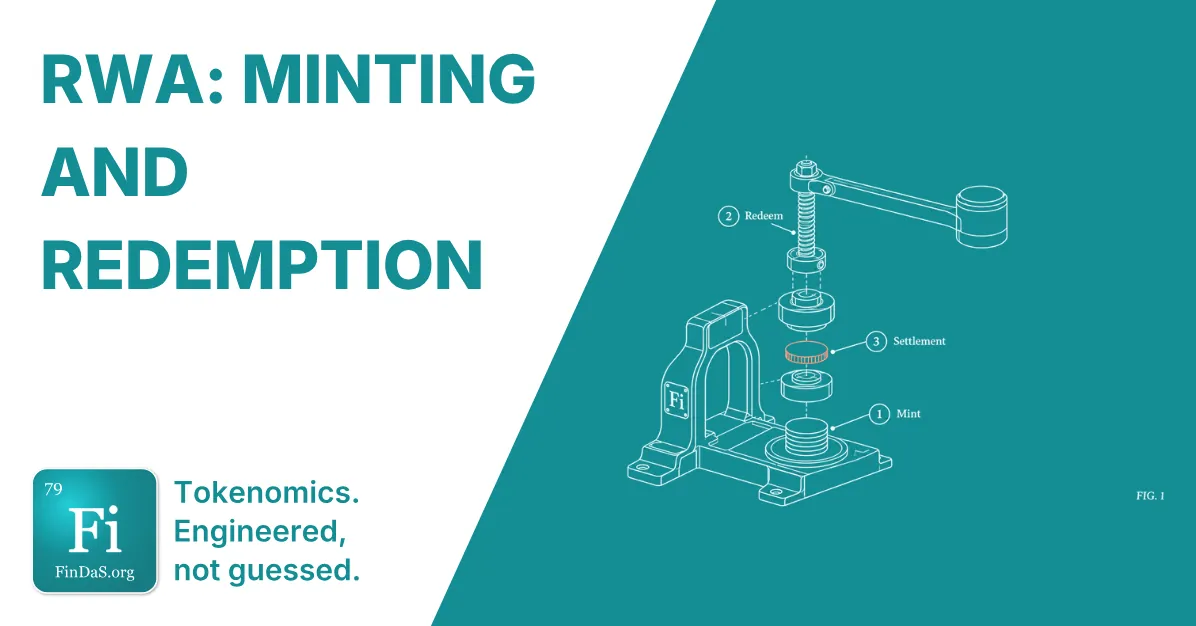
An RWA token's supply is not a lever the issuer pulls. It is the result of who is allowed to mint and redeem, and on what terms: who has direct access, the minimum size, the fees, how fast cash settles, and when redemptions can be paused. Those terms are the token's monetary policy. They also decide whether the market price stays at the value of the asset, because arbitrage only works for the people who can reach the primary market, and only as tightly as their costs allow.
Supply is an output
In most token economies supply is a design parameter: a cap, an emission schedule, a burn. For an asset-backed token it is an output. A token is minted when someone delivers the asset, or the cash to buy it, and burned when someone hands it back for the asset or the cash. Total supply is whatever demand has pushed into the reserve, minus whatever has been taken out.
That is why Part 7.1 of Tokenomics is Easy called issuance and redemption the real monetary policy. Inflation, burns and buybacks mostly do not apply to these tokens; the rules for getting in and getting out do. Those rules sit on top of the unit: they decide how many of them exist at any moment.
Who can mint and redeem
The first rule is access. Very few RWA tokens let anyone mint or redeem directly.
Tether issues and redeems USDT only for verified customers, with a minimum of $100,000 and a redemption fee of 0.1%, at least $1,000. Circle Mint, the direct door to USDC, is for institutions such as exchanges, banks and wallet providers and not for individuals; payouts typically settle the next business day, and since March 2026 Circle charges 5 basis points on its standard tier's redemptions above $2 million a day. Paxos lets only verified customers create or redeem PAXG, and physical delivery starts at about 430 PAXG, one bar. BlackRock set BUIDL's initial minimum at $5 million, in a fund open only to qualified purchasers.
The rest of the market gets the token second-hand, on an exchange or from a dealer. That is not a defect; ETFs work the same way. Only authorized participants, typically large broker-dealers, create and redeem ETF shares with the fund, and only in large blocks, and the SEC describes that arbitrage as what keeps an ETF's market price close to its net asset value. The question for a token design is the one an ETF sponsor asks: are there enough participants with direct access, and do they have a reason to use it?
Arbitrage only works for those inside the door
If a token trades below the value of what backs it, someone with direct access buys it cheaply and redeems it at full value; if it trades above, they mint at full value and sell. That trade is what holds the price, and it is only as tight as its own costs. Fees on both legs, the time cash takes to settle and the minimum size all widen the band in which the price can drift before anyone bothers to correct it.
USDC showed what happens when the door shuts. Late on Friday 10 March 2023, Circle disclosed that $3.3 billion of its reserves, about 8%, sat at Silicon Valley Bank, which had failed that day. With US banks closed for the weekend nobody could redeem, and USDC fell to about 87 cents on 11 March (86 cents at the trough, by the Federal Reserve's count). Circle restarted processing on Monday 13 March and had cleared substantially all of the backlog by the 15th. The reserve came through intact. For two days, the door to it was shut.
In the words of Part 7.1, a redemption that takes five days and needs a 100k minimum is a peg only on sunny days.
Minimums, fees and settlement time
Each of the three is a design choice with a cost on both sides. A high minimum keeps operations cheap (fewer, larger tickets, fewer files to onboard) and shrinks the pool of arbitrageurs. Fees pay for real work, from bank wires to custody to assaying metal, but a fee on the redemption leg is a fee on the peg. Settlement depends on the asset as much as on the issuer: cash can move the same day, a fund unit moves on the fund's cycle, and a gold bar moves by truck.
None of these numbers is a mistake. Each is a trade between the cost of running the primary market and how tightly the price is held, and the right setting depends on who the token is for.
Gates, queues and notice periods
The last rule is what happens when everyone wants out at once. A token backed by Treasury bills can redeem in a day because the bills sell in a day. A token backed by private credit or buildings cannot, and promising otherwise is promising cash the reserve does not have.
Regulators have started to set a floor for money-like tokens. MiCA gives holders of asset-referenced tokens a right of redemption at all times, and holders of e-money tokens a claim on the issuer redeemable at any time and at par. The US GENIUS Act requires payment stablecoin issuers to publish a redemption policy with clear procedures for timely redemption and plain disclosure of fees, without setting a number of days.
For other assets the usual tools are notice periods, queues and gates, borrowed from funds that hold illiquid assets. Blackstone's BREIT, a non-traded real estate trust, limits withdrawals to 2% of net asset value a month and 5% a quarter. When requests ran past those limits in late 2022 it paid out only part of what investors asked for: in November, about 43% of the requests.
A gate is honest when it is in the documents from day one and sized to the asset. It is a run trigger when it appears for the first time in the middle of a stress, which is the subject of a later part of this series.
Designing the primary market
- Who can mint and redeem directly, and how many of them will there be?
- What is the minimum, and does it leave enough arbitrageurs in?
- What do minting and redemption cost, and who pays?
- How long does the cash, or the asset, take to arrive?
- Can redemptions be paused, and is that written down before launch?
- What happens on a weekend, a bank holiday or the day a custodian fails?
These come before any other part of the monetary policy.
If the primary market is clear
The unit (part three) decides what is minted, the legal claim (part two) decides what a holder gets for it, and the business case (part one) decides whether any of it should exist. Until the series closes with its 101, our overview of RWA tokenomics covers the ground at a higher level.
- RWA: Should you tokenize that asset?: the business case, which comes first.
- RWA: What does the holder actually own?: the legal claim behind every redemption.
- RWA: What is one token?: the unit that minting creates.
- RWA tokenomics: the overview this series builds on.
- DEX vs. CEX and the role of market makers: the secondary market, where most holders actually trade.
Frequently asked questions
01Who can mint or redeem an RWA token?
+
02Why does a stablecoin sometimes trade below $1?
+
03What is a redemption gate?
+
04Do minimums and fees matter if the token trades on exchanges?
+
05Can an RWA issuer stop redemptions?
+