Most tokenized real-world assets barely trade. RWA.xyz counts about $38.75 billion of tokens that investors can hold and move on-chain, and BlackRock's $2.25 billion BUIDL fund had 106 holders and 162 transfers in the last 30 days. A token's price stays near its NAV only where arbitrageurs can mint and redeem directly; whitelists and minimums shrink that group and split the market. Much of an RWA token's useful liquidity comes from being accepted as collateral, which needs no trading at all.
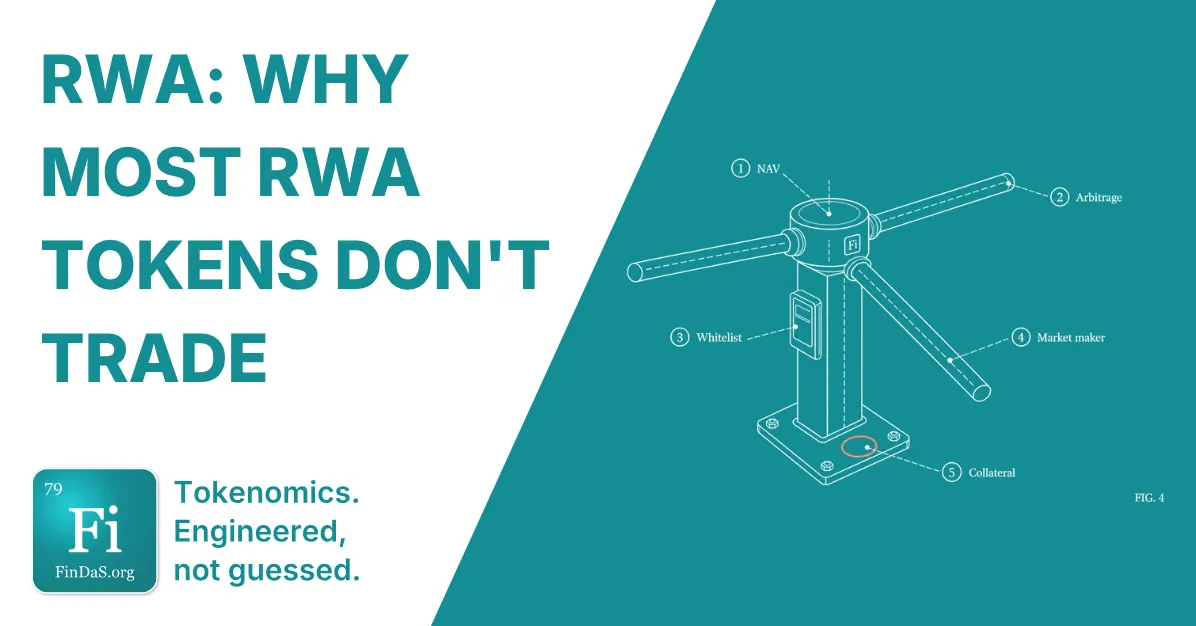
Tokenized is not tradable
RWA.xyz counts about $38.75 billion of tokenized real-world assets that investors can hold and move on-chain, as of 5 October 2026. BlackRock's BUIDL, one of the largest tokenized funds at $2.25 billion, had 106 holders and 162 transfers in the previous 30 days. A 2025 study of the market, which put the total at about $25 billion in mid-2025, counted 104 BUIDL transfers a month and read the pattern as buy and hold. The gold tokens are the exception: PAXG had about 113,000 holders and 126,000 transfers on Ethereum in the same 30 days, and both PAXG and Tether Gold trade on Binance, Kraken and OKX.
Part one of this series made the same point from the issuer's side: a token gives an asset new rails, and rails are not buyers. This part is about the plumbing that decides whether a token trades at all, and at what price.
What holds the price to NAV
An asset-backed token's price is held to its NAV by arbitrage through the primary market. When the token trades above NAV, anyone who can mint creates new tokens at NAV and sells them; when it trades below, anyone who can redeem buys tokens cheaply and hands them back at NAV. Neither trade is free, so the price can drift until the gap pays for the round trip:
Here P is the market price, cm the all-in cost of minting and selling (the creation fee, the trading cost, the capital tied up while it settles) and cr the all-in cost of buying and redeeming. The fees are public. Tether Gold charges 0.25% to buy from or redeem with the issuer, plus delivery or broker costs on redemption; Paxos waives PAXG creation fees until January 2027 and charges 0.125% to 0.5% on net redemptions. Inside the band the price is free to wander. Outside it, someone with access is paid to push it back.
Research on stablecoins says the door does most of that work. A 2026 model of de-peg episodes finds that arbitrage through minting and redemption restores a peg more than exchange trading does, and that recovery stays quick until the frictions at the door pass a threshold, after which it slows sharply. For Tether's de-peg of July 2023 the model put the half-life at 45.9 hours, against 30.7 observed.
The door decides who can arbitrage
The door is rarely open to everyone. Tokenized funds mint and redeem only for onboarded, qualified investors, often with high minimums; part four set out the terms for USDC, USDT, PAXG and BUIDL. Every restriction removes arbitrageurs, and with fewer of them the price can sit outside the band for longer. Even an open door can be outrun: on 16 October 2025, PAXG on Binance jumped 9.3% in one minute, and it traded about 1.2% above Tether Gold for the next two hours (a premium CoinGecko also recorded).
Dravanti's design builds the arbitrage in on purpose. Its tokens sit on ERC-3643 for verified holders, an open-market ERC-20 version exists at a 1:1,000 ratio, and KYC'd arbitrageurs wrap and unwrap between the two to keep both markets priced together. The wrapper's price holds only as well as the number of arbitrageurs allowed through it.
Whitelists split the order book
Whitelists also split one asset into several markets. A permissioned token can only change hands between verified wallets, so its trading happens in a closed pool, and an open-market wrapper is a second pool with its own price. Chains split it again: BUIDL now runs on nine blockchains, with its largest pools on Solana, Avalanche and Ethereum, and every chain is another place where buyers and sellers have to find each other.
Market makers need the door too
A market maker can narrow the band, and it needs the door to do it. Quoting both sides means taking on inventory, and in an RWA token with few buyers the reliable way to get rid of unwanted inventory is to redeem it. Without access to the primary market a market maker quotes wide or not at all. It is the ETF arrangement from part four: the participants who can create and redeem are the ones who keep the price close.
Liquidity without a market
For many RWA tokens the useful liquidity comes from being accepted as collateral, which lets a holder raise cash without selling. BUIDL has been trading collateral on Crypto.com and Deribit since June 2025 and on Binance since November 2025, and Ethena's own dashboard shows its USDtb stablecoin 99% backed by BUIDL. Aave's Horizon market, launched in August 2025, lets approved institutions borrow stablecoins against tokenized Treasury and credit funds. Grove, which manages capital for the Sky protocol (formerly MakerDAO), held $309.6 million of Centrifuge's JTRSY and $119.4 million of BUIDL on 5 October 2026.
The rest is liquidity built onto the door. Circle runs a smart contract that buys BUIDL from its holders for USDC around the clock, an off-ramp that does not wait for the fund to redeem. Ondo lets qualified investors mint and redeem OUSG instantly against USDC, up to $50 million a day across all of them. Both make the door faster; neither widens who may walk through it.
Questions that decide whether it trades
- Who can mint and redeem directly, at what minimum, fee and speed?
- How many of them are there, and do they have a reason to arbitrage?
- What is the all-in cost of a round trip, and so how wide is the band around NAV?
- Who may hold the token, and is there an open-market version of it?
- On how many chains and venues does it trade, and does each have its own way to the door?
- Can a market maker offload inventory through redemption, and how fast?
- Where is the token accepted as collateral, and at what haircut?
If the token trades
The classification decides who may hold and trade it, the yield and the reserve decide what it is worth, the primary market decides who can arbitrage it, the unit and the legal claim decide what is being traded, and the business case decides whether anyone wanted it in the first place. Until the series closes with its 101, our overview of RWA tokenomics covers the ground at a higher level.
- Tokenize everything, but can you sell it?: our review of the paper on RWA liquidity.
- Who restores the peg?: our review of the research on how arbitrage restores a peg.
- DEX, CEX and market makers: what a market maker does and what it needs.
- RWA: Minting and redemption: the door this part keeps coming back to.
- RWA tokenomics: the overview this series builds on.
Frequently asked questions
01Why do most RWA tokens have so little trading?
+
02What keeps an RWA token's price close to its NAV?
+
03Do whitelists hurt liquidity?
+
04Can an RWA token be liquid without trading much?
+
05Why do PAXG and XAUT trade more than tokenized funds?
+