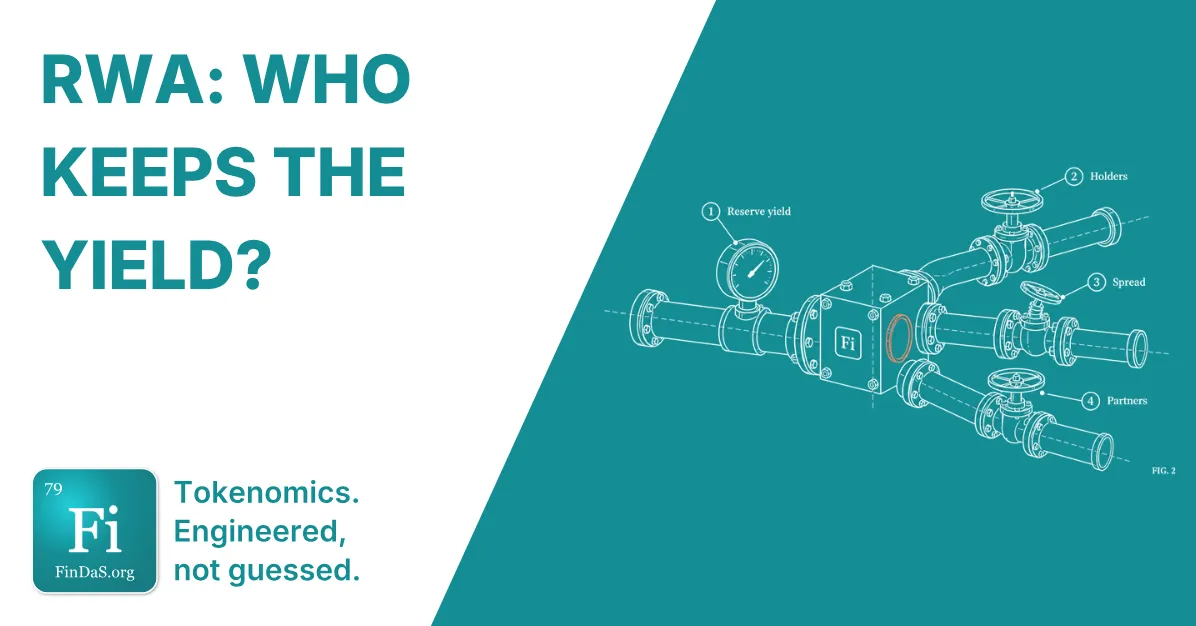
The Treasury bills in a token's reserve earn interest, and one of three parties keeps it: the holders, the issuer as spread, or the partners who distribute the token. Paying holders makes the token an investment, which is why the US GENIUS Act and MiCA bar stablecoin issuers from doing it. Keeping it makes the issuer's business the interest rate: Circle's reserve income was $28.5 million in 2021 and $2.6 billion in 2025. A commodity reserve earns nothing and costs money to store, and someone pays for the vault.
The yield is the fiscal policy
Part 7.1 of Tokenomics is Easy called it the fiscal policy. Treasury bills in a reserve earn interest, and someone keeps it: the holders, the issuer, or the partners who distribute the token. Minting and redemption set how much of the token exists; the yield decides who is paid for holding it, and so what the token is.
A reserve of short Treasury bills earns whatever the bills pay, and the choice of who gets it is made once, in the design. It is hard to change after launch, because each answer puts the token in a different legal box and builds a different business.
Pay it to the holders
Tokenized money market funds pass the income on. BlackRock's BUIDL accrues dividends daily and pays them as newly minted tokens. Franklin Templeton's on-chain government money fund declares a dividend every day and reinvests it as more shares, for a net expense ratio of 0.20%. Ondo's USDY lets its price rise as income accrues, keeps what its launch post called a small spread, and is sold only to buyers outside the US.
How the income arrives, as new tokens, a rising price or a growing balance, is a unit-design question. The harder consequence is legal. A token that passes the reserve's income to its holders is an investment in that reserve, and the products that do it are sold as investments, under securities rules and only to the buyers those rules allow.
For a payment stablecoin, the law has closed that door. The GENIUS Act bars US and foreign payment stablecoin issuers from paying holders "any form of interest or yield" for holding, using or keeping the coin, whether in cash, tokens or anything else. MiCA bans interest on asset-referenced and e-money tokens, and counts any benefit tied to how long someone holds the token as interest, whether the issuer pays it or a third party does.
The US text binds issuers, and the argument has moved to everyone else. The OCC's proposed rule of March 2026 would presume that an issuer is paying banned yield if it pays an affiliate or related third party that passes the money on to holders. The CLARITY Act, as reported to the Senate, would bar exchanges and other service providers from paying yield on a stablecoin for holding it, while allowing rewards for payments, liquidity, collateral or staking; it failed a cloture vote in the Senate on 15 September 2026. Until one of them is final, an exchange paying rewards on a stablecoin balance sits in the gap between them.
Keep it as spread
The two largest dollar stablecoins keep the interest. Circle earned $2.64 billion of reserve income on USDC in 2025, 96% of its revenue. Tether reported net profit of more than $10 billion for 2025, with more than $122 billion held directly in US Treasuries, and does not say how much of the profit came from them. Part 7.1 put the consequence plainly: keep the yield and your business model is the rate spread, which works nicely until rates go to zero.
Circle's filings show what that means. In 2021, with the federal funds rate near zero, its reserve earned 0.08% and brought in $28.5 million. In 2023 the average float was about 39% smaller than in 2022, and reserve income almost doubled, because the yield went from 1.5% to 4.7%. Circle now tells investors that a one-point move in rates changes its annual reserve income by about $737 million and its distribution costs by about $360 million. The Federal Reserve raised its target range to 3.75% to 4% on 16 September 2026, so the spread is wide today. Zero-rate years have happened twice since 2008, the first run lasting seven years and the second two.
Share it with the partners
The third answer sits between the other two: the issuer keeps the yield and pays a share of it to whoever brings in the holders. Circle's agreement with Coinbase starts from net reserve income, keeps an issuer portion for Circle, allocates by how much USDC sits on each party's platform, and gives Coinbase half of what is left. In 2025 that came to about $1.4 billion, and Circle also pays Binance and other distribution partners. Paxos built USDG around the same idea: partners in its Global Dollar Network receive up to 100% of the returns on the reserve behind the USDG held on their platforms, and may pass some of it to their own users as rewards.
Paying a partner is not paying a holder, which is why the structure works under the ban, and the OCC's proposed presumption is aimed at partners who pass the money straight through. It also shares the rate risk: in Circle's own estimate, distribution costs move by about half as much as reserve income when rates do.
Who pays for the vault?
A commodity reserve has the opposite problem. Gold earns nothing and costs money to hold: vault fees, insurance, audits of the bars. Someone pays, and the usual ways to charge it are a fee on the holders' balances, a fee at the door when tokens are created or redeemed, or the issuer absorbing it out of some other income.
The large gold tokens mostly absorb it. Paxos does not charge PAXG holders a storage fee "at this time" and earns at the door: creation fees, waived until January 2027, and redemption fees of 0.125% to 0.5% since September 2026. Tether Gold charges no custody fee, only a one-time 0.25% when tokens are bought or redeemed. SPDR Gold Shares, an exchange-traded gold fund, charges 0.40% a year. The token that did charge storage, CACHE Gold, at 0.25% a year, stopped being backed by gold on 30 September 2025, and its holders were sent PAXG. A vault paid for out of door fees works while tokens keep moving through the door; when they stop, the storage bill still arrives.
Questions that settle the yield
- What does the reserve earn, and at what interest rate does the business stop working?
- Who receives the income: the holders, the issuer, the distribution partners, and in what shares?
- If holders receive it, which regime does that put the token in, and who is allowed to hold it?
- If the issuer keeps it, what happens to the business at a zero rate?
- Is any yield paid that the reserve is not actually earning?
- For a commodity, who pays for storage and insurance, and how: a fee, a spread, or a shrinking balance?
- Can the split change after launch, and who decides?
If the yield is settled
The reserve is what earns the yield, the primary market decides who can redeem, the unit decides how income reaches a holder, the legal claim decides what they are owed, and the business case decides whether the token should exist. Until the series closes with its 101, our overview of RWA tokenomics covers the ground at a higher level.
- RWA: Reserves, custody and proof: what the yield is earned on.
- RWA: What is one token?: how income reaches a holder: new tokens, a rising price or a growing balance.
- RWA: Minting and redemption: the monetary policy the yield sits beside.
- RWA tokenomics: the overview this series builds on.
Frequently asked questions
01Can a stablecoin pay interest to its holders?
+
02How do stablecoin issuers make money?
+
03What happens to a stablecoin issuer when interest rates fall?
+
04Who pays to store the gold behind a gold token?
+
05Are yield-bearing tokens securities?
+