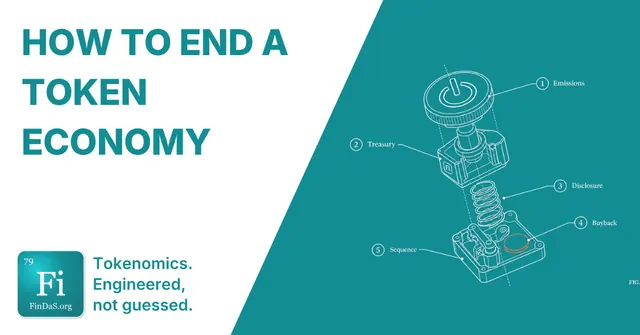
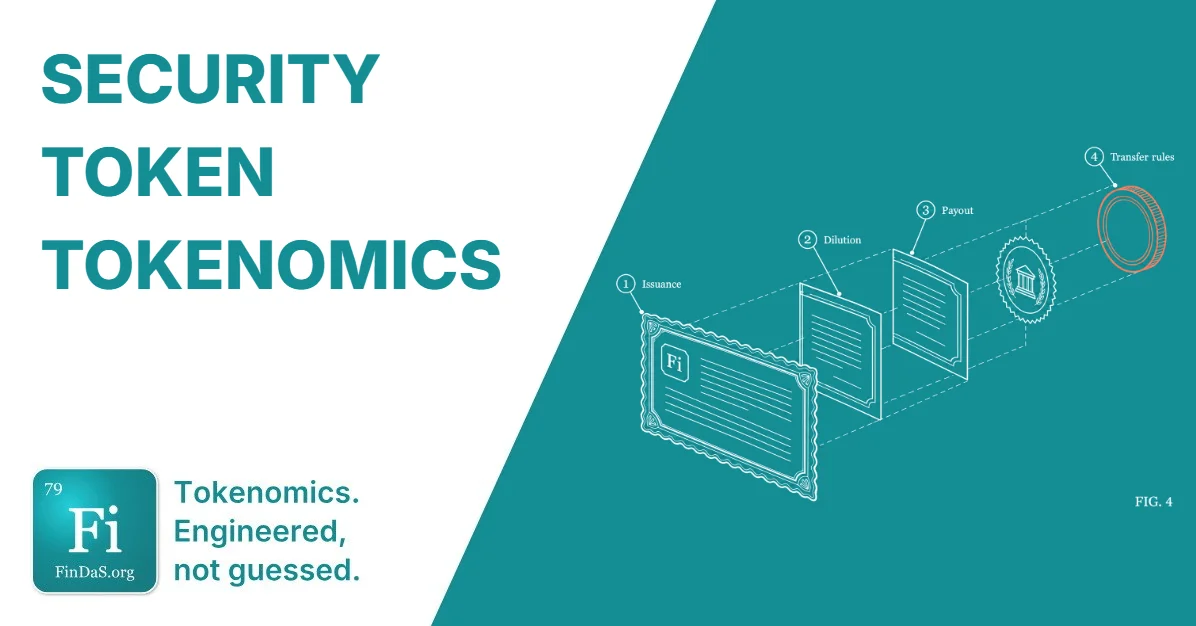
A security token's monetary policy is its issuance terms and its fiscal policy is its payout rules, and both are set by company law and the instrument, not by the smart contract. Minting is dilution, which shareholders authorise; burning is a buyback; staking exists as a loyalty dividend; vesting is an option plan. In the worked example an invented company sells 20% of itself as 2,000,000 tokens at €5.00, pays €0.08 a token from €1.575 million of profit, and its token holders get nothing back from a sale of its assets below €23 million.
Security tokens already have a monetary policy
Part 7 of Tokenomics is Easy listed the toolbox people reach for when they hear the word tokenomics: inflation, burning, staking, emissions, buybacks. Part 7.1 tried it on asset-backed tokens and found that supply there is an output, not a lever. Part 7.2 tried it on security tokens, and every tool in the box already exists, under a corporate-finance name, with company law behind it.
- Inflation is issuing new shares. It is called dilution, and in an EU public limited company any increase in capital is decided by the general meeting, or by the board within an amount and a period the meeting fixed.
- Burning is a buyback and cancellation. The general meeting authorises it, and the law decides with whose money.
- Staking exists in French company law as a loyalty dividend: up to 10% more for holders who keep their shares registered for two years.
- Emissions to the team are an option plan. It lives in the cap table, not in the whitepaper.
The token is a wrapper around a claim, and the claim decides what a holder owns. It also decides the policy, and the smart contract only carries it out. Change a parameter in the contract without changing the claim and either nothing happens legally, or the issuer has just broken the terms it sold the tokens on.
A worked term sheet
The post ended on "design them like a term sheet, because that is what they are". Here is one. SolarCo SA is invented: a French public limited company that owns a solar park. Its founders hold 6,000,000 shares and its seed investors 2,000,000, and it sells 2,000,000 more as tokens, one token per share, to fund the build. Every figure in the rest of this article follows from the terms in this table and nothing else.
| Term | SolarCo's choice | The tokenomics name for it |
|---|---|---|
| Instrument | Ordinary shares; one token is one share, recorded in the share register | The token |
| Supply | 10,000,000 shares after the offering | Total supply |
| Offering | 2,000,000 tokens at €5.00: €10.0 million raised, valuing the company at €40 million before the money and €50 million after | The token sale |
| Option plan | 500,000 options for the team, exercise price €5.00, four-year vesting, one-year cliff | Team emissions |
| Authorised issue | The board may issue up to 1,000,000 new shares for cash within three years; pre-emption rights apply | Inflation |
| Buyback | Authorised for up to 200,000 shares at no more than €6.00 each, cancelled on purchase | Burn |
| Loyalty bonus | 10% more dividend on shares registered to the same holder for two full years | Staking |
| Payout policy | 40% to 60% of net profit, paid once a year in euro | Fiscal policy |
| Ranking | After a €20 million senior bank loan at 7% and a €3 million subordinated note at 10%; all shares rank equally | The waterfall |
| Transfers | Between whitelisted wallets only; tokens sold in the US as restricted securities wait one year under Rule 144 | Velocity |
Read down the right-hand column and it is the tokenomics of a utility token. Each line in the middle column is a clause a lawyer drafts and a general meeting approves.
Supply is fixed by the instrument
SolarCo's supply is 10,000,000 because that is how many shares exist. The token investors own 20.0% of it. Count the option pool and the company has 10,500,000 shares fully diluted, and their stake is 19.0% before anyone has done anything.
The vesting schedule is the emission schedule. 125,000 options vest at the end of year one, then about 10,417 a month until all 500,000 have vested at the end of year four. The difference from token vesting is that a vested option is not supply yet: it becomes a share only when its holder pays the €5.00 and the company issues one.
Any supply beyond that is a new issuance, with a prospectus or an exemption behind it. In the EU, securities may be offered to the public only after a prospectus is published, unless an exemption applies. It is not a smart contract parameter someone changes on a Tuesday, and supply design for a security token is mostly the decision of how much the shareholders let the board issue without asking them again.
Minting is dilution, burning is a buyback
In year two SolarCo wants €6.0 million for a second park. The board uses its authority and issues 1,000,000 new shares at €6.00. That authority came from the general meeting: under EU company law the meeting decides every increase in capital, or authorises the board to make one up to a fixed amount, for at most five years at a time.
A holder of 10,000 tokens owned 0.100% of SolarCo. After the issue they own 0.0909%, unless they use their pre-emption right. New shares paid for in cash are offered first to existing holders in proportion to what they hold, so this holder may buy 1,000 of the new tokens for €6,000 and stay at 0.100%. The right can be removed only by the general meeting, on a written report from the board justifying the issue price.
That is more protection against dilution than many utility token holders get (whose supply schedule changes when the foundation's multisig says so). It only works if the issuer knows who holds each token, which is why the share register is usually the record that counts.
In year four SolarCo has spare cash. It buys back 200,000 tokens at €6.00, €1.2 million in total, and cancels them. Supply falls to 9,800,000. The holder of 10,000 tokens now owns 0.102% without doing anything, and every later dividend per token is 2.04% larger for the same total payout.
Company law sets the conditions. The general meeting authorises the buyback and sets the maximum number of shares, the price range and the period, which may not exceed five years. The purchase may not take net assets below the company's capital and the reserves it may not distribute, only fully paid shares qualify, holders in the same position must be treated equally, and the market abuse rules still apply. A utility token burn funded from a treasury answers none of those questions.
Staking already exists, as a loyalty dividend
French company law lets a company's articles pay up to 10% more dividend to any shareholder whose shares have been registered in their name for at least two years at the end of the financial year, and still are when the dividend is paid. The same bonus can apply to free share distributions. In a listed company, the shares eligible for it are capped at 0.5% of the capital per holder.
Air Liquide uses it. In its June 2024 distribution of one free share for every ten held, 100 shares held in registered form for more than two full calendar years received 11 new shares; the same 100 shares held in bearer form received 10. The lock is a register entry. There is no smart contract and no slashing, and the reward comes out of the dividend rather than out of new supply, which is the part staking rewards paid in new tokens usually get wrong.
SolarCo's articles carry the same bonus. In year three, 9,200,000 shares qualify: the founders' 6,000,000, the seed investors' 2,000,000, and 1,200,000 of the 2,000,000 tokens that stayed with their first holder. The bonus costs €73,600, and €48,000 of it, 65%, goes to the founders. A loyalty reward pays most to whoever already holds the most and never sells, and in an unlisted company that is the founders. The 0.5% cap is what limits it in a listed one.
Payout rules are the fiscal policy
The payout rules are the value accrual: what gets paid, out of which line of the profit and loss, how often, and in what. Part 2 of the series built the profit and loss, and this is where the token holders meet it. SolarCo in year three:
| Year three | SolarCo |
|---|---|
| Revenue | €9.0 million |
| Operating costs | (€3.2 million) |
| EBITDA | €5.8 million |
| Depreciation | (€2.0 million) |
| Operating profit | €3.8 million |
| Interest: €1.4 million to the bank, €0.3 million on the note | (€1.7 million) |
| Profit before tax | €2.1 million |
| Tax at 25% | (€525,000) |
| Net profit | €1.575 million |
| Dividend: €0.08 on 10,000,000 shares | €800,000 |
| Loyalty bonus: €0.008 on 9,200,000 loyal shares | €73,600 |
| Paid out | €873,600, 55.5% of net profit |
The holder of 1,000 tokens receives €80.00, or €88.00 with the loyalty bonus. At the €5.00 issue price that is a 1.6% cash yield, paid after the bank and the note holders have had their interest.
The policy is a ratio, 40% to 60% of net profit, so the dividend moves with the business: a year with half the profit pays about half. The line it is paid from is the real choice. A revenue share pays from the top line and keeps paying in a loss-making year; a dividend pays from what is left and stops. Either way it is a term of the instrument, and changing it means changing the terms.
Paying in more tokens is inflation with paperwork. If SolarCo paid its €800,000 base dividend in new tokens at €6.00, it would issue 133,333 of them and supply would grow 1.33% that year. That is a scrip dividend, and it is a capital increase like any other.
The waterfall: who is paid when it goes wrong
Dividends are what holders get while the business works. The waterfall is what they get when it is sold or wound up: senior debt first, then junior debt, then the shares. SolarCo's tokens are ordinary shares, so they rank equally with the founders' shares, behind €23 million of debt.
Sell the parks for €22 million and the bank gets its €20 million, the note holders get €2 million of their €3 million, and the tokens get nothing. At €30 million the shares split €7 million, which is €0.70 a token, so the token investors' €10 million comes back as €1.4 million. They get their €5.00 back only on a sale above €73 million: the debt plus the €50 million valuation they bought in at.
That is the good case, because the place in line is written down. If a token's ranking is not in its terms, it is usually last, behind everyone who has a contract; When the backing falls short covers how a loss is shared then.
Who may sell, and when
Transfer rules are the velocity policy: who may hold the token and when they may sell it. SolarCo's contract moves tokens only between whitelisted wallets whose owners passed its checks. Tokens it sold in the US as restricted securities also carry a holding period: because SolarCo does not file reports with the SEC, Rule 144 lets a buyer resell only after at least one year. A company that had been filing reports for at least 90 days would face six months.
For a utility token, velocity is something the design tries to slow down with incentives. Here the law sets it, a US buyer's velocity in the first year is zero, and the whitelist decides who the buyers can be. That is a large part of why most RWA tokens do not trade.
Every policy change is a legal event
Once a token is a financial instrument, MiCA does not apply to it. The regulation excludes crypto-assets that qualify as financial instruments (Article 2(4)(a)), and its recital 9 keeps them under existing financial services law, "regardless of the technology used for their issuance or their transfer". In the EU that means MiFID II for the instrument and the Prospectus Regulation for the offer. Whether a token is a financial instrument at all is the classification question.
So a governance vote does not amend a prospectus. Raising the payout ratio, adding a class of token, shortening a lock-up: each is a change to the articles, the terms of the instrument or the offering documents, with whatever meeting, majority and publication that change requires. An on-chain vote can record what the holders want (governance done properly), and the legal change still has to be made.
Questions that settle the term sheet
- What exactly is one token a claim on, and which register records it?
- How many units exist fully diluted, and what can create more: options, an authorised issue, a dividend paid in tokens?
- Who may authorise new issuance, up to how much and for how long, and do token holders have pre-emption?
- Can the issuer buy tokens back, with which money, at what price, and are they cancelled?
- What is paid, from which line of the profit and loss, at what ratio, how often and in what currency?
- Where do token holders rank behind debt and other classes, and at what sale value do they get their money back?
- Who may hold the token, and how long must each kind of buyer wait before selling?
- Which of these can change after issue, and what does each change require?
The answers lean on three other parts: the class decides which law the token sits under, the claim decides what one token is owed, and the yield decides who keeps what the assets earn. RWA Tokenization 101 puts all of it in order.
- RWA: Who keeps the yield?: the fiscal policy of an asset-backed token, from Part 7.1.
- What does an RWA token holder actually own?: the claim this policy is written on.
- RWA: When the backing falls short: the waterfall, when it is needed.
- Token emissions 101: the utility-token version of the schedule above.
Frequently asked questions
01How does tokenomics work for a security token?
+
02Can a security token have staking?
+
03Can an issuer burn security tokens?
+
04Does MiCA apply to security tokens?
+
05How long must a security token be held before it can be sold in the US?
+